










Mixed-Use Buildings
A mixed-use building has a business on the ground floor and homes above it. In Nashville that mix tends to occupy the very zoning where Metro still grants new permits to owners renting apartments they do not occupy, which suits nightly stays on the upper floors. The ground-floor tenants, the shared walls and the fire code decide whether it works.
- Permits
- One per dwelling unit, up to four sleeping rooms each
- Zoning that allows new not-owner-occupied permits
- MUN, MUL, MUG, MUI, OG, OR20-OR40-A, ORI, CN, CL, CS, CA, CF, DTC North/South/West/Central, SCN/SCC/SCR
- Fire Marshal inspection
- Required for 3 or more dwellings on the property
- Issued STR permits, ZIP 37201
- 346 (338 non-owner-occupied), Oct. 6, 2026
On this page
What the type is
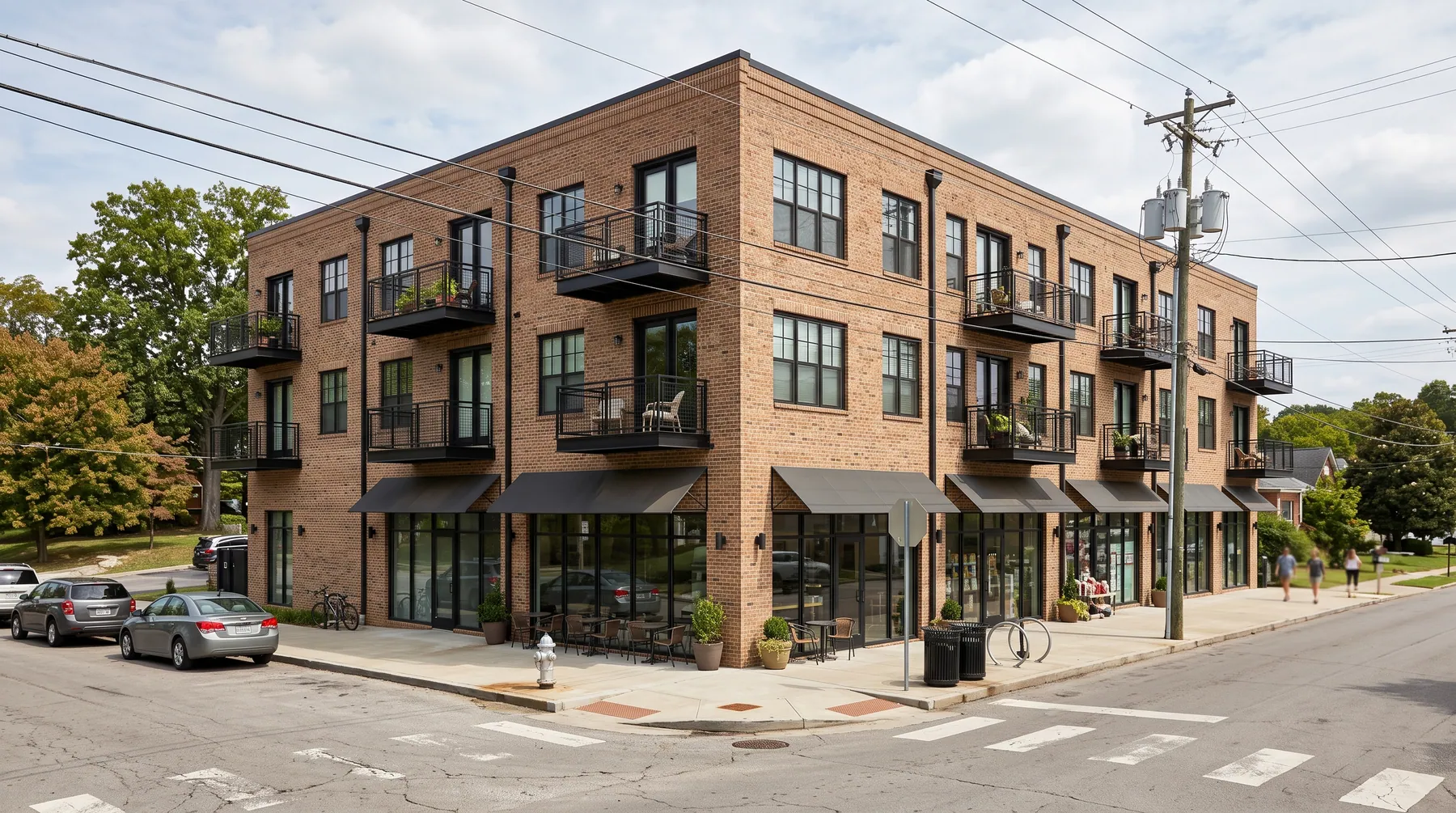
Retail, a restaurant, a bank branch or offices sit at street level. Apartments, lofts or suites sit above. Some are century-old downtown buildings with a storefront and a stairway beside it. Others are new mid-rises with a podium of shops under several floors of units.
The management questions are the same in both. Who shares the entrance, who shares the walls, and which part of the building does each permit, lease and insurance policy actually cover. Rad Stay's flagship is a mixed-use building: Union Street Lofts, four lofts (201 to 204) over the street at number 329, all given Metro permits in April 2023 for an owner living elsewhere. The parcel is zoned DTC, which is where this page starts.
Zoning and permits
Shops-below, homes-above buildings mostly stand on business, mixed-use or downtown land, which is where Section 6.28.030 lets new absent-owner permits issue; every qualifying district appears in the zoning guide we link below.
Farm and residential zoning, the two neighborhood office districts, industrial land and East DTC get no entry for the use in Table 17.08.030. A district carrying an NS suffix, CS-NS among them, rules out both permits. A building on a Specific Plan or inside a Planned Unit Development gets permits only if the plan allows them.
A mixed-use building inside a residential district, the corner store with apartments above that has stood for decades, is the case to watch. On RM or R land, Metro says no new absent-owner permits are issued. Existing holders may renew, but the permits cannot be transferred if the property is sold.
Every apartment upstairs takes its own permit, and none may exceed four sleeping rooms. A whole building cannot be permitted in one go, and the code sets no limit on how many of its units go short-term. An apartment takes four guests plus two per sleeping room, with 12 the ceiling.
Three requirements bite harder in mixed-use buildings. First, the applicant has to notify adjoining owners in writing before filing, and for Metro adjoining means front, rear and both sides, plus the floors overhead and underneath in a stacked building. A restaurant or shop directly under a unit counts. Second, Metro grants no new permit to a parcel within 100 feet, from one parcel line to the other, of a playground that serves a school or day care, a park, a church or other religious institution, a school, or a licensed day care. Council may waive that with a 21-vote resolution, and the apartments above one storefront row can all go into one.
The upper floors must be approved residential dwelling units. If they serve as offices or storage today, converting them is its own project, and Section 17.16.030 subsection F.12 shuts some adaptive-residential lots out of permits altogether, except where a good-standing permit already existed before August 1, 2024. Ask Metro Codes and Planning whether that provision reaches your building.
Fire and building code
A mixed-use building is two buildings in one, and the model building code treats it that way. Since the Council passed BL2025-898 on July 15, 2025, the 2024 International Building Code is the edition Metro enforces. In the earlier 2021 model text, separated occupancies are divided by fire barriers, horizontal assemblies or both, and a residential group beside a business or mercantile group needs one hour of separation in a sprinklered building and two hours without sprinklers, so have your architect check those figures in the 2024 table. Metro enforces its own adopted edition with local amendments, so treat these as questions for Metro Codes and a licensed architect rather than answers.
The practical question for a short-term owner is classification. The building code classes residential space by length of stay: nightly use leans toward transient occupancy, annual leases toward permanent occupancy. Changing leased units to nightly use can change the occupancy group, and with it the alarm, exit and sprinkler requirements. Ask before you buy furniture. Metro's checklist also brings in the Fire Marshal wherever a property contains at least three dwellings, and each short-term unit needs UL 217 smoke alarms in its sleeping areas, along its exit path, and on each floor.
Accessibility rules
Fair Housing Act design and construction rules reach four-plus-unit buildings that had their first residents after March 13, 1991. If an elevator serves the building, all of its units are covered. If not, only ground-floor units are, and the federal rules define a ground floor as one with a building entrance on an accessible route. A storefront building with a stairway to the upper floors raises a real question about which units, if any, count.
The Americans with Disabilities Act adds two things. A shop, restaurant or bank is a place of public accommodation, and that is the ground-floor tenant's concern first and the landlord's second. The upper floors raise another question. Federal rules define a place of lodging as a facility whose guest rooms are used for stays that are primarily short-term, generally 30 days or less, and they exclude an owner-occupied facility with five or fewer rooms for rent. A building run as nightly units from one front desk looks more like a hotel than an apartment house. Talk to an accessibility consultant before adding front-desk check-in, linen service or housekeeping.
Hotel occupancy tax and income streams
Nightly stays in a permitted unit owe Metro's hotel occupancy privilege tax, set out in Metro Code Chapter 5.12. The rate, the filing schedule and which bookings a marketplace collects on are set by Metro Finance and the state, so confirm them there before you set prices. The related guide on hotel occupancy taxes covers the detail.
In a mixed-use building the nightly rooms are one of two income streams. The retail or office leases are the other, and they follow commercial lease law, not the Metro permit. Keep the two streams separate in the books, with each unit's occupancy tax filings tracked on their own.
Financing and operating models
Lenders underwrite the commercial space and the residential units differently, and the mix can narrow the field. Agency multifamily loans generally look at the share of income or floor area that is commercial, and each lender sets its own limit. No published limit is cited here, so ask each lender in writing how it counts commercial income and whether it counts nightly revenue at all.
Bring the permits, the zoning record, the commercial leases and any operating history of the short-term units to the first call. A sale voids short-term permits, so a buyer and a lender both need to know that new permits depend on the parcel's zoning that day.
Under a management agreement the owner keeps the leases, the permits and the risk, and pays a manager a fee to run the building. A master lease makes the operator owe fixed rent for the residential floors and carries the vacancy risk. Under a revenue share, what the units earn is divided between owner and operator. In a mixed-use building the master lease is usually written for the residential floors only, leaving the ground-floor tenants with the owner.
Permits complicate any lease. A permit can be neither transferred nor assigned, it belongs to the person or entity named on it, and deeding it from yourself to a trust or LLC, or back again, also counts as a change. Before you sign a master lease, settle whose name goes on each permit, who carries Metro's required liability coverage, $1 million per occurrence, and who will act as responsible party. Another workable mix: nightly stays on the lower and street-facing floors where guests carry luggage, and 31-day-plus stays or annual leases on the rest, which gives the lender steady rent beside the nightly income.
Operations at this scale
A ground-floor business changes how a building runs. Delivery trucks, trash pickup, kitchen exhaust, late hours and music reach the units above at hours guests care about. A bar below a unit will not be quiet at midnight on a Saturday, and a nightly guest will say so in a review.
Entrances matter as much. A guest who arrives with luggage needs a lit, signed entry that is not through the restaurant, a lock code that changes with each stay, and a clear path to the stairs or elevator. Metro limits each permit to one booking party, requires the lead renter to be at least 21 and stays of at least 24 hours and at most 30 consecutive days, and wants the guest cap and contact posted inside. The guest register is kept at least six months.
Metro's open data on October 6, 2026 showed 346 issued permits in ZIP 37201, which covers 329 Union Street: 8 owner-occupied and 338 non-owner-occupied; the county total was 7,022, and ZIP 37203 had the most, 1,706 with 1,617 non-owner-occupied. Those count permits, not buildings, and a single building can hold several.
Nashville examples
Village 21 at Regions Park, 1608 21st Avenue South in Hillsboro Village, opened in 2017 with apartments, a restaurant and retail space. Nashville Post reported on March 16, 2020 that Atlanta-based TriBridge Residential bought the apartment portion for $31.7 million and that the seller, GBT, kept the restaurant and retail space. That is a useful pattern: the residential floors and the commercial space can be owned, financed and managed separately.
Real Estate Business reported on November 7, 2022 that Parke West, a project by GBT Realty in the West End area, had been delivered. It pairs a 15-story tower of 210 apartments with a nine-story, 172-key hotel split between Hilton Garden Inn and Home2 Suites by Hilton, plus roughly 11,000 square feet of shops. Both show how large new buildings stack uses. Buyers of older mixed-use buildings face a smaller version of the same questions.
Risks
- A sale voids every short-term permit, and a district change or rule change such as BL2025-1005 for RN and RL districts can close new permits.
- A refused 100-foot waiver, or a park or day care that opens nearby, can keep units from renting by the night.
- Violate the general provisions three times and Metro may revoke the permit after 15 days' notice, then issue none for a year. Renting without a permit draws a fine of $50 for each day.
- A condo declaration, lease or association rule can forbid short stays even on land zoned for them, and each applicant signs that renting will not breach those documents.
What Rad Stay handles
The company handles nightly and monthly stays as well as yearly leases. For a mixed-use building that means tracking permits and renewals for the upper units, helping with occupancy and sales tax, setting rates, messaging guests, automating bookings, coordinating cleaners and protecting against damage. Apartments unsuited to nightly rental, or not allowed it, go on monthly or yearly leases. We also review mixed-use buildings for owners who are weighing a hold, a conversion, a lease or a partnership. Rad Stay's direct experience is one building of four lofts, Union Street Lofts.
Questions
Can I run every apartment above a shop as a short-term rental?
Not unless the parcel's district is on Metro's list, every apartment holds its own permit with no more than four sleeping rooms, and the units pass the distance test and a Fire Marshal inspection. No rule in the code limits how much of the building may rent short-term. Confirm with Metro Codes.
Does my ground-floor tenant have to be told?
Metro requires proof of written notice to each adjacent property owner before filing, and adjacent includes above and below where applicable. Your commercial lease may also give the tenant rights over shared entrances, hours and noise, so read it.
If I sell the mixed-use building, what happens to its permits?
They end. They cannot be assigned or transferred, and any change of owner ends them, including moving title from you to your LLC or back. The buyer applies again, and succeeds only if the parcel's zoning allows the use.
Do accessibility rules apply to an older mixed-use building?
The design rules reach four-plus-unit buildings whose first occupancy came after March 13, 1991, so a building occupied before 1991 falls outside them as built. The ADA applies to the shop or restaurant as a public accommodation. If nightly units are run like a hotel, ask an accessibility consultant about the place-of-lodging definition.
Do guests pay occupancy tax?
Nightly stays owe Metro's hotel occupancy privilege tax, which Chapter 5.12 of the code sets. Confirm the current rate, the filing schedule and what a marketplace collects with Metro Finance.
Sources
- Metro Code section 6.28.030 and Title 17 land use table, Municode (current through June 23, 2026)
- Metro Codes, short-term rental permit types (Wayback copy, Feb. 17, 2026)
- Metro Codes, not-owner-occupied permit checklist (Wayback copy, Feb. 16, 2026)
- Metro Nashville open data, Residential Short Term Rental Permits (status Issued, retrieved Oct. 6, 2026)
- Metro Code chapter 5.12, Hotel Occupancy Privilege Tax, Municode
- International Building Code 2021 model text, chapter 5, sections 508 and 510 (UpCodes); Metro now enforces the 2024 edition
- 24 CFR 100.201, Fair Housing Act definitions, Cornell LII
- 28 CFR 36.104, ADA definitions of place of lodging and public accommodation, Cornell LII
- Nashville Post, Hillsboro Village buildings sell for collective $52.2M (Mar. 16, 2020)
- Real Estate Business, GBT completes 15-story Parke West mixed-use development in Nashville (Nov. 7, 2022)
- Metro Council, BL2025-898, adopting the 2024 International Building Code and 2024 International Residential Code, passed July 15, 2025 (Legistar)
Checked October 18, 2026.
Top image: Illustration of a representative building, not a specific property.
To keep this page, print it or choose Save as PDF in your browser's print window. The printout keeps the sources and the date.
More property types
All 19
Office Buildings
An office building is a rent roll that turns over suite by suite, with lobbies, elevators and restrooms you keep running for everyone.
Retail Storefronts
A retail storefront is sidewalk-level space leased to a shop, salon, restaurant or bar, often with apartments or lofts above it.
Small Apartment Buildings
A small apartment building in Nashville has 13 to 49 units.