










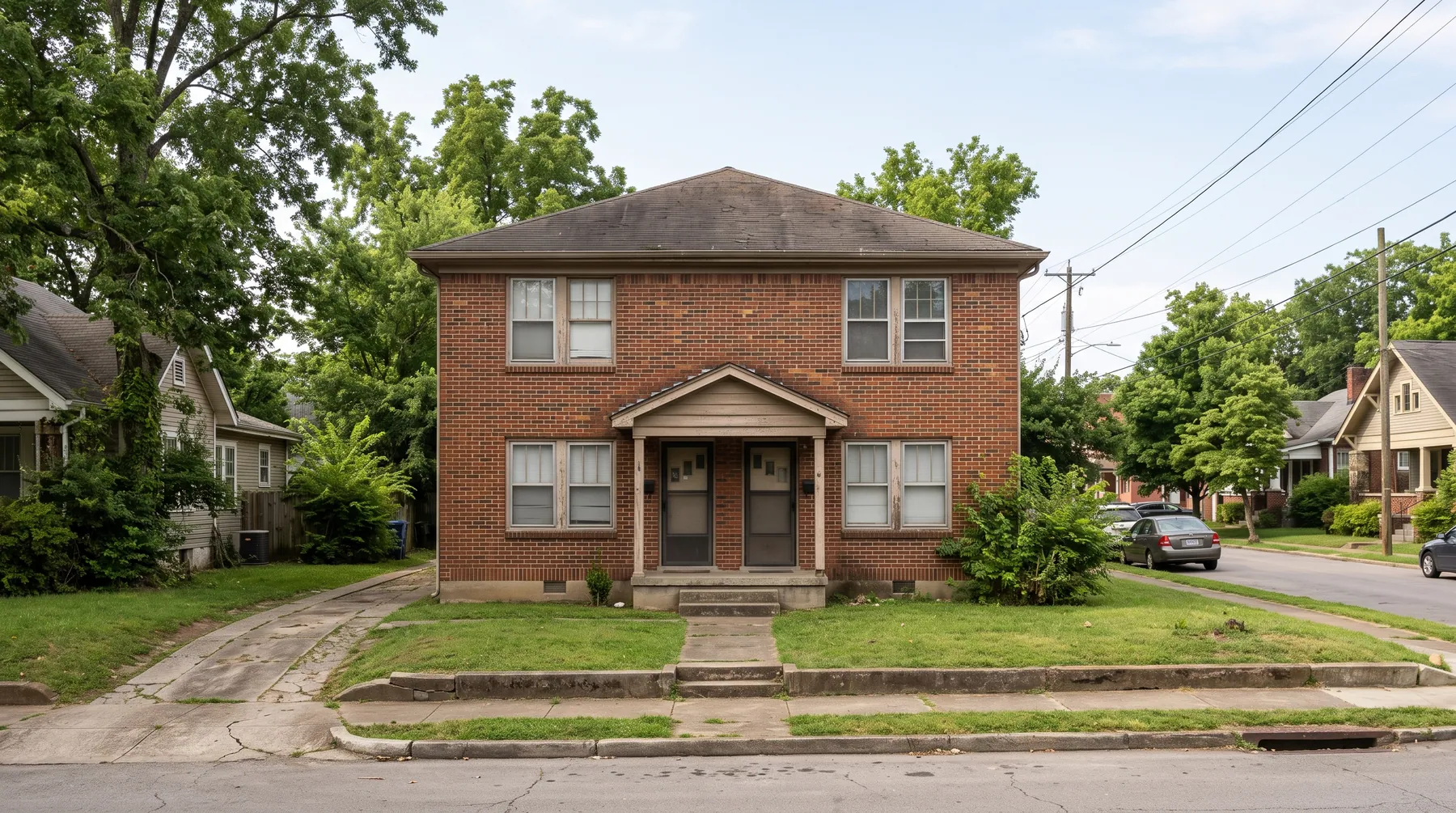
Fourplex
A fourplex is the largest building that still fits the one-to-four-unit loan limits, and it is well past the two-unit line where Nashville's building code stops treating a building as a house. That one fact changes your zoning choices, the number of permits a fourplex needs, the accessibility rules that apply and the county's tax treatment.
- Units
- 4
- Building code group
- IBC R-2 for leases; R-1 if stays are mostly 30 days or less
- Zoned for multi-family by right
- RM districts, MUN, MUL, MUG, MUI, OR20-OR40, ORI, CF, DTC, SCR
- Non-owner-occupied STR allowed
- Mixed-use, office, commercial, shopping center and most DTC districts; not RM, RN or RL
- Davidson County homes in 3-4 unit buildings
- 10,352 (ACS 2024 1-year)
- Parcels with exactly 4 non-owner-occupied STR permits
- 13 (Metro open data, Oct. 18, 2026)
- 2026 conforming loan limit, 4 units, Davidson County
- $1,979,350
On this page
- Where four units changes the rules
- Zoning districts that allow four units
- Short-term rental permits for four units
- Building and fire code at four units
- Accessibility rules that start at four units
- Financing a fourplex
- Running four units day to day
- Short, mid and long stays in one fourplex
- Fourplexes in the Davidson County numbers
- What Rad Stay handles
- Questions
- Sources
Where four units changes the rules
Metro brought in newer building codes through BL2025-898, which Council passed on July 15, 2025. Under the 2024 International Building Code, a building with no more than two dwelling units is Group R-3, and a building with more than two units is Group R-1 or R-2. A fourplex is designed, permitted and inspected as a small apartment building, even when it looks like a large house.
Tennessee draws its own line in the same place. Under Tenn. Code Ann. Under 67-5-501, a dwelling property that has two or more rental units is taxed as industrial and commercial property. Tenn. Code Ann. Section 67-5-801 values that class for tax at 40 percent, against 25 percent for homes. Living in one unit of a fourplex and renting the other three still leaves it commercial for property tax.
Federal accessibility rules for new housing also start at four units, and the residential loan limits stop there. Each of those is covered below.
Zoning districts that allow four units
Section 17.08.030's land use table allows multi-family use by right in all RM districts, in MUN, MUL, MUG and MUI, in OR20 to OR40, ORI and CF, downtown in all five DTC subdistricts, and in SCR. It is permitted with conditions in OG, CN, CL, CS, CA, SCN and SCC, where the residential rules for buildings in commercial districts apply. RS single-family and R one-and-two-family zoning do not permit multi-family use.
The number in an RM district name is its density in units per acre (Section 17.08.010). Four units on a quarter-acre lot works out to 16 units an acre, which is more than RM15 allows, so that lot needs RM20 or higher. On a half-acre lot, RM9 allows 4.5 units, enough for a fourplex on paper. Setbacks, height and parking still have to fit.
Since BL2025-1005 passed Council on December 4, 2025, its new RN and RL zones have barred short-term rental by owners who live elsewhere. A fourplex in an R or RS district is not a permitted use there. Ask Metro Codes whether yours is a legal nonconforming use before you buy or plan an addition.
Short-term rental permits for four units
Every unit is its own short-term rental property under Section 6.28.030, allowed four sleeping rooms at the most, and every listing shows that unit's own permit number. Renting all four units by the night takes four permits, and each lapses a year after issue without a renewal.
A fourplex can get absent-owner permits only where its zoning is one of the commercial, office or mixed-use districts the code names, or downtown other than DTC East, as our zoning guide lists. They are not allowed in any RM, RN, RL, R or RS district, and districts with an -NS suffix prohibit both permit types.
In an RM district the only option is an owner-occupied permit. That owner must be an individual, not an LLC, must live in the permitted unit as a primary home, and cannot list the whole home for short stays. Put together, those rules give an RM-zoned fourplex no route to nightly rental of whole units unless an SP or PUD on the parcel allows it. Have Metro Codes confirm your fourplex's parcel before you underwrite it that way.
Two more rules matter when you buy. Parcels close to schools, parks, day cares or houses of worship face a 100-foot bar on new absent-owner permits, which 21 Council votes can waive; the permit guide linked below has the detail. Nor can a permit be transferred: once the fourplex changes owners its permits end, and the buyer applies fresh.
Each applicant certifies, too, that no lease, condominium agreement or HOA agreement forbids renting. Every unit in a fourplex may hold its own permit; Metro sets no cap on the count. A fourplex has three or more dwellings, so the Fire Marshal inspects it. Metro's February 2026 FAQ put the permit fee at $313, and liability insurance of $1 million or more an occurrence is a condition of every permit.
Building and fire code at four units
The building code defines transient occupancy as a stay of not more than 30 days. Group R-2 covers buildings with more than two units whose occupants are primarily permanent, such as apartment houses. Group R-1 covers the same buildings when the occupants are primarily transient. A fourplex rented mostly by the night can be reviewed as R-1, so find out from Metro Codes how your building will be classed before you convert leased units.
The classification decides the fire alarm. Classed R-2, a fourplex needs a manual fire alarm only when a unit is at least three stories over the building's lowest exit-discharge level, more than a story below it, or the building passes 16 units. An R-1 building must have a manual fire alarm, except where it is no more than two stories high and every unit, separated by one-hour fire partitions, exits straight to a yard or public way. Where an R-1 building is sprinklered, sprinkler water flow can trigger the alarm, and one manual pull station replaces a full set. R-1 interior corridors serving sleeping units also need automatic smoke detection.
New buildings with a Group R fire area need automatic sprinklers under Section 903.2.8. Section 6.28.030 also calls for UL 217 smoke alarms in each short-term unit, placed in each sleeping area, on the path out of it, and on every story.
Accessibility rules that start at four units
Federal Fair Housing rules (24 CFR 100.201, 100.205) reach any building of four dwelling units or more, covering every unit in an elevator building and the ground floor of a walk-up. They apply when the fourplex's first occupants arrived after March 13, 1991. A covered fourplex must provide:
- The requirements, from entrances and routes to wide doors, reachable controls, grab-bar backing and usable kitchens and baths, are set out in the accessibility guide.
- Public and common use areas that are accessible to people with disabilities
- Doors wide enough for a wheelchair into and within the units
Financing a fourplex
FHFA sets conforming loan limits by number of units, from one to four. For 2026 the national baseline for a one-unit loan is $832,750. Davidson County is a high-cost county: its one-unit limit is $1,029,250 and its four-unit limit is $1,979,350. The limits stop at four units.
If you plan nightly rentals, check the loan program first. Under 12 U.S.C. 1731b, housing with an insured mortgage, including a two-, three- or four-family dwelling, may not be operated for transient or hotel purposes except under two narrow exceptions for older properties, and any rental for a period of less than 30 days counts as transient. An FHA owner-occupant loan on a fourplex and short-term rentals in the other units do not go together.
Underwrite the property tax at the commercial rate described above, and get the lender's written answer on short-term income before you close.
Running four units day to day
Every permitted unit must post its own maximum occupancy and the name and phone number of the local responsible party, a person or business within 25 miles who answers calls 24 hours a day during every stay. The guest cap per unit works out to four plus two for every sleeping room, never more than 12, so four two-bedroom units can hold as many as 32 people at once. Bookings must name a responsible guest who is 21 or more, last a day or longer, and come without meals from the permit holder.
Section 6.28.010 calls for a guest register with each guest's name, address and arrival and departure dates, held six months or longer. With four units turning over on the same weekend, keep it in your booking system so it is complete for each unit.
Required parking follows Section 17.20.030, and the requirement depends on the zoning district and bedroom count, so get the number for your parcel from Metro Codes. Short-term rental guests may not leave RVs, buses or trailers visible on the street or property.
Short, mid and long stays in one fourplex
A permitted stay can be as short as one day or as long as 30 consecutive nights. Stays longer than that fall outside Chapter 6.28 and are leases, so a fourplex can run two units by the night and lease the other two to residents, or switch a unit to furnished 31-day stays when a permit is not available. A unit without a permit must not be advertised for short stays at all.
Keep the mix in line with the building code: the more units that turn over nightly, the more the building looks primarily transient, and the classification affects the fire alarm rules above.
Fourplexes in the Davidson County numbers
Census Bureau figures from the 2024 American Community Survey find 10,352 Davidson County housing units in three- and four-unit buildings, about 2.7 percent of the county's 382,555, give or take 1,812. Of the occupied ones, about 7,444 were rented and 2,365 were owner-occupied.
Metro's open-data count on October 6, 2026 stood at 7,022 issued permits, 5,010 of them for absent owners. In that count is 329 Union Street, a fourplex that Metro permitted unit by unit in April 2023, Units 201 to 204, all for an absent owner.
What Rad Stay handles
Those four second-floor lofts at 329 Union in the DTC district are run by Rad Stay, so a building with four permits is its everyday case. For fourplex owners we handle nightly, monthly and yearly management, permit and tax support, rate setting, guest messages, cleaning schedules, booking automation and damage protection. Where a fourplex cannot hold short-term permits, we run it on monthly or yearly leases, and we also review fourplexes whose owners would sell, lease or partner.
Questions
Can all four units of my fourplex get short-term rental permits?
Only if the parcel's district, without an -NS suffix, appears among those Section 6.28.030 makes eligible for absent-owner permits, such as listed commercial, office and mixed-use zones or downtown. Every unit needs a separate permit, and each new one must clear the 100-foot rule.
If I live in one unit, can I rent the other three by the night?
Not under an owner-occupied permit. That permit covers only the unit the owner lives in, the owner has to be an individual, and the listing cannot offer the whole home. The other three units would need absent-owner permits, which RM, RN and RL zoning do not issue.
Can I use an FHA loan and run short-term rentals?
No, as a rule. 12 U.S.C. 1731b bars insured-mortgage multifamily housing, which includes two- to four-family dwellings, from transient or hotel use, with narrow exceptions for older properties, and any rental shorter than 30 days counts.
Does the Fair Housing Act apply to my older fourplex?
Federal design and construction requirements apply to a four-unit building if its first occupancy postdates March 13, 1991. A fourplex first occupied before then is outside those design rules.
Why is my fourplex taxed more than a house?
Tennessee's industrial and commercial class takes in any residential property with two-plus rental units, and the assessment there is 40 percent of value; homes are at 25 percent.
Sources
- Metro Code Chapter 6.28, Sections 6.28.010 and 6.28.030 (short term rental property permits), Municode, version of June 23, 2026
- Metro Code of Ordinances, Sections 17.08.010-17.08.030 and 17.20.030 (zoning), Municode
- 2024 International Building Code, Chapters 2, 3 and 9, International Code Council public access
- 24 CFR Part 100, Subpart D, Sections 100.201 and 100.205 (Fair Housing Act design and construction rules), Cornell LII
- FHFA, Conforming Loan Limit Values for 2026, full county list (Davidson County, Tennessee) and national baseline announcement
- 12 U.S.C. 1731b, transient or hotel use of multifamily housing with FHA-insured mortgages, Cornell LII
- Tenn. Code Ann. 67-5-501, property classification definitions, FindLaw
- Tenn. Code Ann. 67-5-801, assessment percentages, FindLaw
- U.S. Census Bureau, American Community Survey 2024 1-year estimates, Tables B25024 (Units in Structure) and B25032 (Tenure by Units in Structure), Davidson County
- Metro Nashville Residential Short Term Rental Permits (open data), status Issued, retrieved 2026-10-06
- Metro Council legislation BL2025-898 (building codes) and BL2025-1005 (RN and RL districts), Legistar
- Metro Nashville Codes, Not-Owner-Occupied STR checklist, Wayback copy of February 2026
- Census Reporter, ACS 2024 1-year, Tables B25024 and B25032, Davidson County
Checked October 18, 2026.
Top image: Illustration of a representative building, not a specific property.
To keep this page, print it or choose Save as PDF in your browser's print window. The printout keeps the sources and the date.
More property types
All 19
Historic Lofts
A historic loft building in Nashville is usually an old factory, warehouse, bank or store that now holds homes.
Boutique Hotels
A boutique hotel is a small building rented by the night, usually under a few dozen rooms, run as a hotel rather than as apartments.
Historic Downtown Buildings
A historic downtown building is an older brick commercial structure of three or four stories or more, built between the 1870s and the 1930s, with shops or offices at street level and open floors above.