










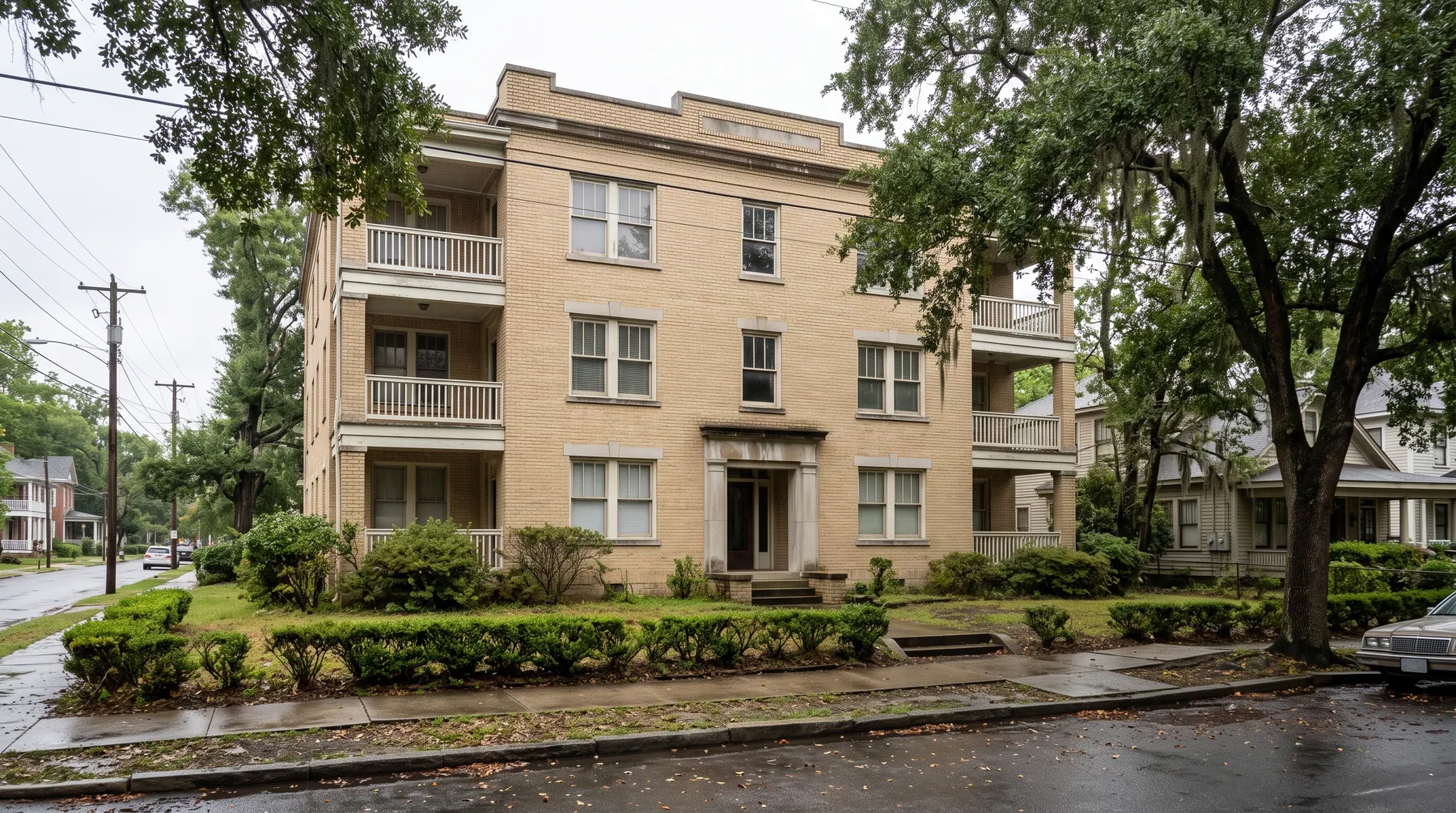
Eightplex
An eightplex is big enough that its layout and zoning drive the rules. Whether it is two floors of four units or four floors of two affects the stairs, the fire protection and which units must be accessible, and eight short-term units can put up to 64 guests in one building on a busy weekend.
- Units
- 8
- Short-term permits needed for all-nightly use
- 8, one per dwelling unit (Metro Code 6.28.030)
- Permit fee, Metro FAQ, February 2026 copy
- $313 per permit, $2,504 for eight
- Guests at once
- 48 with eight one-bedroom units, 64 with eight two-bedroom units
- Accessible units for a new R-1 building of 8 units
- At least 1 (IBC accessible-unit table for R-1)
- Renter-occupied homes in 5-9 unit buildings, Davidson County
- 16,363 (ACS 2024 1-year)
On this page
- Eight units on a Nashville lot
- Permits for eight short-term units
- Owner-occupied or not
- Rules for each of the eight units
- Fire protection and life safety
- Accessible units in an eightplex
- Financing eight units
- Running eight units
- Mixing short, mid and long stays
- Eightplexes in the Davidson County numbers
- What Rad Stay handles
- Questions
- Sources
Eight units on a Nashville lot
Whether a lot can hold eight units turns on its zoning district and on the use table in Metro Code Section 17.08.030. Confirm the district with Metro Planning before you count on eight units.
The RM districts are residential multifamily districts named for their density in units per acre. Eight units on a quarter acre is 32 units an acre, so the lot needs RM40 or higher. On half an acre it is 16, so RM20 works. On an acre, RM9 allows nine.
Ordinance BL2025-1005 created the RN and RL districts. Both districts bar nightly renting by an absent owner, so an eightplex there runs on monthly or yearly leases instead.
Permits for eight short-term units
Section 6.28.030 permits short-term rentals unit by unit, none having over four sleeping rooms. Nor does the code cap the share of an eightplex's units that may rent by the night. Renting all eight units by the night takes eight permits, eight applications showing $1 million of per-occurrence liability coverage, and eight posted notices of each unit's guest cap with the nearby responsible party's phone number, with that person answering around the clock.
New eightplex permits for absent owners exist only in the code's list of business, downtown, mixed-use and shopping-center districts (DTC East excluded), and in none ending in -NS. Metro's permit-types page says eightplexes zoned RM, RS, R or AR2A get no new permits of that kind. Existing holders there may renew, but those permits do not transfer when the property is sold.
Each of the eight applications needs proof that every adjoining owner, the units overhead and below counted where they exist, was told in writing, plus a signed statement that renting breaks no condominium agreement, lease or HOA agreement. With Metro's February 2026 FAQ putting the fee at $313, eight applications come to $2,504 before card processing. Permits last 365 days apiece, so an eightplex has eight renewals a year to track.
Since eight dwellings is well over Metro's line of three, the application also includes a Fire Marshal inspection. One- and two-family homes can send a certification signed by a licensed engineer, architect or home inspector instead.
Check how the eightplex became residential. In commercial and office districts an apartment building can count as an adaptive residential use, and Section 17.16.030 makes those lots ineligible for either kind of short-term permit if most of their frontage is carried by a local street, or if the Urban Services District does not reach them; any permit that was in good standing on August 1, 2024 is left alone.
Permits stay with the owner named on them. On a sale, all eight lapse at once, and the buyer starts eight new applications. Those include the 100-foot rule for licensed day cares, places of worship, parks and schools, which Council may waive by resolution on 21 votes once it has held a public hearing. All eight units can go into one resolution, since a single resolution may cover several units of one development.
Owner-occupied or not
Metro issues two kinds of short-term permits, owner-occupied and non-owner-occupied. The owner-occupied permit needs one or more individual owners who make the unit their primary home, which rules it out for an eightplex titled to a company, a partnership or a trust. That permit also cannot list a whole home, apart from a detached accessory dwelling permitted under the law, an accessory apartment, or one unit of a covenanted duplex.
An eightplex held by a company therefore needs non-owner-occupied permits, which are limited to the listed districts. If you plan to live in one unit and rent the rest, ask Metro Codes which permit applies to each unit before you buy.
Homeowners association and condominium rules can be stricter than Metro's. Metro's FAQ says an association may go further than Metro's rules, and each application includes the signed statement that renting breaks none of those agreements, even if no association exists.
Rules for each of the eight units
Each unit hosts one party at a time, and the person who books it must be 21 or older. No stay can be shorter than 24 hours or longer than 30 consecutive days. The permit holder may not serve guests food, and buses, trailers and RVs may not be parked in view. Every listing has to put the permit number, or a photo of the permit, where guests can see it, and the responsible party has to be based inside 25 miles.
With eight units, one slip tends to repeat eight times. Metro may revoke the permit, with 15 days' written notice, once the general rules have been broken three times, and the holder can appeal that decision to the STR Appeals Board. After a revocation no new permit is issued for one year. Renting with no permit draws fines of $50 per day. Build one checklist for the building and run it against each unit's listing, posting and record.
Fire protection and life safety
The building code classifies a building by how long people stay. Stays of 30 days or less are transient, which points to Group R-1; mostly permanent residents point to Group R-2. Metro Codes makes that call, so ask before you convert a leased building to nightly use.
Exit stairs, fire alarms and sprinklers depend on the classification, the number of stories and the year of construction. Before you buy, convert or change the mix of stays, get your eightplex's requirements in writing from Metro Codes and from the Fire Marshal's office. The Fire Marshal inspection that comes with the permit applications is the first check, so do not wait for it to find a problem.
Accessible units in an eightplex
Fair Housing Act design standards cover an eightplex that first had occupants after March 13, 1991, every unit if an elevator serves it and the ground floor if none does. Those units need an accessible entrance and route, usable kitchens and bathrooms, wide doors, reachable switches and thermostats, and bathroom walls ready for grab bars.
The building code adds a second layer for new short-stay buildings. For Group R-1, its accessible-unit table calls for one fully Accessible unit or more in any building with up to 25 units. Confirm the edition and table Metro enforces. If you are building an eightplex for short-term use, plan that unit from the start.
Hotel-style operation can also bring the ADA into play. Federal rules call a facility a place of lodging when most stays are short, usually 30 days or fewer, and it runs much like a hotel, with reservations and management handled on site or elsewhere, rooms offered on a call-in basis, linens or housekeeping, and booking by room type.
Financing eight units
Lenders size an eightplex loan on income, and nightly units do not fit a standard rent roll. Ask how the lender will measure stabilized occupancy and count nightly revenue before you lock a rate. Fannie Mae's multifamily programs set their own occupancy and debt service tests, so read the current term sheet for the program your lender uses.
Running eight units
Each unit may host twice its sleeping rooms plus four guests. Eight one-bedroom units can hold 48 guests at once and eight two-bedroom units 64. Section 6.28.010 requires a guest register, and you keep it at least six months.
Eight units usually justify a laundry room or linen service, a locked owner's closet with spare linens and supplies, and an electronic lock on every unit and on the main entry so codes change with each stay. Plan for two turnover teams on peak checkout days instead of one.
Each of the eight permits stands on its own, so keep a file per unit with the permit, the insurance proof, the adjacent-owner notices and the renewal date. A renewal that slips on one unit then stays a one-unit problem, and a sale or a change of manager does not leave you rebuilding eight sets of records from memory.
Mixing short, mid and long stays
Chapter 6.28 caps a permitted short stay at 30 consecutive days. Longer stays are leases, and in Davidson County they fall under Tennessee's Uniform Residential Landlord and Tenant Act, which applies in counties with more than 75,000 people under the 2010 census. Treat every 31-day-plus guest as a tenant with a written lease.
Split the units by layout. Units on the ground floor near the entry are easiest for nightly guests with luggage; upper units with quieter outlooks often suit residents and longer stays. Keep each unit's use consistent through the year so its permit history, tax filings and lease records stay clean.
Eightplexes in the Davidson County numbers
The 2024 American Community Survey put about 16,363 renter-occupied homes in five-to-nine-unit buildings across Davidson County, near one in ten of the county's 163,743 renter households, and 3,018 owner-occupied homes. That is 16,363 of 163,743 renter households, or 10.0 percent, and renters outnumber owners in these small apartment buildings by more than five to one.
What Rad Stay handles
For an eightplex, Rad Stay supports permit and tax compliance for each unit, prices every unit separately, answers guests, coordinates cleaning crews and linens, automates bookings and arranges damage protection. Any unit that cannot, or should not, rent by the night goes on a monthly or yearly lease. Rad Stay also looks at eight-unit buildings with owners weighing whether to sell, lease or partner.
Questions
Does a new short-term eightplex need an accessible unit?
If it is classified Group R-1, the building code's accessible-unit table requires at least one Accessible unit for 1 to 25 units. The Act's design rules apply once a building reaches four units.
How many guests can an eightplex hold?
Each unit is capped at twice its sleeping rooms plus four. Eight two-bedroom units can hold 64 guests at once.
What happens to the eight permits when I sell?
They do not transfer. The buyer applies for new permits under the rules in force when Metro receives the applications.
My eightplex is in a CS district. Can it get short-term permits?
CS zoning allows absent-owner permits, but where the apartments are an adaptive residential use, Section 17.16.030 bars the lot if a local street takes most of its frontage or the lot lies beyond the USD, except a permit that already stood in good standing before August 1, 2024.
Can every unit in an eightplex rent short-term?
Section 6.28.030 has no percentage limit. Each unit just needs its own permit and zoning that allows one.
Will a lender count nightly rent toward stabilized occupancy?
Ask in writing. Lenders set their own tests for stabilized occupancy, and how they measure it in a short-term building varies.
Sources
- Metro Code Chapter 6.28, Sections 6.28.010 and 6.28.030 (short term rental property permits), Municode, version of June 23, 2026
- Metro Code of Ordinances, Sections 17.08.030 (land use table), 17.16.030 and Chapter 17.38 (zoning), Municode
- Metro Nashville Codes, Short Term Rental Permit Types (Wayback copy of Feb. 17, 2026)
- Metro Nashville Codes, Not Owner Occupied Checklist (Wayback copy of Feb. 16, 2026)
- Metro Nashville Codes, Short Term Rental Frequently Asked Questions (Wayback copy of Feb. 11, 2026)
- 2024 International Building Code, Chapters 2, 9 and 11, International Code Council public access
- 24 CFR Part 100, Subpart D, Sections 100.201 and 100.205 (Fair Housing Act design and construction rules), Cornell LII
- 28 CFR 36.104, definitions of place of lodging and place of public accommodation (ADA Title III), Cornell LII
- Tenn. Code Ann. 66-28-102, where the Uniform Residential Landlord and Tenant Act applies, FindLaw
- U.S. Census Bureau, American Community Survey 2024 1-year estimates, Table B25032 (Tenure by Units in Structure), Davidson County
Checked October 18, 2026.
Top image: Illustration of a representative eightplex, not a specific property.
To keep this page, print it or choose Save as PDF in your browser's print window. The printout keeps the sources and the date.
More property types
All 19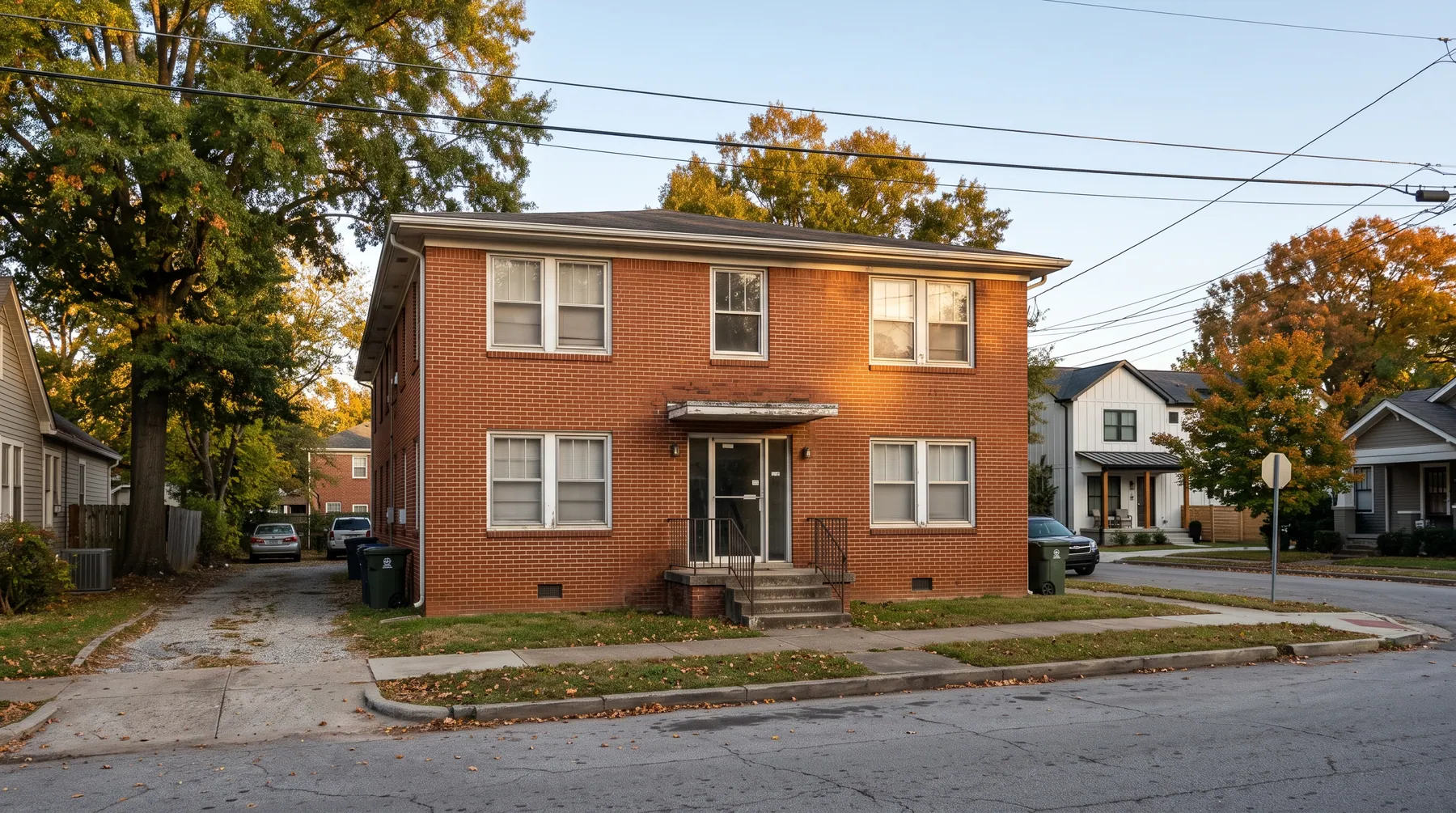
Sixplex
Six units is the size where a Nashville building starts to be run like a small business.
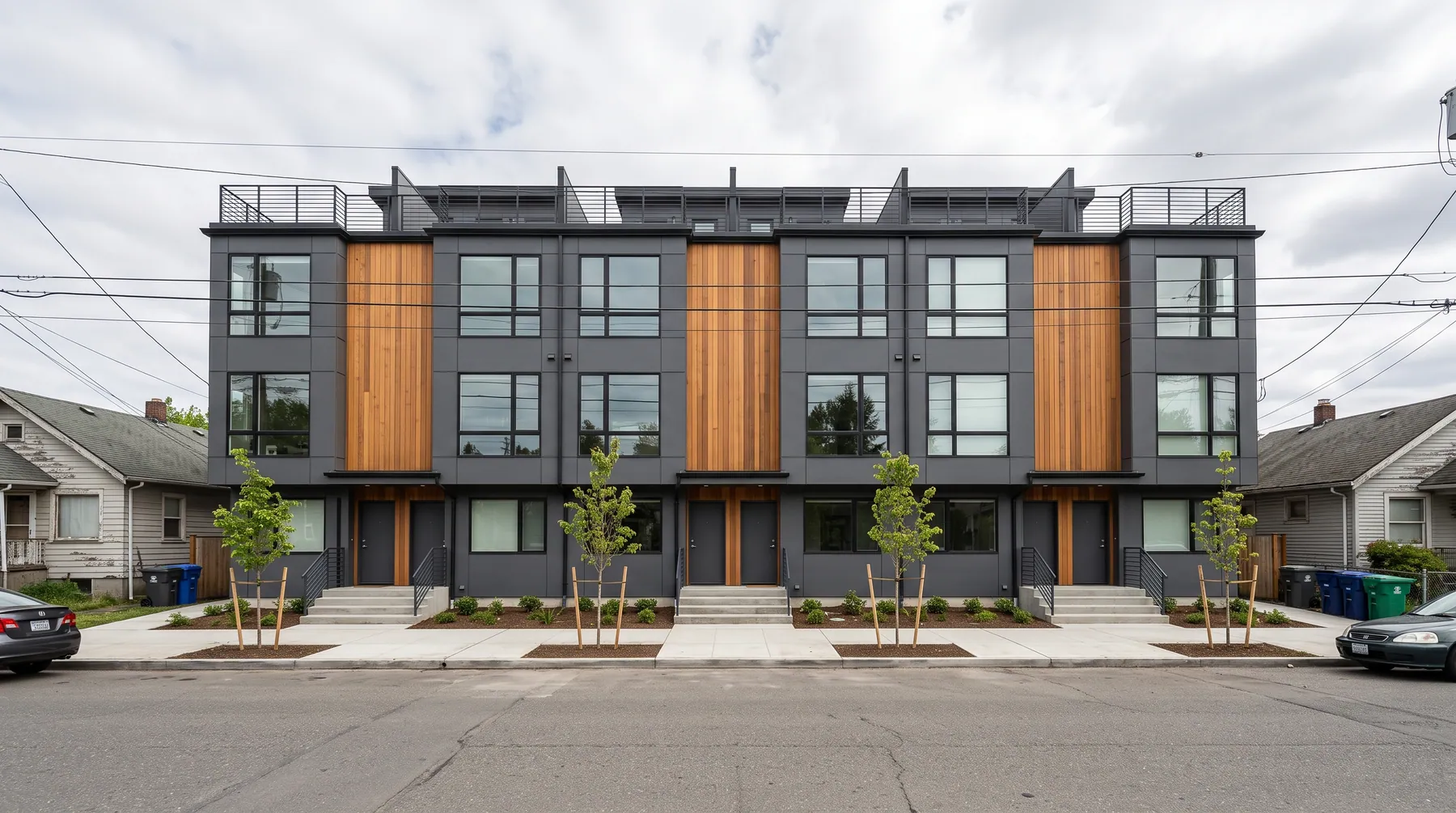
Tenplex
At ten units, an owner in the right district faces a real choice: ten separate short-term rental permits, a lodging use that Metro's zoning code calls hotel/motel, or a building of residents.
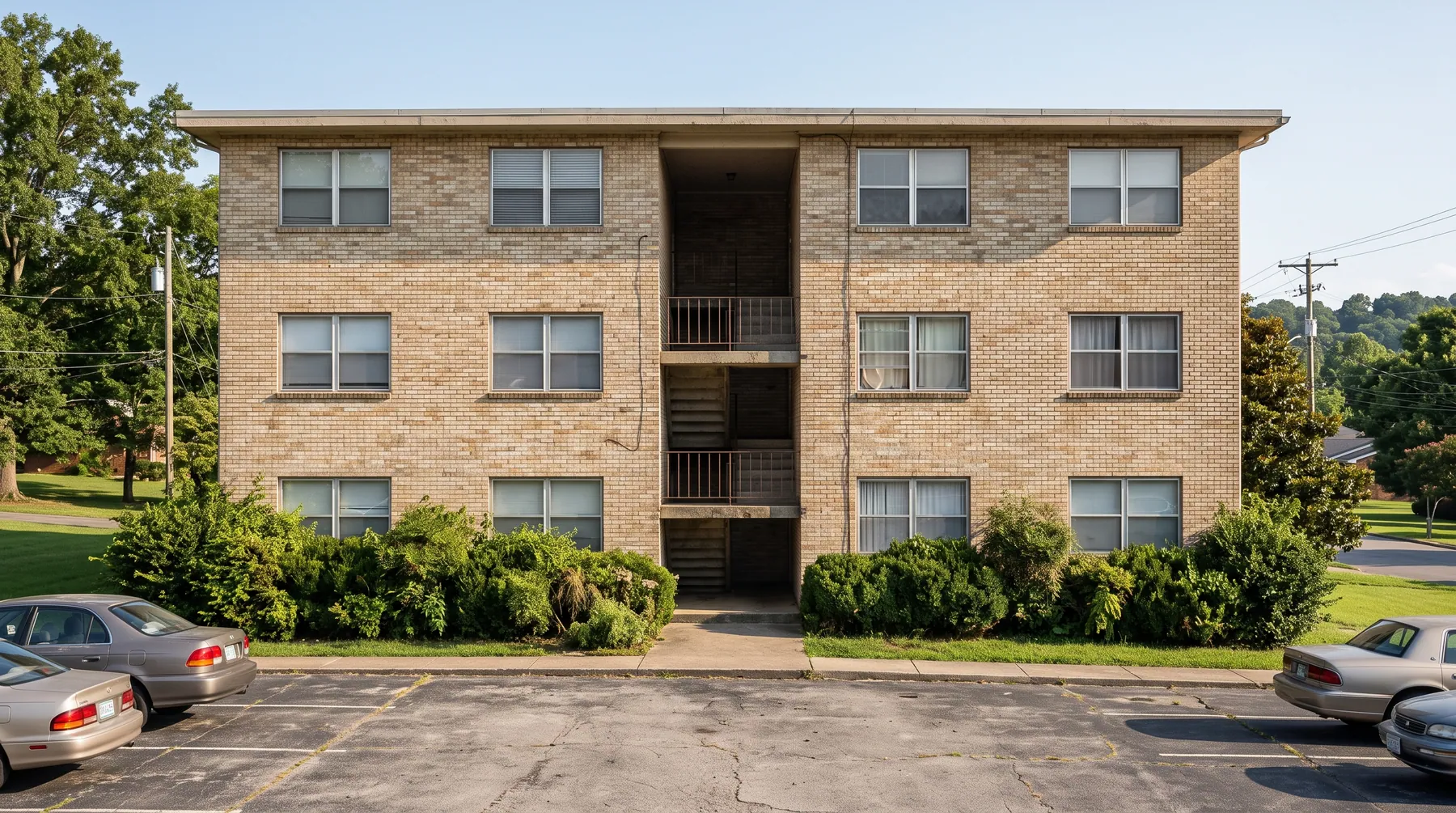
Twelveplex
Twelve units can be three floors of four or two floors of six.