










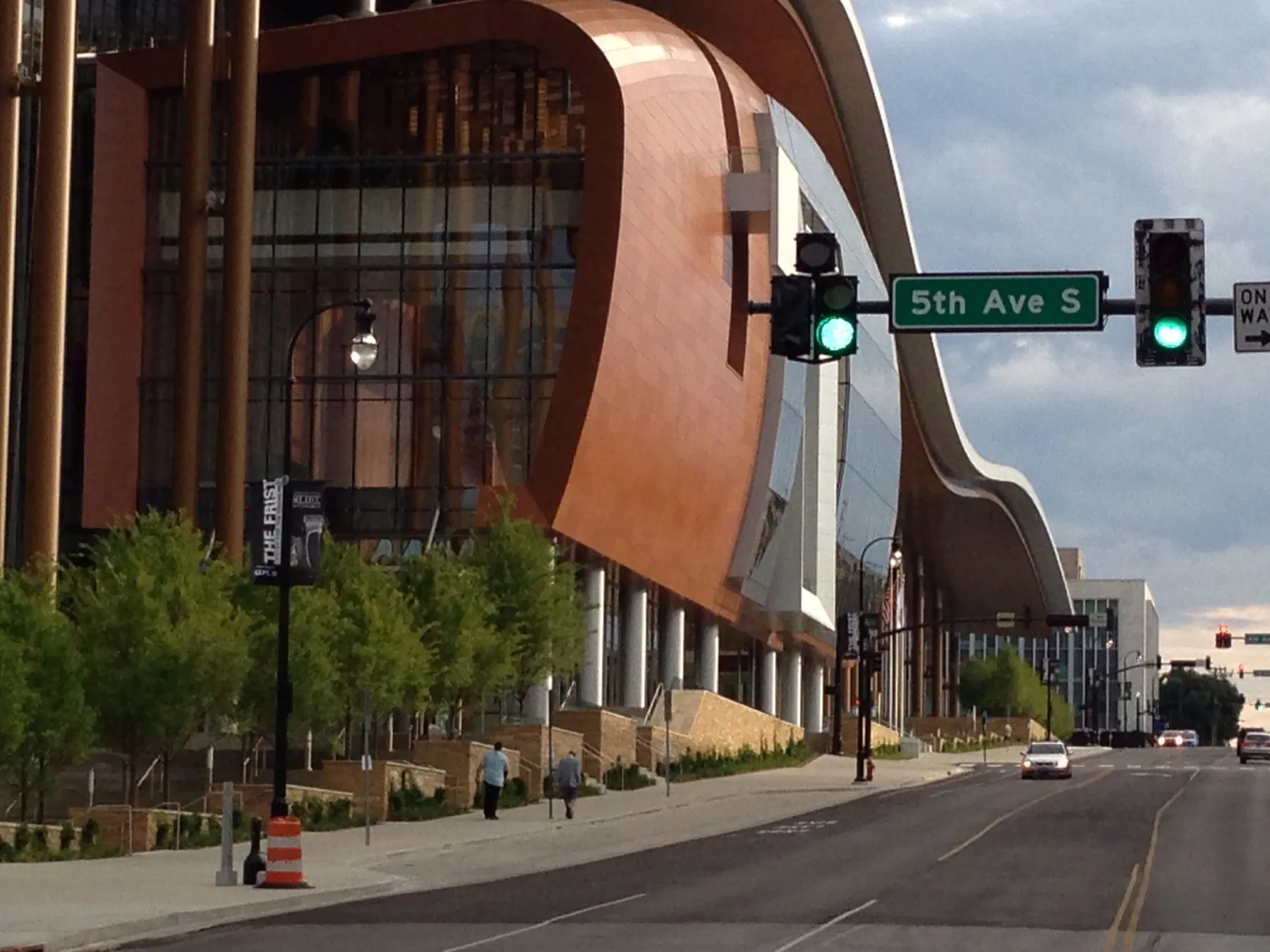
SoBro
SoBro is the part of downtown Nashville south of Broadway: the Music City Center, the Schermerhorn concert hall and a run of new residential and hotel towers. For a building owner, ZIP 37203 holds more issued short-term rental permits than any other Nashville ZIP, and the next wave of new buildings is arriving. This page covers the ground, the buildings, the zoning and permit rules, and the checks an owner should run before a purchase or conversion.
- ZIP codes
- 37203, 37201
- Anchor
- Music City Center, 201 5th Avenue South
- Issued STR permits, ZIP 37203
- 1,706 (89 owner-occupied, 1,617 non-owner-occupied)
- Issued STR permits, ZIP 37201
- 346 (8 owner-occupied, 338 non-owner-occupied)
- Zoning to know
- DTC North, South, West, Central allow new non-owner-occupied permits; DTC East does not
- Rules apply per unit
- Each unit needs its own permit; no percentage cap in a building
On this page
- Where SoBro is
- How the area developed
- The anchors
- Buildings and housing today
- What is under construction and proposed
- SoBro zoning and short-term permits
- The 100-foot rule and its waivers
- Owner-occupied permits and overlays
- Rule changes since 2023
- Permits issued in ZIP codes 37203 and 37201
- Who visits and why
- Longer stays in SoBro
- Getting around
- Building types that fit SoBro
- Checks before a SoBro purchase
- Rad Stay on a SoBro building
- Questions
- Sources
Where SoBro is
SoBro is short for South of Broadway. Visit Music City describes it as the south side of Broadway in downtown Nashville and says the area is known for all things new. There is no official boundary. SoBro is a district name used by marketers, developers and visitors, and it does not appear as a unit in Metro's zoning code. That matters to an owner, because every rule you will meet is tied to a parcel and its zoning district, not to the word SoBro.
In practice the name is used for the blocks around the Music City Center at 201 5th Avenue South. Visit Music City names the convention center and the Schermerhorn concert hall among the district's newer buildings. The Downtown Partnership's development map uses the name too, for Modera SoBro at 825 6th Avenue South and a proposed SoBro Hotel at 600 4th Avenue South.
Two ZIP codes show up among the landmarks. The Hall of Fame, on Rep. John Lewis Way, is in 37203. The Schermerhorn's mailing ZIP is 37201-2031. If you are pulling permit data for a building, check both ZIP codes.
How the area developed
The Cumberland River is the lowest point in Nashville, at 385 feet above sea level, according to Wikipedia's article on downtown. That article also notes that downtown saw little new construction until the mid-2000s, and that the Pinnacle, which opened in 2010, was the first skyscraper built in the preceding 15 years. Of 33 towers at least 300 feet tall (as of April 2023), 24 were completed after 2000.
The public buildings that define the area came in two steps. In the 1990s, under Mayor Phil Bredesen, the city built or renovated the Hall of Fame, the downtown library, Bridgestone Arena and Nissan Stadium. The Hall of Fame moved into its current building, number 222 on Rep. John Lewis Way, in May 2001. The Schermerhorn concert hall opened on September 9, 2006, at a cost of $123.5 million, with a gala conducted by Leonard Slatkin. The Music City Center followed in May 2013.
The 2010 flood shows how this part of downtown can be hit. Flooding between May 1 and 7, 2010 caused damages estimated at over $2 billion, and eleven people died. At the Schermerhorn, about $40 million in damage was caused and water reached 24 feet at the flood's height. The hall reopened on December 31, 2010, with a concert by Itzhak Perlman.
Every finished residential project in this part of town on the Downtown Partnership's map was completed between 2023 and 2026.
The anchors
The Music City Center is the district's convention venue. Wikipedia lists it at about 2.1 million square feet, built for roughly $623 million, designed by tvsdesign with Tuck-Hinton Architects and Moody Nolan. The city owns the building, and the Convention Center Authority runs it. The same article reports plans to add more than 300,000 square feet because events had been cancelled for lack of space. The article gives no completion date for that expansion.
Wikipedia says a $100 million expansion in 2014 doubled the Hall of Fame to 350,000 square feet. Hatch Show Print, a letterpress shop, is inside the museum. The Schermerhorn's Laura Turner Concert Hall seats 1,844.
A newer addition to the transit picture is an underground station that The Boring Company announced in July 2025 beneath the convention center, as part of phase one of its Music City Loop. Wikipedia's Music City Center article expects that phase to finish around late 2026 or early 2027, with a tunnel linking the center to the airport. Treat it as an announcement until the service is running.
Buildings and housing today
The Nashville Downtown Partnership development map is the best public list of what has been built. It is not limited to SoBro, and it mixes in Gulch projects, so read the addresses. The finished projects on it that sit in or beside SoBro include the following.
Hyve Condominiums at 629 7th Avenue South is an 83-unit residential development completed in 2023. The map labels it STR Eligible. Modera SoBro at 825 6th Avenue South has 404 residential units and is listed for 2026. Motto by Hilton at 311 Third Avenue South has 256 rooms and was completed in 2025. The Everett at 960 Commerce Street has 361 apartments and The Emory at 630 Commerce Street has 312 condominium units, both listed for 2025. Prime at 801 Church Street (350 apartments, 2024) and Alcove at 900 Church Street (356 apartments, 2023) are also on the finished list. The Nashville Yards creative office at 955 Church Street adds 300,000 square feet of office space, listed for 2025.
The list also includes Gulch projects: Modera Gulch (376 units, 2023), Paseo South Gulch's Prima (278 units, 2024) and Society Nashville at 915 Division Street (502 units, listed for 2026). They are on the same map and bring the total up.
Add them up and the projects listed above deliver more than three thousand apartments and condominium units between 2023 and 2026, plus the 256 rooms at Motto. A buyer of an older small building here would be competing with that new supply.
Of the residential projects on the map that list a unit count, only two are apartment-building size by our measure: Hyve, with 83 units, and Allegro, with 82 for-purchase units under construction. The others run from 250 to 500 units. For a manager working with a smaller building, that usually means a floor or block of units in a condominium building, or a smaller mixed-use building.
What is under construction and proposed
The same development map lists projects not yet finished. They are changing the district for the next several years, and any owner buying here should read it for what is going up next door. Entries below are as the map read in October 2026, and timing for proposed items is shown as to be determined.
Under construction: Pendry Hotel and Residences at 701 7th Avenue South, with 180 guestrooms and 146 residences, listed for 2027. The Hook by Marriott and Marriott Vacation Club at 1221 Grundy Street, with 144 extended-stay rooms and 168 timeshare units, also listed for 2027. Paramount, sited at 1010 Church Street, a 60-story residential tower with a 100,000-square-foot YMCA, listed for 2028. Allegro at 621 Middleton Street, with 82 for-purchase units, listed for late 2028. A Courtyard by Marriott in the Gulch at 701 8th Avenue South (185 keys) has no date.
Proposed: a 257-room hotel at 600 4th Avenue South (listed as SoBro Hotel); a project at 712 4th Avenue South with 165 hotel rooms, 80 short-term rentals and 40,600 square feet of restaurant and retail space; a 525-apartment project at 522 4th Avenue South; a 281-key hotel at 422 Rep. John Lewis Way South; a 16-story Marriott Element hotel at 600 6th Avenue South; the St. Regis Nashville at 805 Demonbreun Street with 173 guestrooms and 111 residences; and a Ritz-Carlton two-tower project at 417 7th Avenue South with 240 hotel rooms and 150 condos in the first tower. Proposals can change or stall, so do not underwrite against any of them.
The 4th and Elm entry matters most to a short-term rental owner, because it lists 80 short-term rental units next to 165 hotel rooms in one proposal. It is a proposal, not a permit, and the map does not say how those units would be permitted.
SoBro zoning and short-term permits
The parcel's zoning district is what Metro's short-term rental rules attach to. Downtown, Section 6.28.030 makes new permits available to owners who do not live in the unit, with conditions, in all but the East subdistrict of the DTC zone, and the Title 17 table leaves the use blank in DTC East and on residential land; our zoning guide adds the qualifying business and mixed-use districts. It does not include DTC East.
Where a parcel is zoned CS-NS or any other district with the NS tag, the code prohibits both permit types. If the parcel is under an SP or PUD, the plan, not the base district, decides.
This page cannot tell you which DTC district a given SoBro parcel is in, and you should not assume. Look the parcel up in the Parcel Viewer; Metro Codes gives the final word.
The rest of the rules matter at building scale. Every SoBro unit needs its own permit, capped at four sleeping rooms. The code sets no ceiling on how much of a SoBro building may rent short-term. Do not take a broker's word that a cap exists, and do not assume the way is clear either: a condo association or a lease can still say no. Each applicant certifies that the rental violates no lease and no co-op, condo or HOA agreement, a step Metro requires even without an association, and the city warns that associations can set tighter limits.
In a SoBro condominium tower, the declaration is often the deciding document. Read it before you get to the zoning.
The 100-foot rule and its waivers
Since August 2023 the code has also kept new absent-owner permits out of the 100 feet around schools, parks, churches and licensed day cares, although Council can grant waivers and mostly has, and projects under way in 2020 are exempt; our multifamily permits guide explains both. Run the check on a specific parcel before you sign a contract.
A Council waiver is possible. The lesson for a building owner is that a waiver is a vote and a calendar, and it should be priced in as risk and time.
That is unlikely to apply to the 2023-to-2026 towers, so assume the rule does.
Owner-occupied permits and overlays
The second type, owner-occupied, is allowed as an accessory use in zoning districts that allow residential use, except NS districts. The owner-occupied permit fits only a person living in the unit, and it cannot advertise a whole home except in narrow cases. An applicant submits four proof documents, two from one group and two from another.
For an investor buying several condominium units, that means the owner-occupied type is not a route to a block of units. Each unit in a tower would need a not-owner-occupied permit plus a district that allows it.
Overlays are a separate check. Chapter 17.36, on overlays, says nothing of short-term rentals outside its detached accessory dwelling overlay. Look up the parcel's overlays in Parcel Viewer anyway, because they can carry other limits on what you build or change.
Rule changes since 2023
The distance rule is recent. BL2023-136, which addressed review by the STR Appeals Board, passed on February 6, 2024. BL2024-187, on adaptive residential lots, passed on July 16, 2024.
It revised the proof required for owner-occupied permits, made a change of ownership void the permit and revised the waiver process. BL2025-1005 and BL2025-1007 passed on December 4, 2025. The December 2025 bills address RN and RL zoning and accessory dwellings, and do not touch a downtown tower. No short-term rental ordinance appears in Legistar's titles after June 23, 2026.
Renewal is yearly. After a revocation, Metro issues no new permit for one year, and an owner whose owner-occupied application is denied waits six months. A revocation can be appealed to the STR Appeals Board.
Permits issued in ZIP codes 37203 and 37201
Metro's open data on residential permits, filtered to Issued as of October 6, 2026, counts 7,022 across the county. Of those, 1,706 are in ZIP 37203, and all but 89 of them are not-owner-occupied. That is about 24 percent of the city's issued permits in one ZIP, and about 95 percent of them are not-owner-occupied. ZIP 37201 has 346: 8 owner-occupied and 338 not-owner-occupied.
Together the two ZIP codes hold 2,052 issued permits, about 29 percent of the citywide total, and 1,955 of them are not-owner-occupied. The file does not break the counts down by neighborhood, and both ZIP codes are larger than SoBro, so do not read 1,706 as a SoBro figure. It describes the whole ZIP. What it does tell you is that permitted short-term rentals are common in these ZIP codes, and that a new unit competes with a lot of other permitted ones.
A sale ends every permit, since none can be transferred, and so does putting the building into the owner's own trust or LLC; the buyer then makes a fresh application. A building with permits in place has income you can underwrite from the operating record, but the permits themselves do not come with the sale. A buyer has to qualify under today's code, which for non-owner-occupied permits means the parcel's district and the 100-foot rule. Metro's references say state law locks a holder only into the rules that applied on the permit's issue date.
Who visits and why
The Music City Center is the first place to look. The convention center's own calendar lists the events, so track the dates of large ones against any unit you plan to price.
The Schermerhorn concert hall and the Hall of Fame draw visitors too. The Hall of Fame's address is 222 Rep. John Lewis Way S., and the Schermerhorn is in ZIP 37201.
Office space is the third place to look. The Nashville Yards creative office at 955 Church Street adds 300,000 square feet, and the proposed Nashville Yards Parcel 5 office would add 620,000 square feet at 1001 Church Street. Whether office tenants send visitors who want furnished space for weeks rather than nights is a mid-term question, covered next.
Longer stays in SoBro
No permitted stay in Nashville may pass 30 consecutive nights. Ask Metro Codes how a particular monthly stay will be treated. For an owner whose zoning or association rules out nightly stays, monthly or yearly leasing is the fallback and sometimes the main plan.
This page has no sourced rent or demand figure for longer stays in SoBro, so test any plan against current listings rather than a rule of thumb. Rad Stay manages stays of every length, and the right one for a SoBro building depends on the permits, the declaration and the rent at the time.
Getting around
Addresses differ for the Schermerhorn, the Music City Center and the Hall of Fame, so time the walk from the building itself.
For the airport, WeGo's Route 18 Airport is the public bus. Under the summer 2026 changes in force from July 5, 2026, buses come every 30 minutes, all week, through the daytime hours of 6 to 6, and every 40 minutes at night. Before the change it ran every 45 to 55 minutes in the day and hourly in the evening. The MTA Board approved the change on April 23, 2026, and the funding comes from Choose How You Move. Wikipedia's article on downtown notes that a new MTA bus hub was completed in downtown.
By road, Wikipedia notes that I-40, I-65 and I-24 converge near the core area of downtown. Parking is a building-level question. Ask whether a unit has a deeded space, whether guests may use visitor parking, and what the garage charges. Those facts are different for each tower, and no public source here covers them.
Building types that fit SoBro
Condominium units in a tower are the most common entry point for a short-term rental owner. Whether they work depends on the association, as covered above. Hyve Condominiums is the example where the development map flags short-term rental eligibility. A buyer of several units in one building, or of a floor, can run them as a block under one manager.
A mixed-use building with ground-floor retail and apartments above is the next fit. The 4th and Elm proposal combines hotel rooms, 80 short-term rental units and 40,600 square feet of restaurant and retail space in one project. A smaller mixed-use building can do the same at a smaller scale, since business and mixed-use zoning also qualifies for absent-owner permits with conditions.
Newly built apartment buildings in lease-up are a third. A building that is still filling can use a managed short-term or mid-term program on unleased units, subject to the same permit and lease rules as any other. A hotel that is not performing is a fourth. Metro's rules cover a residential dwelling no larger than four sleeping rooms, so ask Metro Codes before any guest books a converted hotel room.
Checks before a SoBro purchase
Start with the parcel. Pull the zoning district, the overlay, the floodplain status and the 100-foot distances from Metro's maps and codes. The 2010 flood is the reason to check floodplain status for any building near the river.
Read the condominium declaration and bylaws. Confirm the building's rental rules, the minimum lease term, the fees for short-term use, the rules for fobs and elevators, and who pays for front-desk staffing. Every applicant signs off that none of these documents forbids renting, so a rental ban in the declaration ends the plan.
Look at the fire and life-safety side. Any property holding at least three dwellings gets a Fire Marshal inspection on Metro's checklist. A building of that size needs it for each application. Then the countywide duties: notice to every adjoining owner, floors above and below counted, a $1 million liability policy, the permit number shown in listings, a guest cap, a responsible party on call, and a yearly renewal, all detailed in the multifamily guide.
Price the operating rules into the numbers. Metro's February 2026 FAQ puts the fee at $313.
Check the neighbors you will have in two years. Read the development map for new towers and hotels within a block or two of the address, and note how many short-term rental units a nearby proposal plans.
Read this as general information, not as legal or tax advice; Metro Codes decides.
Rad Stay on a SoBro building
Rad Stay, whose flagship holds four lofts at 329 Union Street, manages SoBro-size buildings for nightly, monthly and yearly stays. In a SoBro building the work is the same list, adjusted for the tower format.
For nightly units in SoBro the work is pricing around the convention calendar, guest messages, cleaners, bookings, damage protection, plus permit and tax filings. Check-in logistics get their own attention in a tower: fobs, elevators, visitor parking and the desk. Mid-term and long-term units follow the same operating discipline with different leases and calendars.
Owners weighing a sale, lease or partnership can have it review SoBro buildings too. In SoBro, the review starts with the parcel and the association documents, and the underwriting follows from them. Our multifamily permit guide covers the steps by building size.
Questions
Is SoBro an official zoning area?
No. SoBro is a district name used by marketers and developers. Everything turns on the parcel's district, so check it in Parcel Viewer and with Metro Codes.
Can a SoBro tower unit get a new permit when its owner lives somewhere else?
Possibly. With conditions, yes in four DTC subdistricts (Central, North, South, West) among other districts, and no in DTC East. The 100-foot distance rule applies, and a condominium declaration can rule rentals out even where the zoning allows them.
Does the 1,706 figure for ZIP 37203 show how many rentals are in SoBro?
No. It is the count of issued permits in the whole ZIP on October 6, 2026: 89 owner-occupied and 1,617 non-owner-occupied. ZIP 37201 adds 346 more.
Sources
- Metro Code Chapter 6.28, Municode (text current through June 23, 2026)
- Metro Code 17.08.030, land use table, Municode
- Short-term rental permit types, Metro Codes (Wayback copy, Feb. 17, 2026)
- Not-owner-occupied permit checklist, Metro Codes (Wayback copy, Feb. 16, 2026)
- Operation requirements, Metro Codes (Wayback copy, Feb. 12, 2026)
- Frequently asked questions, Metro Codes STR (Wayback copy, Feb. 11, 2026)
- Metro Code Chapter 17.36, overlay districts, Municode
- Renew a short-term rental permit, Metro Codes (Wayback copy, Oct. 12, 2026)
- Council legislation records, Metro Nashville Legistar
- Metro Nashville Residential Short Term Rental Permits (open data), status Issued, retrieved Oct. 6, 2026
- Development map, Nashville Downtown Partnership
- Music City Center, Wikipedia
- Downtown Nashville, Wikipedia
- Schermerhorn Symphony Center, Wikipedia
- Country Music Hall of Fame and Museum, Wikipedia
- SoBro, Visit Music City
- WeGo summer service changes go into effect July 5, WeGo Public Transit
Checked October 18, 2026.
Photo: Pjgdds, CC BY-SA 3.0, via Wikimedia Commons. Cropped.
To keep this page, print it or choose Save as PDF in your browser's print window. The printout keeps the sources and the date.
More markets
All 28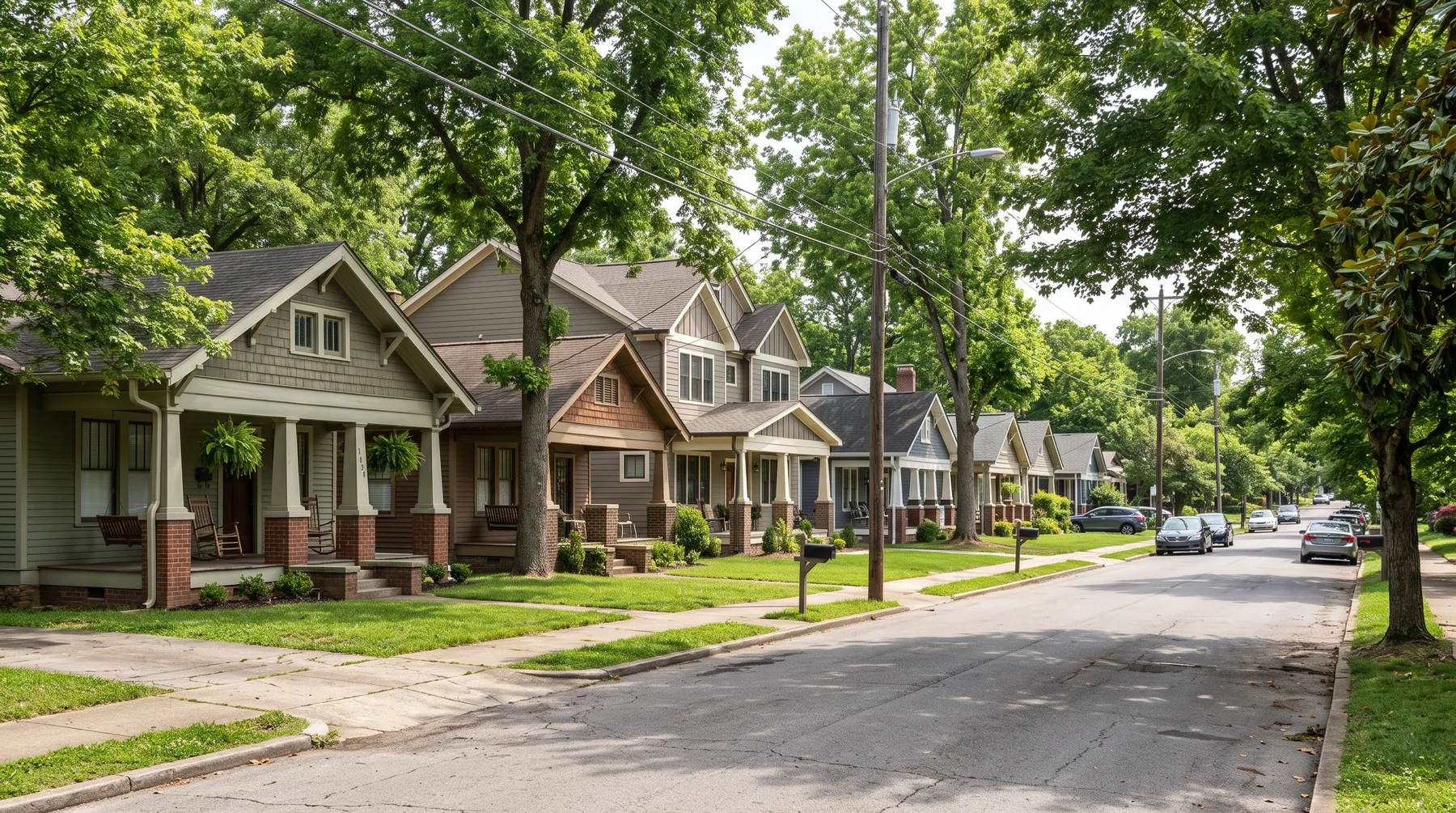
Sylvan Park
Sylvan Park is a West Nashville neighborhood that the Nashville Land Improvement Co.
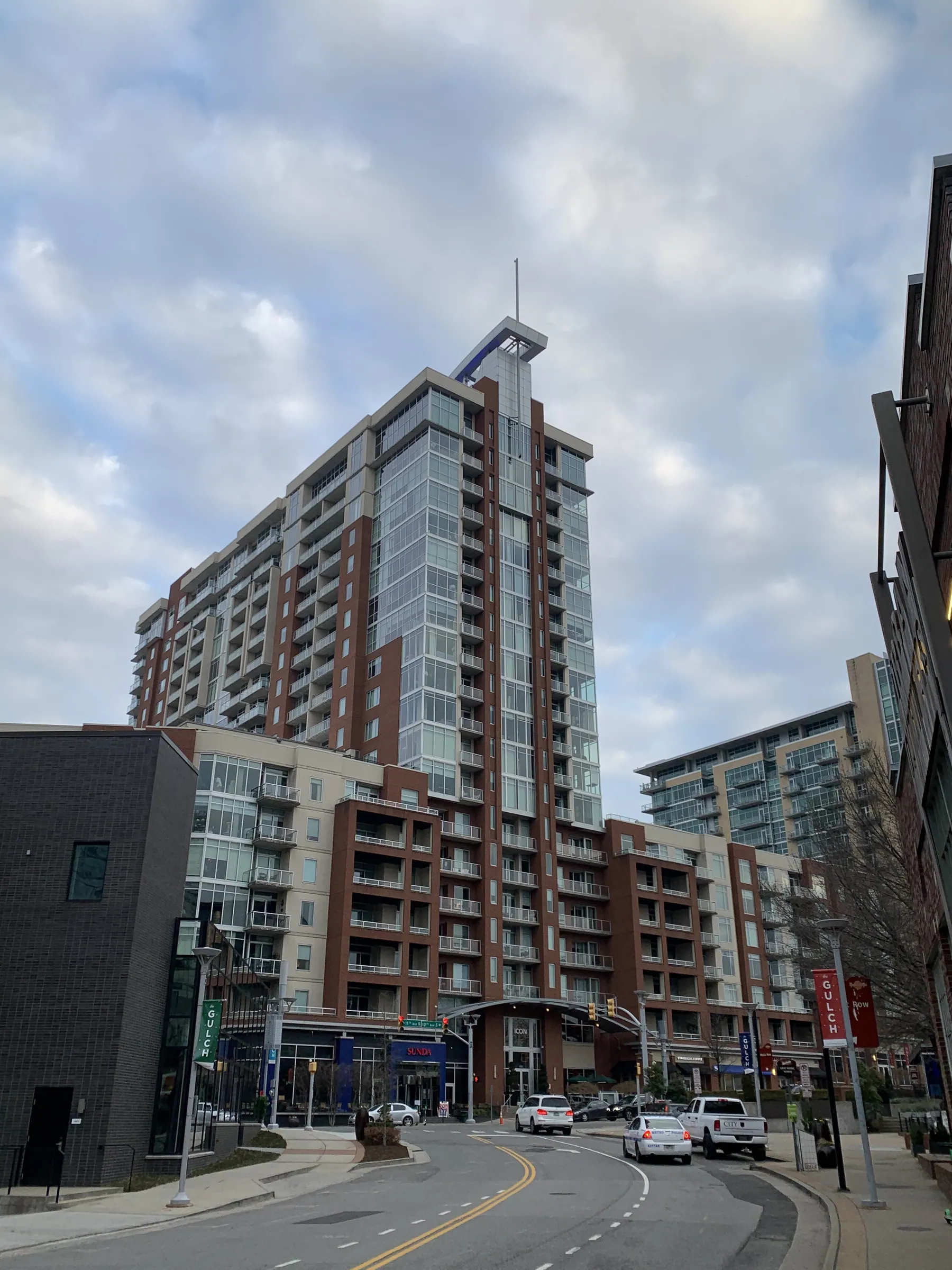
The Gulch
The Gulch is a former rail yard on the south edge of downtown Nashville, now a district of apartment and condo towers, offices and hotels.
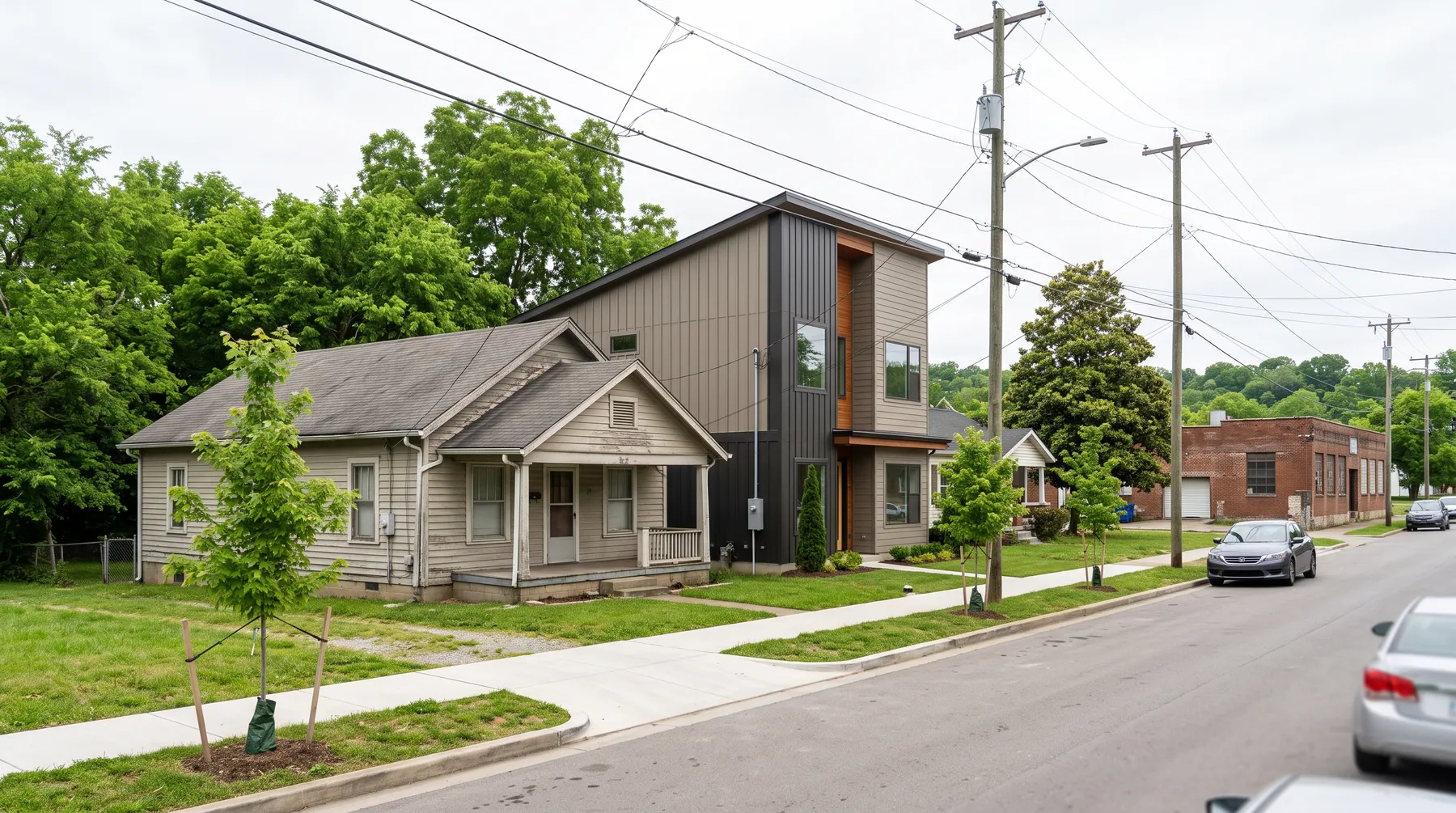
The Nations
The Nations is a former industrial and working-class neighborhood west of downtown Nashville, centered on 51st Avenue North and Centennial Boulevard in ZIP 37209.