










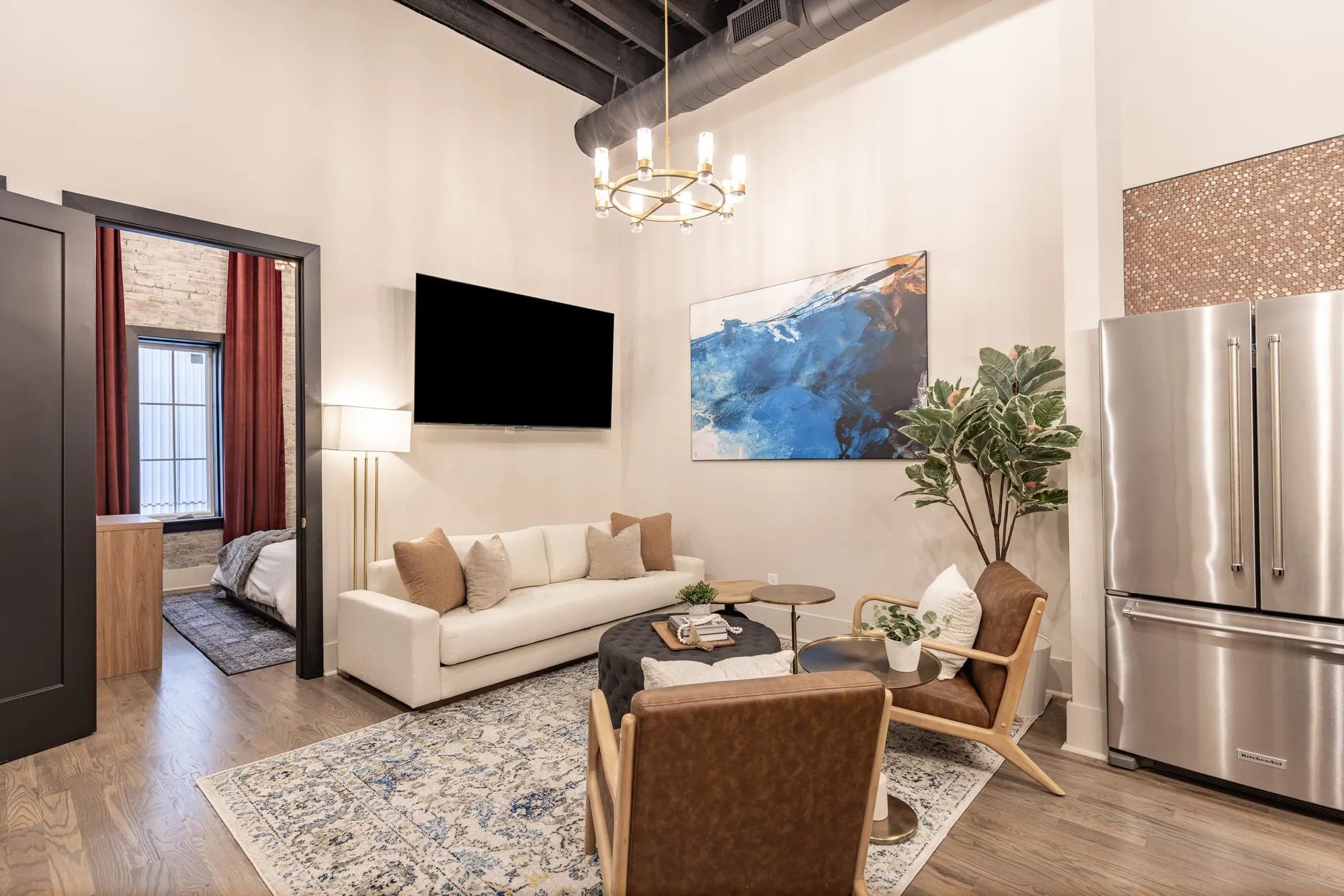
Historic Lofts
A historic loft building in Nashville is usually an old factory, warehouse, bank or store that now holds homes. If you own one, three things decide how you can run it: the zoning district, the street its front door faces, and whether a historic overlay or a tax credit adds a reviewer to your plans. This page walks through each one with Metro's current rules.
- Non-owner-occupied STR permits allowed in
- MUN, MUL, MUG, MUI, OG, OR20-OR40, ORI, CN, CL, CS, CA, CF, DTC North, South, West and Central, SCN, SCC, SCR
- Industrial districts (IWD, IR, IG)
- No non-owner-occupied STR permits
- Frontage test for adaptive residential lots
- No STR permit if most frontage is on a local street or the lot is outside the Urban Services District (Metro Code 17.16.030 F.12)
- Most sleeping rooms per permitted unit
- 4
- Federal rehabilitation credit
- 20% of qualified rehab costs, taken over 5 years
On this page
- What counts as a historic loft here
- Zoning decides whether short stays are possible
- The 2024 frontage test
- Other limits that can rule out permits
- Permit rules that shape the unit plan
- Fire and building review
- Historic review on the outside
- The 20 percent federal credit
- Choosing how the building is run
- Questions
- Sources
What counts as a historic loft here
Nashville's loft buildings come out of its manufacturing, banking and trade years. Marathon Motor Works built the Marathon automobile in Nashville from 1909 to 1914, in a works established from a cotton mill complex. The preserved building went onto the National Register on January 4, 1996. It now holds a museum and workshops, along with the Marathon Music Works venue. The Stahlman, finished in 1907 for Major Edward Bushrod Stahlman, first housed the Fourth National Bank and has since been renovated into loft apartments and retail space.
Those two buildings show the range an owner deals with. A factory floor and a bank office building were both designed for people who went home at night. Turning either into places where people sleep, for a year or for a weekend, raises a zoning question, a fire and building code question and, in some cases, a historic review question. Start with zoning, because it decides whether short stays are possible at all.
Zoning decides whether short stays are possible
For lofts whose owner lives elsewhere, Section 6.28.030 names every district that can receive a new permit, all of them business, mixed-use or downtown zones; our zoning guide, linked below, gives each code. Residential districts are not among them, and DTC East is left off as well. Industrial districts are not on it either. In IWD, IR and IG, the only short-term rental the code allows is an owner-occupied one, as an accessory use to a multi-family use tied to a Manufacturing, Artisan use.
That list sorts loft buildings into two groups. A loft conversion on commercial, office or mixed-use land, or downtown, can apply for permits one loft at a time. A converted building that still carries industrial zoning cannot host non-owner-occupied stays under 30 days, however good the units are. For that group the choices are furnished stays of 30 days or longer, standard leases, or a rezoning, which is a separate Metro process.
The 2024 frontage test
The same subsection takes both permit types, owner-occupied included, away from a loft lot built out under an adaptive residential use, in two cases: most of the lot's frontage is on a local street, or the lot sits outside the Urban Services District. Lofts that held a good-standing permit before August 1, 2024 keep it. Council passed the change as BL2024-187 on July 16, 2024.
That test only reaches loft lots built under the adaptive residential use. Ask Metro Planning whether your conversion was approved under that heading. If yours was, check how the street is classified before you price the lofts on nightly income, since the street outside the front door can settle the matter alone.
Other limits that can rule out permits
Specific Plan and Planned Unit Development sites are a special case. Metro issues permits on those properties only if the Specific Plan or the PUD allows them. Council has amended Specific Plans to add the use: BL2024-211 did so and passed April 16, 2024. An NS suffix on a district, as in CS-NS, rules out both kinds of permit.
For residential zoning, Metro's permit-types page rules out new absent-owner permits on any parcel in the AR2A, R, RS or RM districts. Current holders there may renew, but a sale ends those permits. Each loft's applicant also signs that renting violates no lease and no condominium, HOA or co-op agreement. Metro's FAQ adds that an HOA's rules may be tighter than Metro's.
Permit rules that shape the unit plan
Where permits are possible, each loft takes one, and a loft may have four sleeping rooms at most. No single permit covers a whole multifamily building, so every loft needs its own. A loft's guest limit equals its sleeping rooms doubled, plus four, and never tops 12, so a two-bedroom loft tops out at eight and a four-bedroom loft at twelve. Each booking is one party, so a big loft cannot be split into rooms sold separately.
Every loft also carries these terms: whoever books is 21 or older; a stay is one day long at minimum and 30 nights at most; the permit holder serves no food; a responsible party is based inside 25 miles and answers day or night; and liability coverage is no less than $1 million for each occurrence. Each listing has to show the loft's permit number. Each permit lasts 365 days, and Metro sends renewal emails twice, 60 days and then 45 days before expiry. The fee was $313 in Metro's February 2026 copy of its FAQ.
New permits for absent owners also need a 100-foot gap between the parcel and any park, place of worship, licensed day care, school or school playground. Council can set the gap aside by a resolution carrying 21 votes, after holding a public hearing, and many lofts of one building can share it. Before filing, owners also have to prove they notified each adjoining owner in writing, the units overhead and underneath included, which counts in a stacked loft building.
Fire and building review
Three dwellings or more on one property means a Fire Marshal visit under the not-owner-occupied checklist. A house or duplex instead files a certification from an engineer, architect or home inspector with a Tennessee license. A loft building with three or more units therefore goes through the Fire Marshal.
Whether moving some units of a building approved as apartments to short stays triggers further requirements is a question for an architect or code consultant who has read your certificate of occupancy. Get that review before closing, then get the answer confirmed by Metro Codes and by the Fire Marshal.
- Ask for the existing certificate of occupancy and the last building permit set.
- Count exits and stairs per floor and note whether the building is sprinklered.
- Decide which lofts will rent by the night, by the month and by the year before any design work starts.
Historic review on the outside
National Register listing is an honorary designation. The Tennessee Historical Commission states that it does not impose restrictions on what an owner does with the property and that owners do not need the commission's permission to do work, although a property that loses the features that made it eligible can be removed from the Register. The commission tells owners to check with their local government for historic overlays, because local governments set those, not the commission.
Marathon Village is one of those overlays in Nashville. Metro's zoning overlay data lists it as a Historic Preservation District adopted by ordinance BL2020-256, effective December 18, 2020. The overlay chapter of the code, 17.36, says nothing about short-term rental in historic overlays. If your building sits inside one, the permit rules in this page still apply, and exterior work is reviewed under that overlay's own rules, which you should confirm with Metro before you plan any alteration.
The 20 percent federal credit
A certified historic structure rehabilitated for income-producing use can qualify for the federal rehabilitation credit, worth 20 percent of qualified rehabilitation spending. For amounts paid or incurred after 2017 the credit is claimed ratably over five years. The work must be substantial: qualified spending within a 24-month period, or 60 months for a phased project that meets certain conditions, has to exceed whichever is larger, $5,000 or the building's adjusted basis. Property used for the taxpayer's personal use, such as a condo the owner lives in, is not eligible.
If the property is disposed of within the five-year recapture period, part of the credit is recaptured. The IRS says the recapture percentage is 100 percent if the property stops qualifying within one full year after it is placed in service, and it falls by 20 percentage points each year after that.
In Tennessee, the State Historic Preservation Office and the National Park Service's Technical Preservation Services division review projects. The Tennessee Historical Commission reports that more than 1,000 Tennessee buildings, including hotels, bed and breakfasts and factory and mill complexes, have been rehabilitated with the program, generating over $1.5 billion of investment. The IRS notes that rehabilitating a historic building used for short-term rental, such as a bed and breakfast or hotel, can produce a non-passive credit if the owner materially participates, which it describes as more than 500 hours in the operation. Rental real estate is passive by default. Bring a tax adviser in before you sign the construction contract.
Choosing how the building is run
Loft owners usually pick one of three setups. Under a management agreement the permits, the income and the costs stay yours, and you pay a manager to run pricing, guests, compliance and cleaning. A master lease has the operator pay you fixed rent for the lofts and keeps any upside, which takes vacancy risk off your books. A revenue share splits the difference. Settle one point first: Metro says permits are not transferable or assignable, and its Operation page treats a change of owner, even the owner shifting title to their own trust or LLC, as ending it. Ask Metro Codes how a lease structure will be permitted before you sign one.
Rad Stay runs the four Union Street Lofts above 329 Union Street, and manages rentals of every length. For a loft building that means setting rates, replying to guests, booking cleaners, automating reservations, covering damage, and keeping permits and taxes current, with monthly or yearly leasing for lofts or buildings where short stays are not allowed. Rad Stay also reviews loft buildings an owner is thinking of selling, leasing or partnering on.
Questions
Can I rent lofts by the night in an industrial-zoned building?
Not as short-term rentals by an absent owner. IWD, IR and IG do not appear among the districts in Section 6.28.030 that can receive those permits. Plan for stays of 30 days or more, standard leases, or a rezoning.
Does National Register listing stop me from changing the building?
No. The Tennessee Historical Commission describes listing as honorary and says owners do not need its permission to do work. A local historic overlay is different, so check with Metro before you plan exterior work.
How many guests can one loft unit hold?
Four, plus two per sleeping room, capped at 12, and a permitted loft may have four sleeping rooms at most. That caps a one-bedroom loft at six guests and a two-bedroom at eight, and a single party books at any one time.
If I sell the building, do the permits go with it?
No; a Metro permit cannot be transferred, and after a sale the buyer must apply under the rules then in force. For a converted building that can include the 2024 frontage test.
Can I take the historic credit and still run short-term rentals?
The credit requires an income-producing use, and the IRS discusses short-term rental of historic buildings under the passive activity rules. Whether the credit works for your structure depends on your tax position, and disposing of the property within five years triggers recapture. Get a tax adviser's answer before construction.
Sources
- Metro Code Chapter 6.28, Short term rental property permit, sections 6.28.030 A and B (Municode, version June 23, 2026)
- Metro Code Chapter 17.16, sections 17.16.030 F.12 and 17.16.250 (Municode, version June 23, 2026)
- Metro Code Chapter 17.36, Overlay districts (Municode, version June 23, 2026)
- Metro Nashville Codes, Short Term Rental permit types (Wayback copy, February 17, 2026)
- Metro Nashville Codes, Not owner-occupied checklist (Wayback copy, February 16, 2026)
- Metro Nashville Codes, Short Term Rental operation requirements (Wayback copy, February 12, 2026)
- Metro Nashville Codes, Renew a short term rental permit (Wayback copy, October 12, 2026)
- Metro Nashville open data, Zoning Overlay Districts layer (Marathon Village, BL2020-256), queried October 19, 2026
- IRS, Rehabilitation credit (historic preservation) FAQs
- Tennessee Historical Commission, Federal Historic Tax Credit Program
- Tennessee Historical Commission, National Register FAQs
- Wikipedia, Marathon Motor Works
- Wikipedia, The Stahlman
Checked October 18, 2026.
To keep this page, print it or choose Save as PDF in your browser's print window. The printout keeps the sources and the date.
More property types
All 19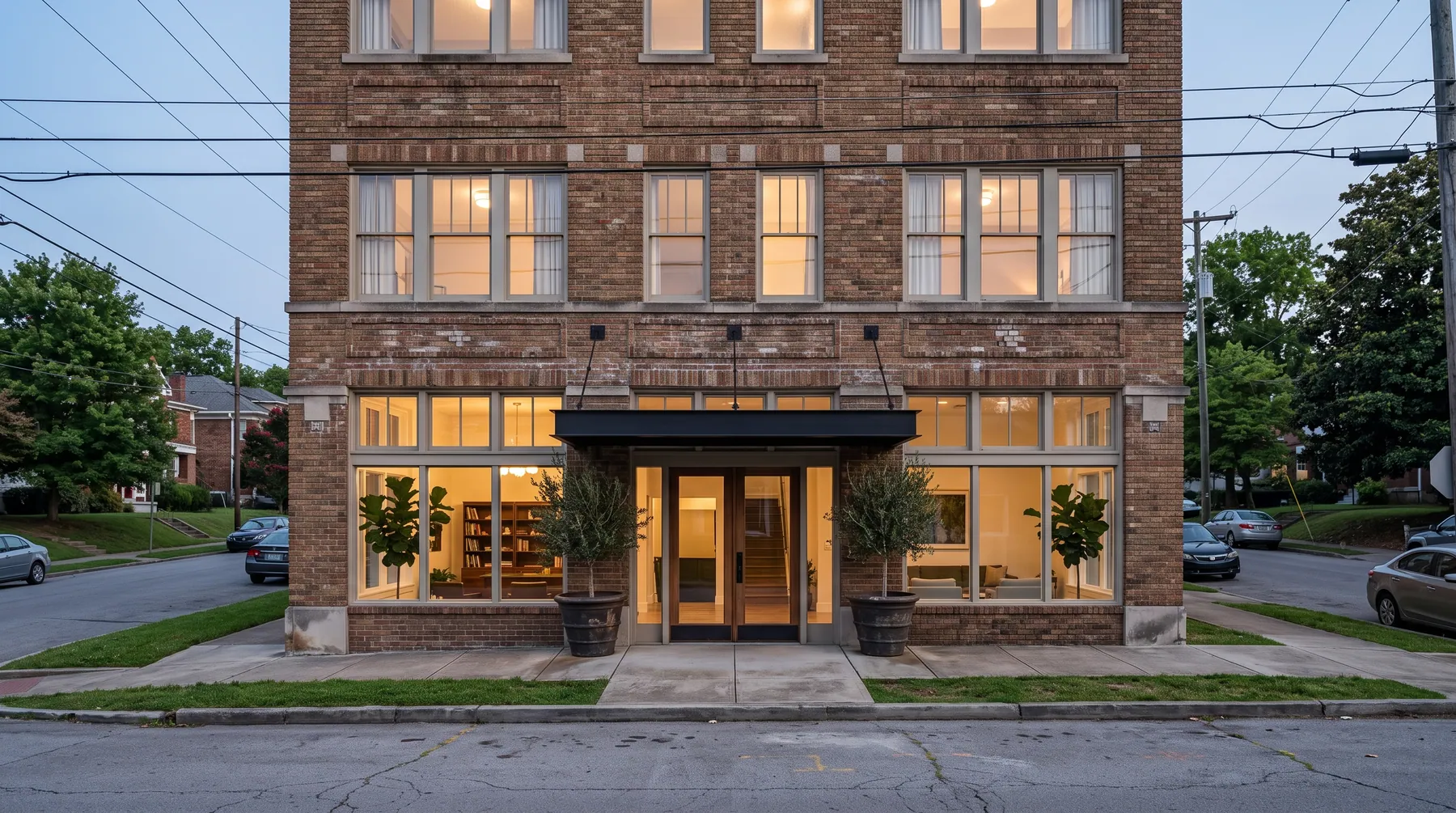
Boutique Hotels
A boutique hotel is a small building rented by the night, usually under a few dozen rooms, run as a hotel rather than as apartments.
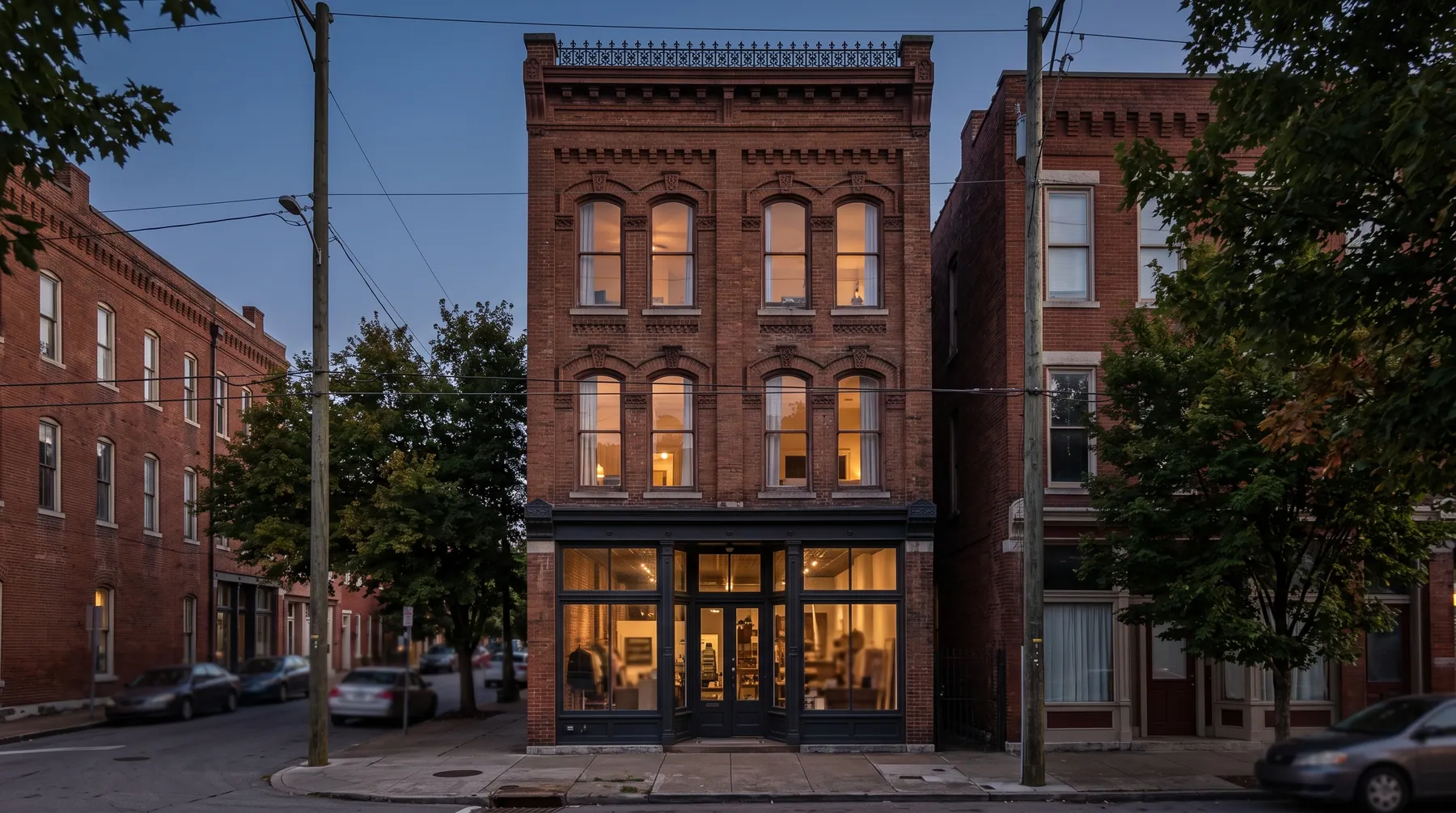
Historic Downtown Buildings
A historic downtown building is an older brick commercial structure of three or four stories or more, built between the 1870s and the 1930s, with shops or offices at street level and open floors above.
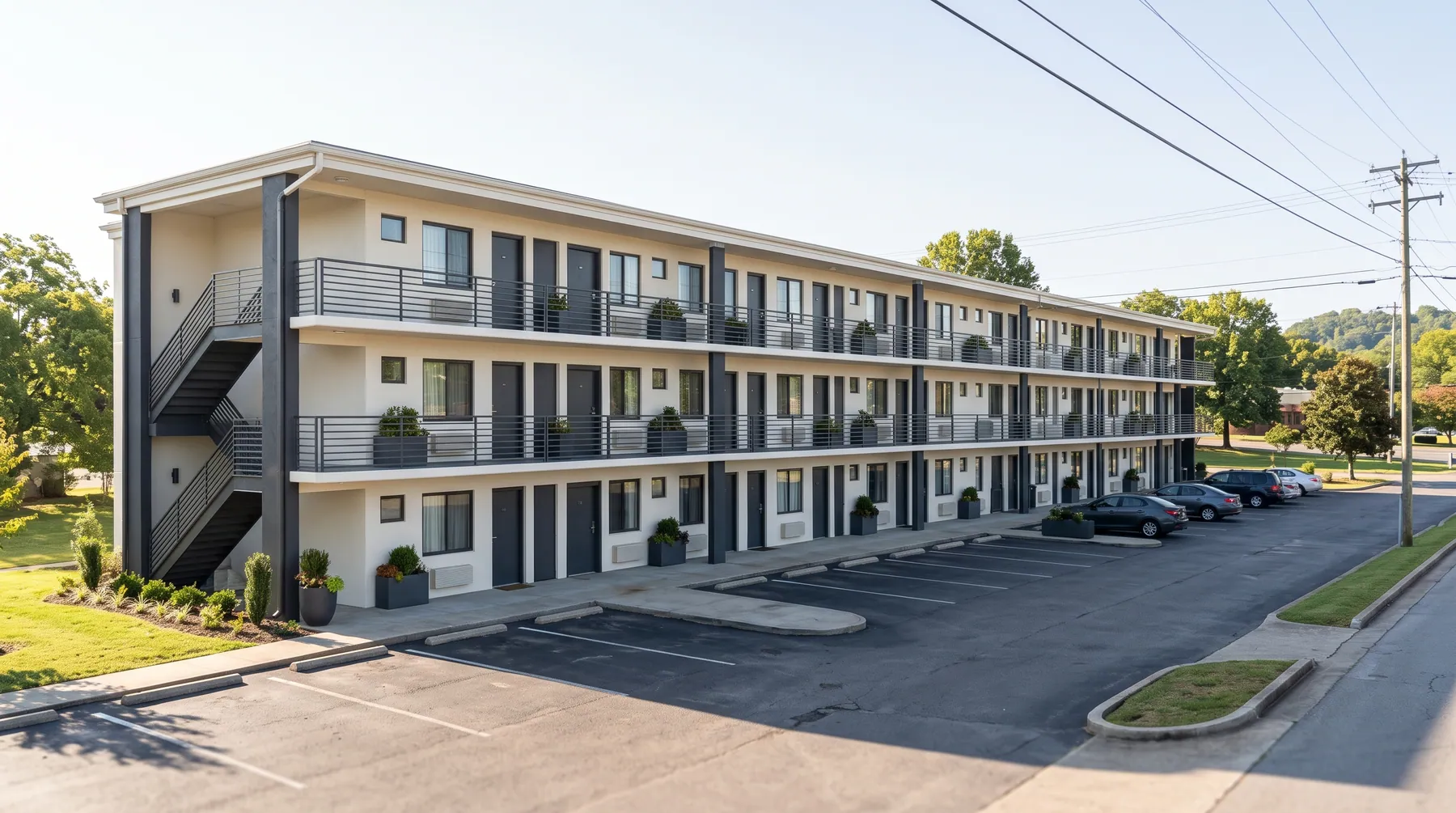
Hotel to Extended-Stay Conversions
A hotel or motel that stops renting by the night and starts renting furnished units by the week or month is a different business under Metro's rules.