










Five Points
Five Points is the commercial crossroads of East Nashville, where Woodland Street, North 11th Street and Clearview Avenue meet. The blocks around it are a mix of commercial lots and older residential streets, so the zoning, overlay and permit answer can differ from lot to lot. This page lays out what Metro's own records say, so the owner of an apartment building, small or large, can check a specific parcel before deciding what to do with it.
- ZIP codes
- 37206 (core); 37207 to the north
- Issued STR permits, ZIP 37206
- 667 (371 owner-occupied, 296 non-owner-occupied)
- Issued STR permits, ZIP 37207
- 808 (246 owner-occupied, 562 non-owner-occupied)
- Zoning to check
- Mixed-use and commercial districts, SP and PUD sites, Lockeland Springs-East End and Edgefield overlays
- Permit data
- Metro Nashville open data, retrieved October 6, 2026
On this page
- Where Five Points is
- How the building stock developed
- Buildings and housing today
- Zoning districts at Five Points and the permit question
- Overlays and preservation review
- Permits issued in ZIP codes 37206 and 37207
- The 100-foot rule near Five Points
- Who visits Five Points and why
- Longer stays and leases at Five Points
- Development from 2013 to 2026
- Getting around
- Which building types fit
- What to check before you buy or convert
- Operating rules for a Five Points building
- Rad Stay on a Five Points building
- Questions
- Sources
Where Five Points is
Five Points lies across the Cumberland from downtown, in the part of Nashville people call East Nashville. Wikipedia describes the intersection as the place where Woodland, Clearview and 11th streets meet. It describes East Nashville as lying across the river from downtown, with the Cumberland bounding most of it on the south, southwest and east. It has no official western or northern boundary. Some residents use Ellington Parkway as the western edge and Cahal Avenue and Porter Road as the northern edge, and a broader "Greater East Nashville" uses I-65 and I-24 on the west and Briley Parkway on the north.
The core ZIP code is 37206. Wikipedia's East Nashville article gives 37206 as the core of what it calls "Smaller East Nashville" and adds 37216 and 37207 for the greater area. For permit counts this page uses 37206 and 37207, because blocks north of the commercial strip fall in 37207 and a building owner shopping for comparable permits will see both. Always confirm a parcel's ZIP and zoning in Metro's Parcel Viewer rather than assuming from a neighborhood name.
How the building stock developed
East Nashville grew in layers. According to Wikipedia, East End began in 1876 as an addition to the Edgefield community, and Lockeland was named in 1880 after the Weakley family and their 1790 homestead. Streetcar suburbs formed in Lockeland and East End as farmland was subdivided. The Lockeland Springs entry on Wikipedia fills in the timeline: the old country estates were cut into lots from the 1870s, a bridge carried Woodland Street over the river from 1886, streetcars ran between downtown and East Nashville by 1890, and the City of Nashville annexed the area in 1905. A second bridge, at Shelby Street, came in 1909.
A fire shaped the western side. On March 22, 1916, a fire that started near the Seagraves Planing Mill destroyed more than 500 houses and left more than 2,500 people homeless, per Wikipedia. Edgefield, once described as Nashville's most exclusive suburb, lost most of its homes. The city cleared part of the burned area to create East Park, which runs between 6th and 8th Streets. Because of the fire and the later subdivisions, the age of the buildings can change sharply from one street to the next.
Five Points itself is a planned commercial district. Nashville Sites, a Nashville Historical Foundation resource, traces the Five Points Redevelopment District to the 1970s, when cheap loans from the city's housing agency, MDHA, brought businesses to the intersection. A tornado crippled the district in 1998. Wikipedia says at least 300 homes were damaged in East Nashville in that storm. Rebuilding and a major revitalization in the early 2000s turned the district into a hub of shops, restaurants, arts and culture. Wikipedia adds that in the 1970s "urban pioneers" moved into East Nashville and rehabilitated its neighborhoods.
Then came the second tornado. About half an hour past midnight on March 3, 2020, an EF-3 tornado reached East Nashville. Wikipedia says it hit Five Points particularly hard and that two pedestrians died from struck debris. Lockeland Springs' entry says it destroyed several commercial buildings in Five Points before damaging homes on nearby streets, and that the Holly Street Fire Hall sustained extensive damage. For an owner, the practical meaning is that some buildings near the intersection may be post-2020 repairs or replacements, and some may be older stock that was patched. Ask for the repair permits and the structural documentation on any building in the damage path.
Buildings and housing today
The sources behind this page do not describe a large inventory of loft towers or hotels in Five Points, and this page does not invent one. The sources do describe a commercial district of restaurants, bars and retail, surrounded by older residential neighborhoods, plus two documented multifamily proposals near the intersection. The Nashville Historical Foundation's entry lists restaurants, bars, American cuisine and retail as the business categories at the intersection. Nashville Post reporting covers the two multifamily projects in the development section below.
Named places that anchor the area, according to the sources reviewed, include Main Street Gallery at 625 Main Street, which Hoodline lists as the venue for the Tomato Art Fest preview party, and ArtHouse Gardens, which Wikipedia says served as a coordination center for cleanup during the May 2010 flood. Lockeland Springs keeps the Lockeland School, built where the area's first house, a log cabin, once stood, and the old fire hall on Holly Street. Wikipedia also notes that Tulip Street Methodist Church and St. Ann's Episcopal Church survived the 1916 fire when members formed bucket brigades, and that Tulip Street United Methodist was damaged by the 1998 tornado.
At apartment-building scale, the documented examples are the 54-unit building at 715 Woodland Street and the 2017 proposal near Forrest and Main. Together they show the scale developers have discussed here, from a few dozen units to a mid-rise mixed-use building. The sources do not document how many small apartment buildings or converted houses stand on the side streets.
No source reviewed lists the number of rental units in Five Points, vacancy, or building ages by parcel. Owners should pull that from Metro's property records and the Assessor of Property, not from a neighborhood summary.
Zoning districts at Five Points and the permit question
At Five Points a commercial district and a house district can sit one block apart, and that block decides the permit. The land use table at 17.08.030 and Section 6.28.030, as read through June 23, 2026, allow new permits for absent owners, with conditions, only in listed districts that are business, office, mixed-use, downtown or shopping-center zones, the MUN, MUL, MUG and CS families among them. The house districts (RS, R, RM, RN, RL), AG and AR2a, ON and OL, DTC East and the industrial zones are left blank. Someone already holding one in RM, RS, R or AR2A zoning can renew, Metro's permit-types page says, but a sale of the property ends the permit.
Three more checks matter on a mixed corridor like this one. Neither permit is possible on a parcel whose district ends in NS, CS-NS for example. A Specific Plan or PUD parcel gets permits only if its plan says so, and Council has rewritten individual plans to add the use, as with BL2024-211 in April 2024 and BL2026-1268 in March 2026. And since December 12, 2025, BL2025-1005 has shut RN and RL to absent-owner rentals, permitting owner-occupied ones only where the building is single-family.
The owner-occupied permit works on most residential lots but only for someone living in the home, and it cannot list a whole building, so it does not fit an investor who wants every unit of a Five Points building on the nightly market. Every district and exception is listed in the zoning guide and the multifamily guide linked below.
Overlays and preservation review
Historic Nashville's easement program lists the local overlays in East Nashville. It dates the Lockeland Springs-East End overlay to 1985 and describes it as preserving one of the city's most intact early 20th-century streetcar suburbs. Edgefield is listed as established in 1978, and the same page says it protects the city's first National Register-listed residential district, listed in 1977. Other East Nashville overlays on the same list include Eastwood (listed 2007, with the description saying 2014), Greenwood (2008), Maxwell Heights (2008), Inglewood Place (2016), Eastdale Place (2017), Haynes Manor (2017), Haynes Heights (2021) and Lathan-Youngs (2023).
Chapter 17.36, which covers overlays, is silent about short-term rentals in historic and urban design overlays. The only short-term rental rule in that chapter is for the detached accessory dwelling unit overlay. An overlay still controls exterior work, so confirm with Metro Planning which review applies to the parcel before you plan renovations.
Nashville Post reported in October 2017 that a proposed building at Forrest and Main sat in the Lockeland Springs Historic Zoning District, so the Metro Historic Zoning Commission had to approve the plan. The article also said the site fell within the Metropolitan Development and Housing Agency's Five Points Redevelopment District, so the agency's Design Review Committee had to approve any building. That is one example of two reviewers on one parcel. A buyer should confirm which of these still apply to the parcel in question, since the article is about nine years old.
Permits issued in ZIP codes 37206 and 37207
These counts come from Metro Nashville's Residential Short Term Rental Permits open data, status Issued, retrieved October 6, 2026. In ZIP 37206 there were 667 issued permits: 371 owner-occupied and 296 non-owner-occupied. In ZIP 37207 there were 808: 246 owner-occupied and 562 non-owner-occupied. Countywide there were 7,022. Calculated from those counts, 37206 holds 9.5 percent of the county's issued permits and 37207 holds 11.5 percent, so the two ZIPs together hold 1,475, or 21 percent.
The split tells you more. In 37206, 44 percent of issued permits are non-owner-occupied. In 37207, 70 percent are. A non-owner-occupied permit covers a property whose owner does not live there, so the 37207 share points to a ZIP where most permits are held for investor-style rentals. What it cannot show is which of them sit in multifamily buildings, because the data file used here counts permit records by ZIP, not by building.
The 100-foot rule near Five Points
East Nashville has churches, schools and parks spread through its blocks, so every Five Points parcel needs the distance check before anything else. Under the distance clause of 6.28.030, in force since BL2023-1884 took effect on August 11, 2023, Metro refuses a new permit for an absent owner when a school, school playground, place of worship, park, licensed day care or day-care playground lies under 100 feet from the parcel line. Existing permits are not affected.
Council can waive the distance for one unit or for several units of one development in a single resolution, after a hearing, mailed notice and a posted sign, and on a 21-vote majority. Most of the resolutions we found on Legistar for 2023 to 2026 were approved. A downtown request covering 62 units failed that June and won a month later when cut to 55, so a reworked application can succeed. The multifamily guide linked below walks through each step.
Who visits Five Points and why
The Nashville Historical Foundation's entry describes a hub of restaurants, bars, retail and arts. The festival is the clearest documented draw. The Tomato Art Fest is organized by Good Neighbor Festivals, and Hoodline reported in June 2026 that the 23rd edition runs Friday, August 7 (evening) and Saturday, August 8 (9 a.m. to 7 p.m.) in Five Points. The Tomato Art Show, with more than 350 tomato-inspired works, is open Friday, Saturday and Sunday. A ticketed preview party is on Thursday, August 6 at Main Street Gallery, and a separate 21-and-over Bloody Mary Garden Party is presented by the Tennessee Titans.
Event logistics matter to a manager. Hoodline says rideshare lanes are set at 10th and Woodland and at Forest and North 11th, and a shuttle leaves from the corner of 10th and Woodland on festival days. Street access is free and the festival is cashless. For neighbors and for building managers, it is a weekend of foot traffic and rideshare, so plan arrival instructions for guests in advance.
Beyond the festival, visitors come for the commercial strip and for East Nashville's parks. Wikipedia lists Shelby Park, where a casino with an amusement park opened in the 1890s, went bankrupt by 1903 and was bought by the city in 1909. It also lists the 810-acre Shelby Bottoms Greenway and Cumberland Park, which cost around $17 million to create.
Longer stays and leases at Five Points
No dated rent figures for Five Points were found in the sources reviewed, so this page gives none. Rents and sale prices should come from a dated source for the specific block, such as a recent appraisal, your lender's market study or a broker report that names its data.
What the sources do support is the range of housing in East Nashville. Wikipedia lists three public housing projects: James A. Cayce, Sam Levy Homes and Parkway Terrace, with Cayce coming down in stages for the Envision Cayce redevelopment. It also reports that urban pioneers rehabilitated neighborhoods from the 1970s, so the area has housing from several periods and at several price points. That is a reason to test long-term demand in buildings where short-term rental is not allowed.
The permit rules are what push an owner toward mid-term or long-term use. Section 6.28.030 limits any guest on a short-term permit to 30 consecutive nights. A rental of 31 days or more is outside the STR program, so owners of buildings on residential streets, where a non-owner-occupied permit cannot be issued, look at mid-term and long-term use. Ask Metro Codes how your plan will be classified, and check the lease terms and any condominium or association documents.
Development from 2013 to 2026
Documented development near Five Points is thinner than in downtown or the Gulch, and much of what a search turns up is old. Nashville Post reported in July 2013 (last updated April 2021) on a four-story, 54-unit rental building at 715 Woodland Street, across from East Park. The developer was Arrington Developers LLC, a Mississippi-based firm, with 32 two-bedroom and 22 three-bedroom units and a 67-space garage. East Nashville Properties LP was to own the building and Ledic Management Group LLC, based in Memphis, was to manage it. The article called it the first large-scale rental residential structure within five blocks of Five Points since the area's emergence after 2000. I did not confirm completion for this page, so verify the building's current status and permit history before you cite it as a comparable.
In October 2017, Nashville Post reported that Sunny Meadows LP, formed by developer James Matthews, had bought a site at Forrest and Main for $2.675 million in May, per Metro records. With architect rootARCH, led by John Root, he was considering either a five-story mixed-use building, with two stories of retail on Main Street and three of residences above, or a three-story building with one retail level and two residential floors. Either option would include some structured parking. The existing auto sales building was to be demolished. Unit counts were not stated, and I could not confirm that the project was built.
The sources reviewed give no 2023 to 2026 development list for Five Points: no search turned up 2025 or 2026 coverage of a new apartment or mixed-use project at the intersection. If you know of a project, check Metro's building permit records and the Metro Planning Commission agendas for the parcel, because a stalled or changed plan can alter both supply and the streetscape around your building.
Getting around
Five Points is across the Cumberland River from downtown, and Wikipedia describes East Nashville as lying across the river from downtown. This page found no sourced drive time or transit route for the intersection, so check the drive at the hours your guests will actually travel and check WeGo's latest route map before you describe a bus stop to a guest.
On festival days the neighborhood runs a shuttle from 10th and Woodland and sets rideshare lanes there and at Forest and North 11th, which Hoodline described. A manager should warn guests booked for Tomato Art Fest weekend. In a building with a garage, such as the 67-space garage planned at 715 Woodland, parking is an amenity you can state in the listing. In a building without it, tell guests where they can leave a car, and do not promise street parking. Off-street parking requirements for a new or converted building depend on the parcel's zoning, so ask Metro Planning.
Which building types fit
The documented stock points to a few types. Mixed-use buildings with ground-floor commercial space and apartments above fit the commercial frontage, and they are the type most likely to sit in a district where new non-owner-occupied permits are allowed. The 2017 Forrest and Main proposal was this type. Small apartment buildings with four to twelve units can take new non-owner-occupied permits only in districts that allow them, so many on residential streets are candidates for mid-term or long-term use unless they already hold permits. Larger rental buildings in the 50-unit range exist, as the 715 Woodland example shows, and they can be managed as long-term rentals with furnished mid-term units added where the lease and the code allow.
A fourplex or sixplex with existing permits is a different asset from the same building without them, because the permits cannot be transferred. Under the code a permit dies when the owner changes, even when the move is between a person and that person's trust or LLC, and the new owner applies fresh. Metro's own summary cites Tennessee Code 13-7-603 as vesting a holder in whatever regulations applied on the grant date; we did not check the statute text for this page. Ask a Tennessee attorney how that applies before you rely on it.
What to check before you buy or convert
Start with the parcel, not the neighborhood. These are the checks, in the order that saves the most money if the answer turns out to be no:
- The parcel's zoning code on the Metro Zoning Map, held against the list of districts open to new permits for absent owners. Check for an NS suffix and for SP or PUD terms.
- The distance to the nearest school, day care, church or park, which must be 100 feet or more, measured parcel line to parcel line, and whether a Council waiver would be needed.
- Existing permits on each unit, their numbers, expiration dates and complaint history. Each permit's 365-day term, keeping in mind that a 30-day late-renewal grace is up to Metro and is denied where complaints are documented, so renew before the date.
- Overlay status: Lockeland Springs-East End (1985), Edgefield (1978), or another East Nashville overlay, and the Five Points Redevelopment District review if the parcel is in it.
- Condominium, association and lease documents. The signed statement every applicant files that the permit violates no lease and no association, condominium or co-op agreement or bylaws, remembering that Metro's FAQ lets associations be stricter than the city.
- The Fire Marshal inspection that applies to multifamily structures, meaning any property of three dwellings or more.
- Flood status. The sources reviewed do not give a flood zone for Five Points, and East Nashville sits next to the river, so pull the parcel's FEMA flood zone and its stormwater history from Metro.
- Tornado repair records for buildings in the 2020 damage path, including permits, engineering sign-offs and insurance claims.
- Neighbor exposure: before filing, Metro wants written notice sent to each adjoining owner, counting units above and below in a stacked building, and three violations can lead to revocation.
Operating rules for a Five Points building
A permitted unit here follows the countywide Metro rules: a guest count capped by sleeping rooms and never above 12, a lead renter of at least 21, one booking party at a time, stays of one day to 30 nights, a responsible party within 25 miles answering at any hour, $1 million in liability coverage, the permit number on every listing and a yearly renewal. Tomato Art Fest and other busy weekends do not change any of it. Our guide to permits in multifamily buildings, linked below, gives each rule with its section of the code.
Rad Stay on a Five Points building
Rad Stay manages property in Nashville. Its one verified property is downtown: four lofts at 329 Union Street, Union Street Lofts, each holding a Metro permit for an absent owner since April 2023. It runs nightly, monthly and yearly rentals and looks at buildings to buy, to lease, or to partner on. It has not published results for East Nashville, and this page makes no claim about performance here.
What a manager does for a building in a place like Five Points is a list of services. Permit and tax compliance support covers the permit applications, renewals, adjacent-owner notices and occupancy tax filings. Revenue management and dynamic pricing set rates around the calendar, and in Five Points the calendar includes the August festival weekend. Guest communication covers check-in instructions, parking and noise expectations. Cleaning coordination and booking automation keep turnover on schedule. Damage protection covers guest damage claims.
Questions
Can a Five Points building get new short-term rental permits for an owner living off site?
Only on a parcel whose zoning district Section 6.28.030 names, such as the MUN, MUL, MUG, MUI, CN, CL, CS, CA or CF districts or an office or downtown district, and only if no day care, park, school or place of worship lies inside 100 feet, short of a Council waiver of the distance. Look up the district on Metro's Zoning Map, then check with Metro Codes.
What are the issued-permit counts for the Five Points ZIP codes?
On Metro's October 6, 2026 pull, 37206 had 667 issued (371 owner-occupied, 296 non-owner-occupied) and 808 in ZIP 37207 (246 owner-occupied, 562 non-owner-occupied), out of 7,022 countywide. These are ZIP-wide counts, not Five Points alone.
What happens during Tomato Art Fest weekend?
Hoodline reported that the 23rd Tomato Art Fest runs August 7 and 8, 2026 in Five Points, with a shuttle from 10th and Woodland and rideshare lanes at 10th and Woodland and at Forest and North 11th. A manager should send guests arrival and parking guidance before the weekend.
What if my parcel cannot hold a short-term rental?
A permit covers stays up to 30 consecutive nights, so bookings of 31 nights or longer sit outside the program and are the usual fallback, along with yearly leases. Check your lease terms, any association rules and how Metro will classify the plan before you advertise the units.
Sources
- Nashville Sites (Nashville Historical Foundation), Five Points
- Wikipedia, East Nashville, Tennessee
- Wikipedia, Lockeland Springs
- Historic Nashville easements program, local overlays
- Metro Code chapter 6.28, Municode (version June 23, 2026)
- Metro Code 17.08.030, land use table, Municode (version June 23, 2026)
- Metro Code chapter 17.36, overlay districts, Municode (version June 23, 2026)
- Metro Nashville Residential Short Term Rental Permits (open data), status Issued, retrieved October 6, 2026
- Metro Codes, STR permit types (Wayback copy, February 17, 2026)
- Metro Codes, STR operation requirements (Wayback copy, February 12, 2026)
- Metro Codes, not-owner-occupied checklist (Wayback copy, February 16, 2026)
- Metro Codes, STR frequently asked questions (Wayback copy, February 11, 2026)
- Hoodline, Tomato Art Fest in Five Points (June 2026)
- Nashville Post, work set to begin on East Nashville apartment building (715 Woodland St.)
- Nashville Post, developers eye mixed-use building for Five Points (October 2017)
Checked October 18, 2026.
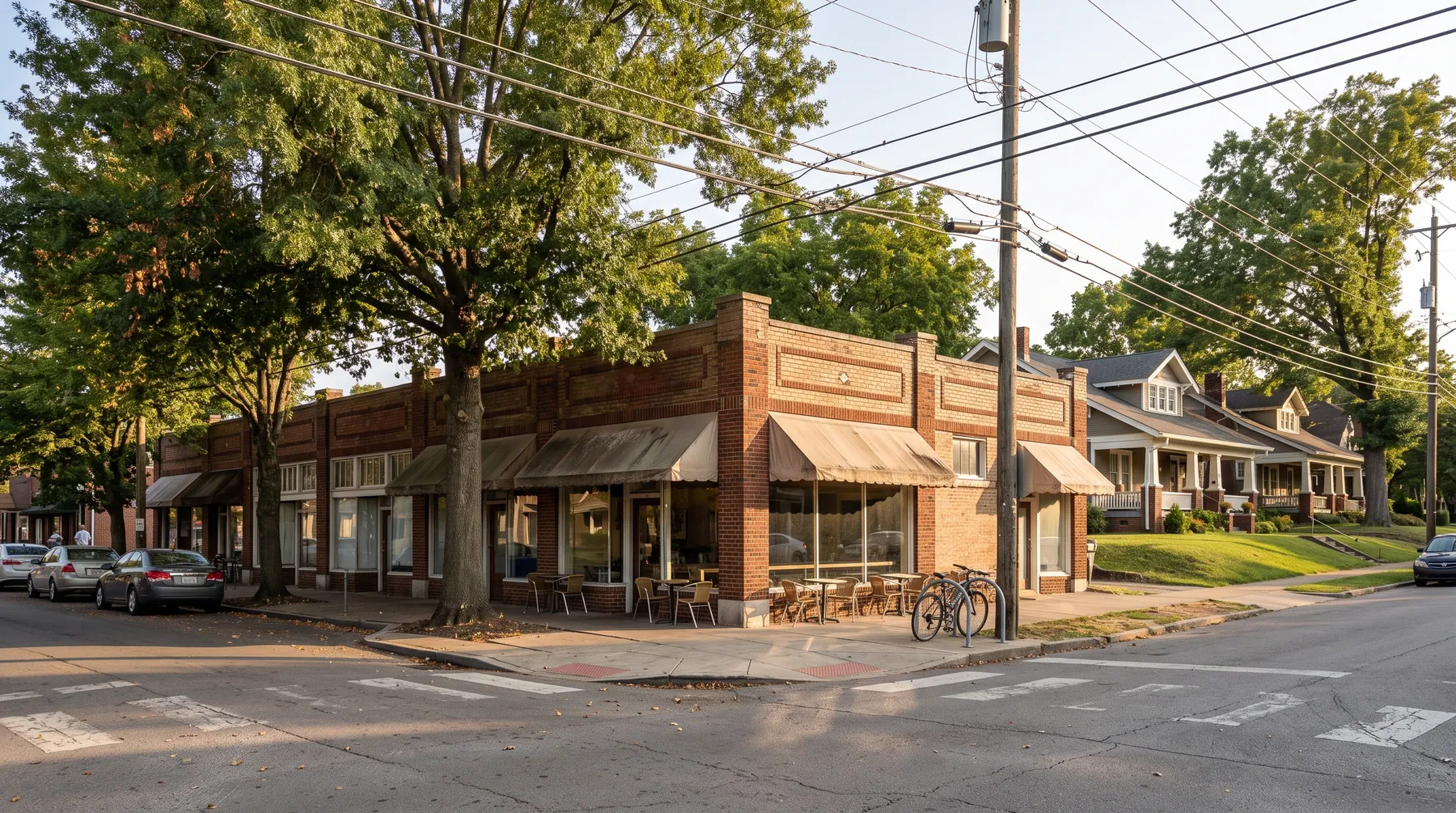
Top image: Illustration of a representative street, not a photo of Five Points.
To keep this page, print it or choose Save as PDF in your browser's print window. The printout keeps the sources and the date.
More markets
All 28
Germantown
Germantown is the 19th-century neighborhood just north of the Tennessee State Capitol, with a minor league ballpark, a state park and the state museum in or beside it.
Hillsboro Village
Hillsboro Village is the small commercial district on 21st Avenue South between the Vanderbilt and Belmont campuses, and Belmont-Hillsboro is the residential neighborhood that wraps around it.
Inglewood
Inglewood is the northern part of greater East Nashville, running along Gallatin Pike in ZIP 37216.