










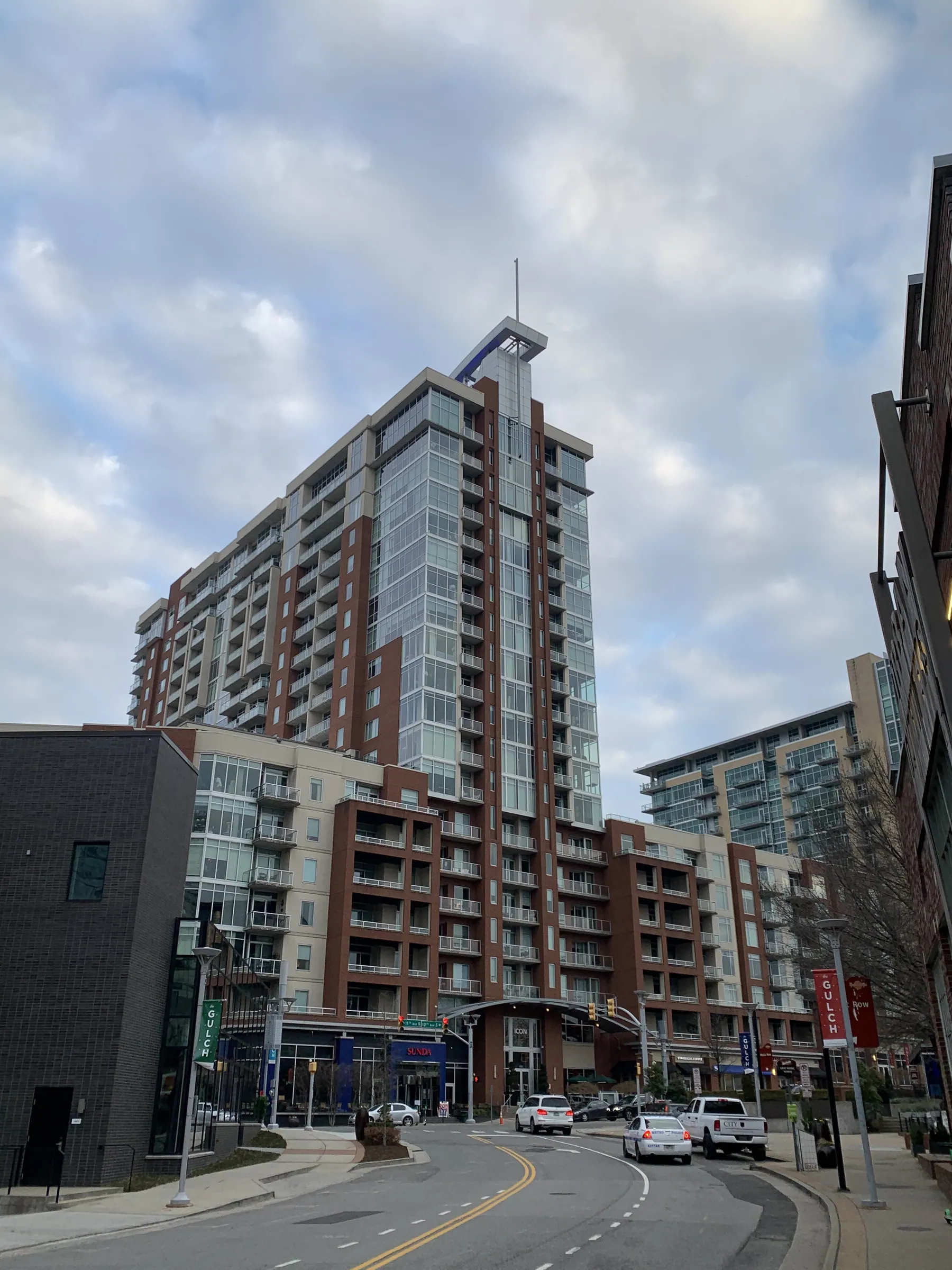
The Gulch
The Gulch is a former rail yard on the south edge of downtown Nashville, now a district of apartment and condo towers, offices and hotels. For a Gulch building owner the questions are specific: the parcel's zoning, whether anything that triggers the distance rule sits within 100 feet, and whether the condo documents or leases allow short stays.
- ZIP code
- 37203
- Neighbors
- Downtown and SoBro to the northeast, Pietown to the east, Music Row to the west, Nashville Yards to the north
- Managed by
- Gulch Business Improvement District (created 2006), run by the Nashville Downtown Partnership
- Issued STR permits, ZIP 37203
- 1,706: 89 owner-occupied, 1,617 non-owner-occupied (Metro data, retrieved Oct. 6, 2026)
- Residential buildings on the district site
- 15
- Zoning to check
- Downtown Code (DTC) districts, mixed-use districts, and SP or PUD parcels
On this page
- Where the Gulch is
- How the Gulch was built
- Buildings and housing today
- Older buildings that remain
- Union Station and the Frist Art Museum
- Gulch housing counted by building size
- Projects from 2022 to 2026
- Gulch zoning and short-term permits
- The 100-foot rule
- Gulch-area permits in ZIP 37203
- Who visits and why
- Longer stays in the Gulch
- Getting around
- Building types that fit
- Checks before a Gulch purchase
- Operating rules for a Gulch building
- Rad Stay on a Gulch building
- Questions
- Sources
Where the Gulch is
The Gulch sits on the south fringe of downtown Nashville, near Interstates 40, 65 and 24. Wikipedia places it between downtown and SoBro to the northeast, Pietown to the east, Music Row to the west and the Nashville Yards development to the north. Its center point is about 36.153 north, 86.782 west.
The district's own site gives no boundary line, and Wikipedia describes the edges only by the neighborhoods around it. For an owner that means the address matters more than the name. A building marketed as being in the Gulch can sit on a parcel with different zoning from the one across the street, so look up the parcel rather than relying on the neighborhood label.
The district is managed by the Nashville Downtown Partnership, which runs a Clean and Safe team that takes service requests through the district website. The Gulch Business Improvement District was created in 2006. Mayor Karl Dean and the developer MarketStreet Enterprises announced on February 17, 2009 that the neighborhood was certified as a LEED Green Neighborhood, which Wikipedia describes as the first in the American South.
How the Gulch was built
The name comes from the land: the Gulch is a low-lying depression on the western edge of downtown. The first locomotive reached Nashville in the 1850s. The Louisville and Nashville became one of the South's leading railroads, and in the Civil War, the Nashville Sites project says, it was the one major route the Union Army could use to supply its troops.
Union Station opened in 1900, and the last passenger train left it in 1978. Nashville Sites describes a slow decline in the Gulch that lasted nearly four decades and ties it largely to the interstate system, which began in 1956. Redevelopment began in the 1980s, when Union Station was converted into a hotel, and in the 1990s Cummins Station was renovated as a mixed-use building. In 1999 MarketStreet Enterprises bought 25 acres south of Broadway through Nashville Urban Venture, LLC.
Some of the rail history is gone. Nashville Sites records that the Union Station train shed, which measured 250 by 500 feet and could hold ten full-length trains, was damaged by fire in 1996 and demolished in 2001. Listed on the National Register in 1969, Union Station was named a National Historic Landmark in 1976, a status removed in 2003. The Kayne Switchyard, which fed trains into Union Station, remains part of an active railroad corridor, and Kayne Street is now Eleventh Avenue.
By the early 2000s the area was mostly parking lots with few attractions, per Wikipedia. The towers came after that. Nashville Sites also includes Cannery Row, a complex built in 1883, the Javanco and Farber Building, the Frist Art Museum, the Station Inn and the Filming Station on its Gulch tour.
Buildings and housing today
The district's own site lists 15 residential properties with their street addresses: Albion in the Gulch at 645 Division Street, Aspire Gulch at 805 Division, Camden Gulch at 908 Division, Crossroads at The Gulch at 803 Division, ICON at 600 12th Avenue South, The James at 1002 Division, Laurel House Lofts at 1101 Laurel Street, Mercury View Lofts at 1209 Pine Street, Modera Gulch at 810 Division, Pine Street Flats at 1055 Pine Street, Prima at Paseo South Gulch at 620 8th Avenue South, Pullman at Gulch Union at 1212 Demonbreun Street, Society Nashville at 915 Division, Terrazzo at 700 12th Avenue South and Twelve Twelve at 1212 Laurel Street.
That list is a district directory. It does not say which buildings are condominiums and which are rental apartments, and it does not give unit counts or heights. The split matters for a short-term operator. In a condo, Metro notes, the association can go further than the city does. In a rental building, the lease forms and the building owner's own policy set the terms.
None of the 15 listings is described as a small building. If you own or want a four-to-ten-unit building near the Gulch, check the neighboring districts covered on the related pages.
Older buildings that remain
Several pre-war industrial buildings survived and were reused, and they set the street-level character of the district. Nashville Sites, a project of the Nashville Historical Foundation, documents most of them.
Cummins Station at 209 Tenth Avenue South was built in 1907 for W.J. Cummins by the Oliver Contracting Company, about 500,000 square feet on five floors. Nashville Sites calls it the largest reinforced concrete terminal building in the world when it was finished. It held offices and warehouses for more than fifty years, listed H.G. Hill Grocery and Cheek-Neal Coffee among its tenants, and joined the National Register in 1983. It was renovated in the 1990s for office and retail use, and the record lists DZL Management Company as owner as of 2019 and says the building earned LEED ND Stage 2 Gold certification.
The Javanco and Farber Building at 401 to 601 Twelfth Avenue South is two joined buildings from the 1930s. Marshall and Bruce Printing set up its plant there in 1938. The electronics seller Javanco moved in in 1960 and left in 1999. MarketStreet Enterprises renovated the complex in 2000, and the record says the complex also includes 32 residential lofts.
Cannery Row, at 1 Cannery Row, dates to 1883, when the Nashville Mill Company built the current buildings on the site of earlier plow works. The record describes it as a music venue with three rooms of about 1,000, 500 and 225 capacity. Union Station at 1001 Broadway opened in 1900 to designs by Richard Montfort in Romanesque Revival style. It became a hotel in 1987, was sold to Pebblebrook Hotel Trust in 2014 for $52 million, and was a boutique hotel as of 2019.
These records predate 2026. Confirm current tenants and uses before you mention any of them to a guest or an owner.
Union Station and the Frist Art Museum
Two landmarks on Broadway appear on the Nashville Sites Gulch tour. Union Station opened on October 9, 1900, for the Louisville and Nashville Railroad. Wikipedia names Henry Hobson Richardson and the railroad engineer Richard Montfort as its designers. Streetcars used it until 1941, and during World War II it was a departure point for tens of thousands of troops. By the end of the 1960s only six trains a day stopped there, down from 16 in the late 1940s. Amtrak's Floridian made its last run on October 9, 1979, according to the article, which also gives 1978 elsewhere, so the exact year of the last train is inconsistent in that source.
The station stayed vacant until 1986, and the hotel that followed had 125 rooms and 12 suites. That first owner went bankrupt and a new group took over. The hotel had an $11 million renovation in 2007, joined Marriott's Autograph Collection in 2012, and was sold in 2014 to Pebblebrook Hotel Trust for $52.3 million. Renovations costing $15.5 million finished in 2016, and the hotel joined Historic Hotels of America in 2015. Wikipedia says Southwest Value Partners now owns and manages it, which conflicts with the older Nashville Sites record that lists Pebblebrook, so confirm ownership before citing it.
The old main post office, white marble Art Deco by Marr and Holman from the early 1930s and National Register-listed since November 1984, now houses the Frist Art Museum. The city bought it from the Postal Service in 1999 for $4.4 million and leased it to the museum for 99 years at $1 a year. The museum opened in April 2001. Wikipedia gives its attendance as about 200,000 visitors, without a year, and notes that a post office branch still operates in the building.
For an owner, the useful point is that a museum, a historic hotel and music rooms such as the Station Inn and Cannery Row all appear on the Nashville Sites Gulch tour. Check distances from your own front door before you state a walking time for any of them.
Gulch housing counted by building size
The U.S. Census Bureau's American Community Survey, 2020-2024 five-year estimates, counts 18,304 housing units in ZIP code tabulation area 37203 (table B25024). A ZCTA approximates a ZIP code and is not the Gulch boundary, so the figures describe the wider area around the Gulch. They are estimates with margins of error.
The area is dominated by large buildings. Of the 18,304 units, 12,744 (about 70 percent) are in structures with 50 or more units, and another 1,179 are in buildings of 20 to 49 units. Buildings with 10 to 19 units hold 757 homes, those with 5 to 9 hold 571, and those with 3 or 4 hold 454, and two-unit buildings hold 178. Detached houses account for 1,261 units and attached houses such as townhomes for 1,065. In total, buildings of 3 to 49 units hold 2,961 units, about 16 percent, which is the size band a 4-to-200-unit manager mostly works in.
Renting is the norm. Table B25003 estimates 14,683 occupied units, of which 11,852 (about 81 percent) are renter-occupied. Median gross rent in the same survey is $2,004, and 2013 is the median year built (tables B25064 and B25035). Median gross rent covers renter-occupied units paying cash rent and includes utilities, so it is not a short-term rate. Occupied units number 3,621 fewer than total units; the survey does not say how many of those are new buildings still leasing up, second homes or short-term rentals.
Projects from 2022 to 2026
Gulch Union, from Endeavor Real Estate Group with equity partner Long Wharf Capital, is a three-building plan bordered by 12th Avenue, 13th Avenue, McGavock Street and Demonbreun Street. The plan pairs an existing 20-story office building with two planned 28-story residential towers. When Endeavor announced the first tower in February 2022, it was to hold 306 apartments and 8,000 square feet of retail, with first units targeted for April 2024. The district's directory lists Pullman at Gulch Union at 1212 Demonbreun Street, an address inside the plan's boundaries. I did not confirm the second tower's status.
The largest 2026 headlines are hotels. Hoodline reported on June 24, 2026 that Tidal Real Estate Partners plans a 16-story building on Grundy Street, at number 1221, with 144 hotel rooms, 168 timeshare units, over 14,000 square feet of shops at street level, a rooftop pool and a gym. Sage Hospitality is the hotel operator. The project used the Downtown Code's Bonus Height Program, and Metro's Planning Commission approved the bonus height on June 12, 2025, tied to LEED Silver certification, below-grade parking and pervious surface. Construction is underway, Tidal is aiming to finish in 2027, and full building permits still depended on meeting the remaining bonus-height requirements.
The same report mentions a separate 28-story Tidal project, Nashville EDITION, whose groundbreaking Tidal recently marked, and says Tidal has several other hospitality projects in the Gulch. A City Now Next report from September 24, 2025 put the downtown hotel pipeline at roughly 6,000 keys, as quoted by Hoodline.
For an owner, new hotel and timeshare rooms add supply of short stays at the very edge of your market. They also add daytime visitors, restaurants and event traffic. Neither effect is guaranteed, and nothing here is a forecast. Track what opens within a few blocks of your building and price against it.
Gulch zoning and short-term permits
It comes down to zoning. A building operator needs the absent-owner permit, which Gulch parcels can get only when their district is named in Section 6.28.030, which DTC East, residential zoning and NS districts are not; for the full list, see our zoning guide below.
I could not open the Downtown Code's sub-district map, so I am not naming a zoning district for any Gulch block, and I cannot say how many parcels fall on the allowed list. Check each parcel in the parcel viewer and compare its zoning with that list.
Parcels zoned SP (Specific Plan) or inside a PUD (Planned Unit Development) follow a different test. Many Gulch parcels sit under an SP or PUD, so check whether the plan allows the use. Council has amended plans to permit it, BL2024-211 for one, so a silent SP is not always closed for good. Metro Council bills BL2026-1268 and BL2024-542 are further examples of plan-by-plan changes.
Each Gulch unit would need a separate permit, four bedrooms at most, and nothing caps the count of permitted units in one building. Confirm everything with Metro Codes before you rely on it. Treat it as general information and not as legal advice.
The 100-foot rule
The distance rule also applies: a licensed day care, a school, a church or a park inside 100 feet stops any new absent-owner permit, short of a Council waiver, as it usually has; our multifamily guide explains the steps. The Gulch has public open space of its own: the district lists Noble Park, Grace's Alley and a dog park. A building next to one of them needs a measurement before you underwrite short stays.
That timeline shows the process is workable and also that it takes months and can fail.
Gulch-area permits in ZIP 37203
1,706 permits had been issued in 37203 by Metro's open-data count of October 6, 2026, with 1,617 for absent owners. That is about 95 percent not-owner-occupied, the opposite of the mix in ZIP 37206, where 371 of 667 permits are owner-occupied. That is about a quarter of the county's 7,022.
Read the count with care. ZIP 37203 extends beyond the Gulch, so 1,706 is not a Gulch number. Metro's data does not break permits down by building, and the count says nothing about how many of those units are booked. It does show heavy use of the permit system here, where an absent-owner permit is routine.
The same data shows 346 in 37201, all but 8 for absent owners, 461 in 37212 and 78 in 37219. A buyer can use these to see how crowded neighboring ZIP codes are. Since permits last a year and renew only when the owner applies, the count shifts.
Who visits and why
Music is the draw closest to the Gulch itself. The Station Inn at 402 12th Avenue South is a bluegrass club that opened in 1974, moved to its current address in 1978 and marked its 40th anniversary in 2014, according to Nashville Sites. The historic Union Station Hotel stands nearby. Wikipedia also lists the Mercy Lounge nearby. The Gulch sits next to Music Row and Nashville Yards, whose tenants include entertainment companies.
Nashville Yards is the work engine to the north. Southwest Value Partners announced in May 2025 that Amazon was starting interior work in its second Nashville Yards tower and had leased a full floor in the CAA Creative Office Building, where other tenants include CAA, AEG Presents, Messina Touring, AXS and L-Acoustics. Amazon was expected to occupy the second tower in 2026. The article gives no employee count, so none is stated here.
That mix produces three kinds of guest: leisure visitors who want a walkable urban base, music-industry travelers with meetings at Nashville Yards or Music Row, and corporate visitors on longer assignments. The third group is the one that fits mid-term stays, which the next section covers.
Longer stays in the Gulch
Mid-term stays run from 30 days up to several months. Metro's cap matters here: the code sets a maximum stay of thirty consecutive days for any guest in a permitted short-term rental. A longer stay falls outside the short-term rental permit, so a building that wants both products needs to plan them separately, unit by unit.
Demand for longer stays follows employers. Amazon at Nashville Yards and the entertainment companies in the CAA building are the nearby employers named in sources I opened. I did not find a dated, reliable rent figure for Gulch apartments. The listing sites that publish rents for individual Gulch buildings give no date I could verify, so this page does not quote any. Pull current rents from a listing for your building type the week you underwrite.
Long-term renting also has an advantage in a building with strict association rules or a distance-rule problem, since it needs no permit. A manager can run a lease-up and revisit the question when the permit status changes.
Getting around
The district's site links a parking guide and a Clean and Safe service request page. I could not open the parking guide's details, so check it for garage rules and event-night limits.
WeGo routes and the airport distance were not confirmed from a source opened for this page, so no figures are given for either. Check wegotransit.com for current routes and the airport's own site for drive times. The Gulch sits near Interstates 40, 65 and 24, which matters for guests arriving by car.
Building types that fit
Three building types appear in the sources. The district lists apartment properties on Division Street and 12th Avenue South, though without unit counts. It also lists two loft buildings, Laurel House Lofts and Mercury View Lofts. Storefront-and-apartment buildings show up among the new projects, since Gulch Union and the 1221 Grundy project both put retail on the street.
I found no fourplex to twelveplex in the district's list. If you own one in a neighboring district, the same permit logic applies, but the zoning can be different.
Checks before a Gulch purchase
Begin with the parcel's zoning, any SP or PUD document, the 100-foot measurement, and any no-short-term-rental overlay. Next read the condominium declaration, bylaws and rules, or the lease forms. Each applicant signs that renting is allowed under the lease and under any association, condo or co-op agreement and bylaws. Associations may go further than the city.
Ownership change matters next. Any change of owner ends the permit, Metro says, even a transfer to the owner's trust or LLC. A buyer who counts on an existing permit is counting on something that does not transfer. The buyer applies fresh, and the distance rule applies to that application.
Check physical and environmental items too. The Gulch was a rail yard and a switchyard, so ask for environmental reports. Flood status was not confirmed for Gulch parcels, so check FEMA's map for the address. Before a permit issues, the Fire Marshal inspects any property holding three-plus dwellings.
Operating rules for a Gulch building
Each permitted unit is bound by the countywide rules on guest caps, lead-renter age, insurance, listings and yearly renewal; the multifamily guide lists them all. A responsible party who lives within 25 miles must answer around the clock.
Metro's February 2026 copy put the fee at $313. Three violations can end a permit for a year; unpermitted renting is fined $50 a day. A multi-unit building multiplies each of these by the number of units, so a compliance calendar for the whole building matters.
Before filing, the applicant sends written notice to every adjoining owner, including the units directly overhead and underneath.
Rad Stay on a Gulch building
Stays of every length are in Rad Stay's hands, and Union Street Lofts downtown is the first property we can verify. For a Gulch-area building, the work is practical: reading the parcel and association documents before committing, setting pricing and booking automation, coordinating cleaning, handling guest messages, adding damage protection, and supporting permit and tax compliance.
Commercial, industrial and warehouse space is part of its work, and it reviews buildings before an owner sells, leases or partners. Gulch owners can ask Rad Stay to review a property and its permit position before choosing between nightly, monthly and yearly use.
Questions
What kinds of buildings make up the Gulch's housing?
Census Bureau estimates for 2020-2024 put about 70 percent of ZIP 37203's 18,304 housing units in buildings with at least 50 units, and about 16 percent in buildings of 3 to 49. A ZIP area is not the Gulch boundary.
Do most people in the Gulch's ZIP code rent or own?
Rent. The 2020-2024 American Community Survey estimates 11,852 of 14,683 occupied units in ZIP area 37203 are renter-occupied, about 81 percent. In ZIP area 37212 the share is about 59 percent.
What is the median rent around the Gulch?
For ZIP area 37203 the Census Bureau's 2020-2024 median gross rent estimate is $2,004, $1,944 in 37201 and $1,660 in 37212. These include utilities and cover all lease types, so they are not nightly rates.
How old are the buildings in ZIP code 37203?
In the 2020-2024 estimates half the structures were built in 2013 or later, compared with 1969 in ZIP area 37212.
Can a Gulch condo be rented by the night?
An absent owner can do it only where the parcel's district allows the permit, the 100-foot test is met or waived, and the condo documents allow short stays. Metro Codes can confirm.
What is the permit count for the Gulch's ZIP?
ZIP 37203 had 1,706 on October 6, 2026, and 89 of those were owner-occupied. The ZIP is larger than the Gulch.
What is the longest permitted stay?
Thirty consecutive days, under the code's maximum stay for any guest. A longer stay is outside what the short-term rental permit covers.
Does a Metro permit override my lease or condo rules?
No. Applicants sign that renting breaks no association agreement, bylaw or lease, and associations can go further than Metro.
Sources
- U.S. Census Bureau, American Community Survey 2020-2024 5-year estimates, tables B25024, B25003, B25064 and B25035, ZCTA 37203, 37201 and 37212 (via Census Reporter)
- Cummins Station, Nashville Sites
- Javanco and Farber Building, Nashville Sites
- Cannery Row, Nashville Sites
- Union Station, Nashville Sites
- Union Station (Nashville), Wikipedia
- Frist Art Museum, Wikipedia
- The Gulch, Nashville, Tennessee, Wikipedia
- Explore the Gulch, Nashville Downtown Partnership
- Gulch Highlights, Nashville Sites
- Gulch skyline shake-up as 16-story hotel and timeshare rises on Grundy, Hoodline (June 24, 2026)
- Work to start on first Gulch Union residential tower, Endeavor Real Estate Group (Feb. 15, 2022)
- Amazon to expand into Nashville Yards, WSMV (May 14, 2025)
- Metro Code Chapter 6.28, Municode (current through June 23, 2026)
- Metro Code 17.16.250 and 17.08.030, Municode
- Metro Codes: Short Term Rental Property Permit Types (Wayback, Feb. 17, 2026)
- Metro Codes: Apply for a Short Term Rental Property Permit (Wayback, Aug. 22, 2026)
- Metro Codes: Not-owner-occupied checklist (Wayback, Feb. 16, 2026)
- Metro Codes: Operation requirements (Wayback, Feb. 12, 2026)
- Metro Codes: Frequently asked questions (Wayback, Feb. 11, 2026)
- Metro Codes: Renew a Short Term Rental Property Permit (Wayback, Oct. 12, 2026)
- Station Inn, Nashville Sites
- Union Station Train Shed, Nashville Sites
- Kayne Switchyard and Clement Landport, Nashville Sites
- Metro Nashville Residential Short Term Rental Permits (open data), status Issued, retrieved Oct. 6, 2026
Checked October 18, 2026.
Photo: Brichar60, CC BY-SA 4.0, via Wikimedia Commons. Cropped.
To keep this page, print it or choose Save as PDF in your browser's print window. The printout keeps the sources and the date.
More markets
All 28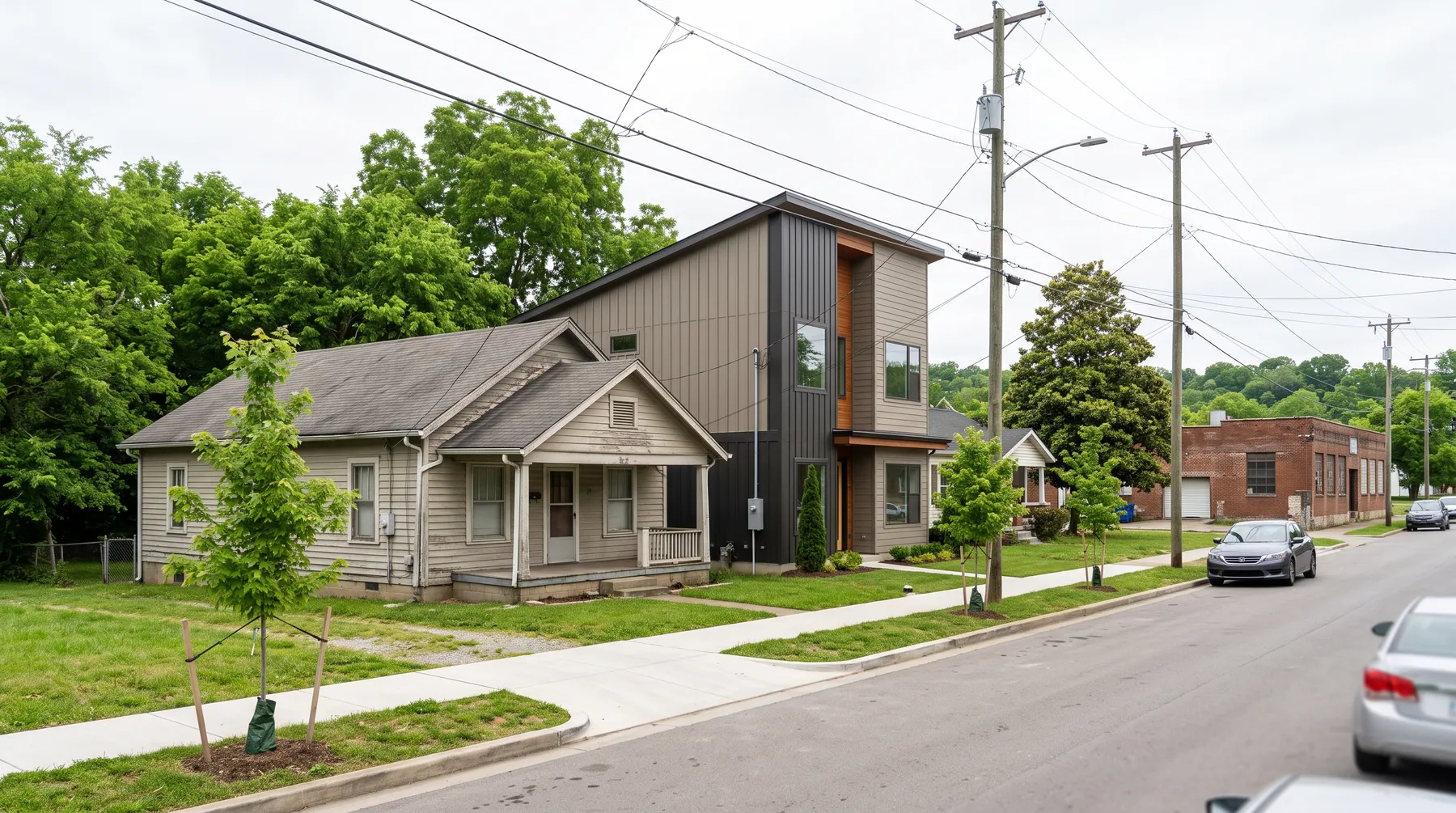
The Nations
The Nations is a former industrial and working-class neighborhood west of downtown Nashville, centered on 51st Avenue North and Centennial Boulevard in ZIP 37209.
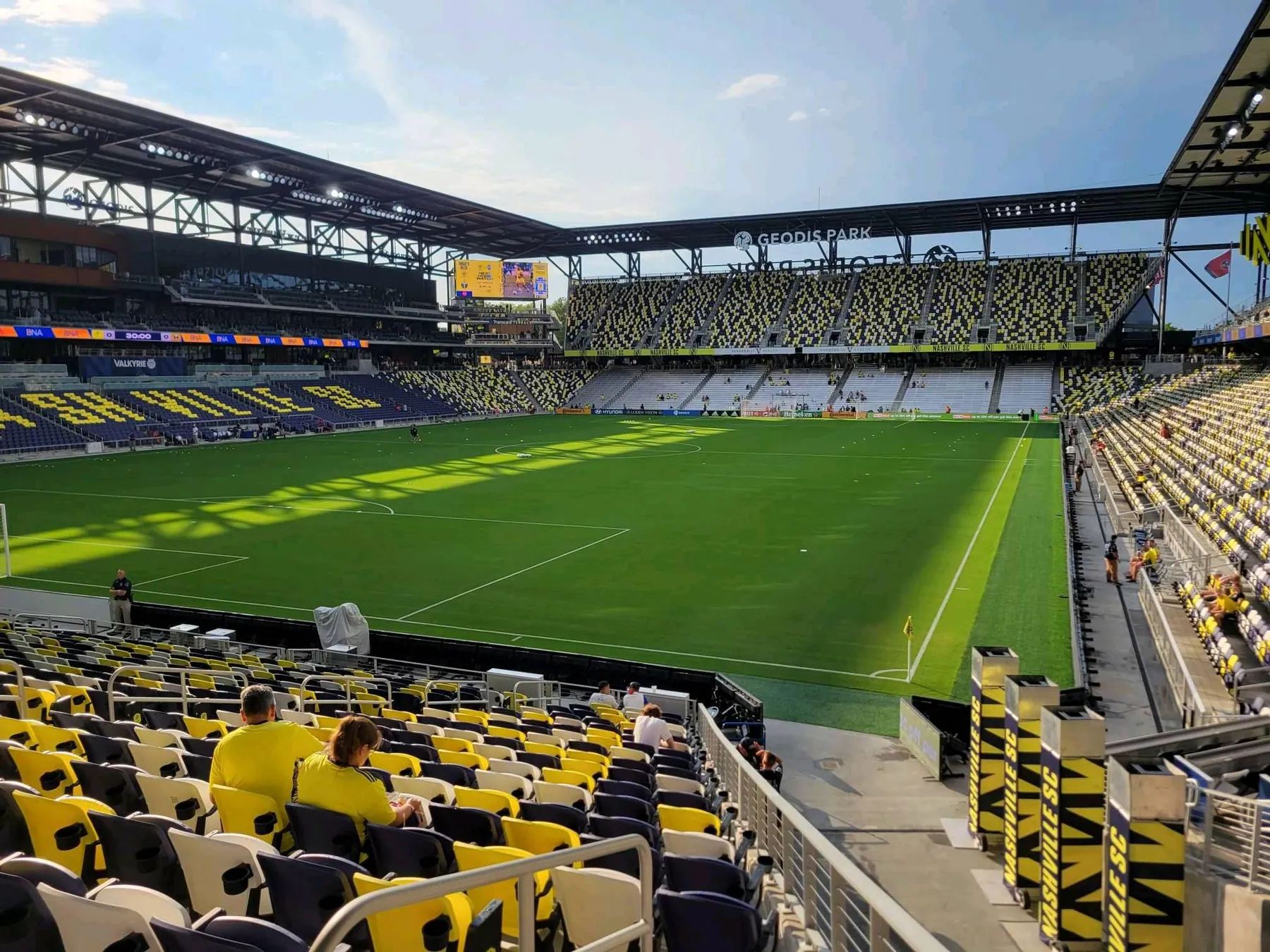
Wedgewood-Houston
Wedgewood-Houston, called WeHo, is a former mill district a few blocks south of downtown.
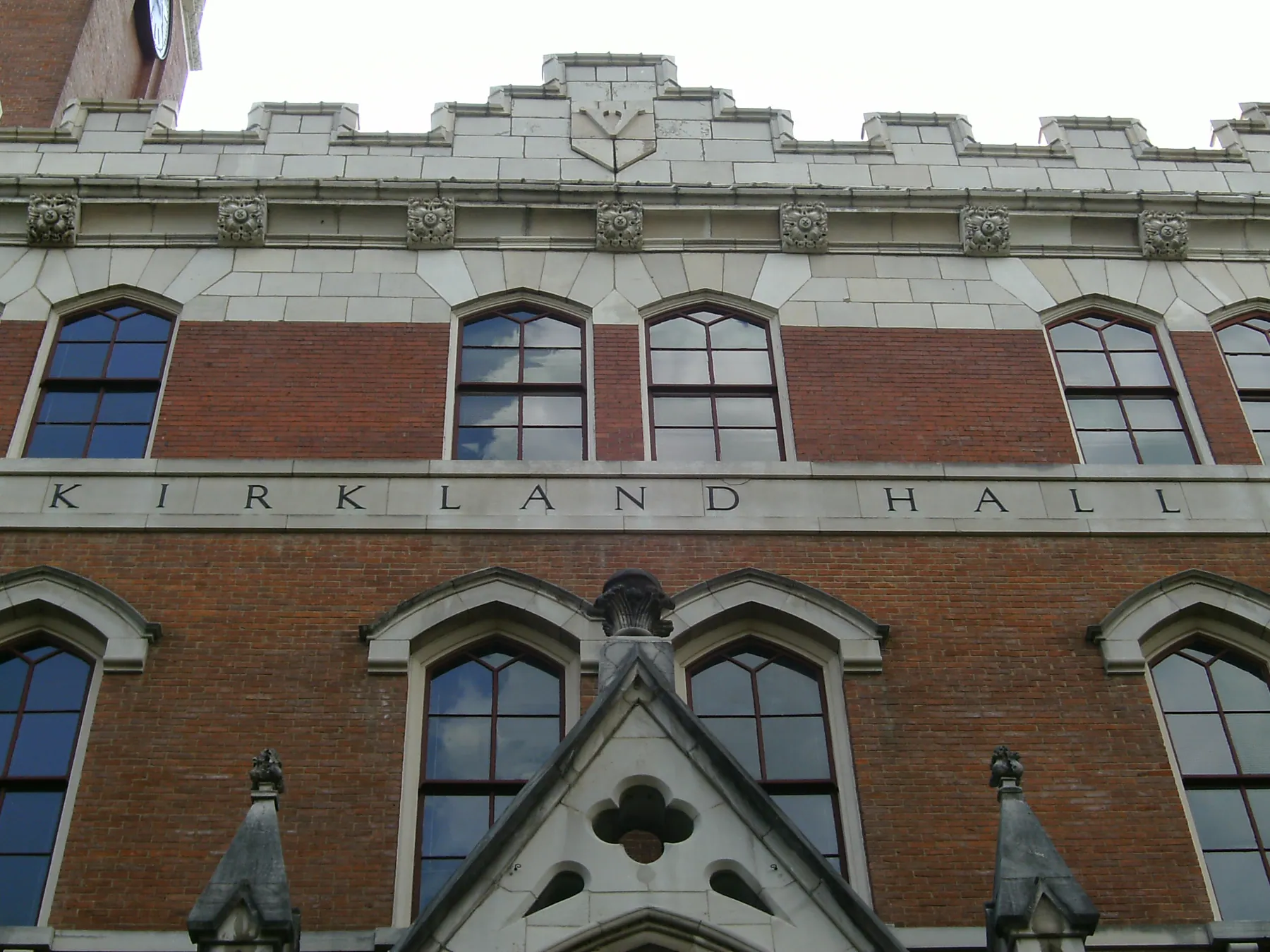
West End
West End is the corridor that runs southwest from Midtown along West End Avenue past Vanderbilt University, Elliston Place and Centennial Park.