










Luxury Apartment and Condo Units
A unit in a Nashville tower is owned or leased one apartment at a time, inside a building whose rules you did not write. Metro's permit rules apply to each unit, and the condo declaration or lease can still say no. This page covers how the two layers fit together, what a tower unit costs to run, and where an owner usually gets stuck.
- Permit unit
- Each dwelling unit is its own permit; four sleeping rooms at most
- Downtown zoning that allows new permits
- DTC North, South, West and Central (not DTC East)
- Issued STR permits, ZIP 37203 (Oct 6, 2026)
- 1,706 (89 owner-occupied, 1,617 non-owner-occupied)
- Issued STR permits, ZIP 37201 (Oct 6, 2026)
- 346 (8 owner-occupied, 338 non-owner-occupied)
- Lodging tax on a stay
- 7% Metro occupancy tax plus a per-room nightly charge ($2.50 on Metro's return)
- Association rules
- Can be stricter than Metro's; Metro requires a statement that the rental breaks none of them
On this page
What counts as a luxury unit here
The label covers three different things, and each runs differently. A condominium unit is owned by an individual, inside a building run by an association. A unit in a rental apartment tower belongs to one company, and a tenant has a lease. A hotel-condo or branded residence has an operator and a rental program written into its documents. Metro's permit rules treat them the same. Your declaration, bylaws or lease do not.
Nashville has built many of these. Downtown's residential towers appear on Wikipedia's tallest-buildings list for Nashville: 505 (finished 2018), Alcove (2023, shown as rental) and The Emory (2025, shown as condos for sale at Nashville Yards). In the Gulch it lists The Pullman at Gulch Union at 1222 Demonbreun (31 floors, 2024) and Modera McGavock (396 units, 29 floors, 2025). The same list puts Albion Music Row in Midtown, at 14th Avenue South and McGavock Street, with 458 units on 29 floors, due in 2026. The list says little about ownership, so check the title and declaration of any building you look at.
505 shows why that matters. Wikipedia's entry on 505 Church Street counts 350 apartments and 178 condominiums, and says sales were not planned at the start because the loan barred selling units during construction. One tower, two ownership structures, and a different answer to the same short-term rental question in each.
Zoning for a tower unit
For a luxury unit whose owner will not live in it, new permits come, with conditions, only in a fixed group of districts that Section 6.28.030 lists and nowhere else. Besides business and mixed-use zones, the list takes in four downtown DTC districts (North, Central, South and West); DTC East is not on it, and neither are the residential districts. The Title 17 land use table (section 17.08.030) agrees.
If the parcel is a Specific Plan (SP) or a Planned Unit Development (PUD), Metro issues a permit only if the plan itself allows it. Read the SP ordinance itself, since the base zoning on a listing sheet will not show it. Council has amended plans to allow not-owner-occupied rentals, so a plan can change, but you cannot count on it. Check the tower's parcel on Metro's maps site and have Metro Codes answer before you make an offer.
Permit rules that apply per unit
There is no separate permit for a tower. Every unit in the tower takes a separate permit, which can cover four sleeping rooms and no more. Nothing in Metro's code caps the share of a tower's units that may rent short-term, so zoning, the distance test and the condo association set the real limits.
A tower whose parcel sits close to a church, school, park or licensed day care can also be blocked by the 100-foot rule in the permits guide. A resolution that wins 21 Council votes after a public hearing can lift that bar, and several units in one development can share a resolution. In a dense tower district, a church, a small park or a day care on the next parcel can decide an application.
The permit fee on Metro's pages in February 2026 was $313. Permits run 365 days, and Metro emails renewal reminders 60 and 45 days ahead. Renting a tower unit with no permit runs up fines of $50 per day, and Metro then makes you wait a year to get one.
A permit also stays with the owner, not the unit. Once a tower unit changes hands, its permit ends, and the buyer applies afresh. Metro applies that even when the unit moves between your name and your trust or LLC. If you plan to buy a unit that already rents, price it as a unit with no permit.
In the open data Metro published as of October 6, 2026 there were 1,706 issued permits in 37203 (1,617 not-owner-occupied), 346 in 37201 (338 not-owner-occupied) and 78 in 37219 (75 not-owner-occupied). A ZIP code count covers every building in the ZIP, so it does not show how many permits sit in any one tower.
Condo bylaws and HOA rules
A Metro permit does not override your association. In the application the owner certifies that no lease, covenant or other restriction bars renting the unit, and no condo, co-op or HOA agreement or bylaw. Metro wants that statement even in a tower with no association. The city's FAQ says an association can be stricter than Metro.
Tennessee law leaves room for associations. Tennessee Code Annotated 13-7-605 says the state's short-term rental act does not stop a condominium, co-op or homeowners association from prohibiting or restricting short-term rentals in its governing documents, and it lets a landlord restrict them in a lease.
On October 17, 2023, the Tennessee Supreme Court held in Pandharipande v. FSD Corp. that a restriction limiting property use to residential purposes does not prohibit short-term rentals. A rule that deals with rentals directly is a different question, so read every amendment and not only the original declaration.
For condominiums, Tenn. Code Ann. 66-27-317 says a declaration is generally amended by owners holding at least 67% of the votes, effective when recorded, with challenges due within one year of recording. Before buying, collect the recorded declaration with every amendment, the bylaws and the current rules, and ask the association in writing whether short stays are allowed and whether any amendment is pending.
- Any minimum lease term, or any rule on rentals by non-owners
- Move-in and move-out fees, elevator reservations and front-desk guest registration
- Whether the master policy and your own liability policy cover transient guests
Building and fire code
A tower easily passes three dwellings, and that is the size at which Metro's checklist requires a Fire Marshal inspection. Single homes and duplexes may instead file a certification from an engineer, home inspector or architect licensed in Tennessee.
This page does not state the International Building Code thresholds for a tower where some units rent to transients, such as whether the building is classified R-1 or R-2, or what a change of use triggers for sprinklers and alarms. Ask the Fire Marshal and a licensed architect which classification the building has today, and get it in writing before you underwrite.
Fair Housing Act accessibility
Federal rules for design and construction cover multifamily buildings whose first residents arrived after March 13, 1991. And under 24 CFR 100.205, an elevator building has all of its units covered. In a walk-up without one, only ground-floor units are. A covered tower needs usable public and common areas, doorways a wheelchair can pass, a wheelchair-friendly path into and around each unit, controls within reach, walls ready for grab bars, and room to turn a wheelchair in kitchens and baths.
Every tower named above was completed in 2018 or later, so for an elevator building the rules reach each unit. In practice, do not renovate away what the building was required to provide, and ask the association whether any accessibility complaints are on file.
Taxes on a tower unit
Nashville taxes each permitted short-term night the way it taxes a hotel room. Metro Code Chapter 5.12 sets a 6% tax plus 1% for the Sports Authority, and Metro Finance's return applies $2.50 per room per night on a separate line. Fifty cents of that amount is set to expire under Section 5.12.140; a September 2026 ordinance pushes the date to 2032, so confirm the amount owed with the Collections Office. Metro wants the return by the 20th, covering tax collected in the prior month. Tennessee sales tax also applies to short stays.
Airbnb and Vrbo collect on their own bookings. Direct bookings and other channels are yours, and so is the filing. Our page on hotel occupancy taxes in Nashville has the details.
Operating models and financing
With a management agreement, the permit, the policy and the unit stay yours, and a manager handles bookings, guests and cleaning for a fee or a revenue share. Under a master lease the operator leases your unit, furnishes and runs it, and pays you rent. A revenue share splits what the unit earns under a written formula. Rad Stay does not publish its fees.
The permit decides which structures work. A permit cannot be transferred or assigned, per Section 6.28.030, and each application states that renting breaks no lease. Ask Metro Codes how it handles a master lease before you sign, and put in writing who applies and renews, who holds the $1 million per-occurrence liability policy, who files taxes and who acts as the responsible party within 25 miles.
This page gives no lender requirements, rates or down payments for condo loans. What the sources show is that short-term income rests on a permit that ends at sale, an association vote and a 12-month renewal. Underwrite two cases, with the permit and without it, and ask a lender whether it will lend on a unit whose declaration restricts rentals. Metro can revoke a permit after a unit's third violation of the general provisions and refuse another for a year, so ask the seller for each unit's permit history.
Running a unit at this scale
In a tower, getting guests through the lobby, garage and elevators is part of the stay. Fobs, garage passes, front-desk guest lists and elevator reservations all affect arrival. Decide who can issue a key and let a guest in, and write it into the check-in instructions.
Each unit carries Metro's operating rules: a single group per booking, a renter in charge who is 21 or older, stays between 24 hours and 30 days, and a guest count no higher than 12, and within that, two per sleeping room with four more. Post the guest cap and the number for the responsible party inside, and make sure that person picks up day or night during every stay. The permit number must show on every listing.
Before applying, you must give written notice to adjacent owners, which includes the units above and below. Those neighbors are your first complaint risk. Ask the association what its noise rules say.
What Rad Stay does
Rad Stay runs nightly, monthly and yearly Nashville rentals, and the one property on record is Union Street Lofts, four lofts downtown at 329 Union Street. For a tower unit, the work is permit and tax support, pricing, guest messages, cleaner schedules and booking automation, plus a review of one unit or a block of units before you buy, lease or partner. This is not legal or tax advice; have an attorney read the declaration.
Questions
Can I run my condo as a short-term rental if Metro grants the permit?
Only if the association's documents allow it. Metro makes you state that the rental breaks no condo, HOA, lease or covenant rule, and Tennessee law lets an association restrict short-term rentals in its governing documents.
Is there a Nashville limit on how many tower units can rent short-term?
Metro Code 6.28.030 sets no percentage cap. Each unit is permitted by itself, so what limits a tower is zoning, the distance test and the tower's own documents.
Does the permit transfer if I sell the unit?
No. Any change of owner voids it, even putting it in your own LLC or trust, and the buyer then applies under the current code.
Which fire inspection applies to a unit in a tower?
Any property with at least three dwellings gets an inspection from the Nashville Fire Marshal. Ask the Fire Marshal and a licensed architect about the building's occupancy classification.
Are tower units covered by Fair Housing Act accessibility rules?
24 CFR 100.205 applies it to covered multifamily buildings that saw first occupancy after March 13, 1991, and in an elevator building it covers every unit.
Who pays the lodging taxes on a tower unit?
Airbnb and Vrbo collect on their own bookings. You or your manager owe Metro occupancy tax and sales tax on direct bookings and on bookings from other channels, and Metro's return for each month is due on the 20th of the next.
Sources
- Metro Codes, Apply for a short term rental property permit (Wayback copy, August 22, 2026)
- Metro Finance, Short term rental occupancy tax return, taxes payable after July 1, 2023
- Tennessee Department of Revenue, Important Notice 17-24, Short-Term Rental of Vacation Lodging
- Metro Code Chapter 6.28, Short term rental property permit (Municode, version of June 23, 2026)
- Metro Code 17.08.030, Land use table (Municode)
- Metro Codes, Not-owner-occupied permit checklist (Wayback copy, February 16, 2026)
- Metro Nashville Residential Short Term Rental Permits (open data), status Issued, retrieved October 6, 2026
- Metro Code Chapter 5.12, Hotel Occupancy Privilege Tax (Municode)
- Tenn. Code Ann. 13-7-605 (FindLaw)
- Tennessee Courts, Supreme Court holds residential-purposes restrictions do not prohibit short-term rentals (October 17, 2023)
- Tenn. Code Ann. 66-27-317, Amendment of declaration (FindLaw)
- 24 CFR 100.205, Design and construction requirements (Cornell Legal Information Institute)
- List of tallest buildings in Nashville and 505 (Nashville), Wikipedia
- Metro Finance, Short-Term Rental Tax return (510), taxes payable after July 1, 2023, line "Number of rooms rented per night x $2.50" (archived copy, October 22, 2026)
- Metro Council, BL2026-1493, passed Sept. 1, 2026, Mayor approved Sept. 4, 2026; Section 4 moves the 5.12.140 B date, Section 10 sets the effective date (Legistar)
Checked October 18, 2026.
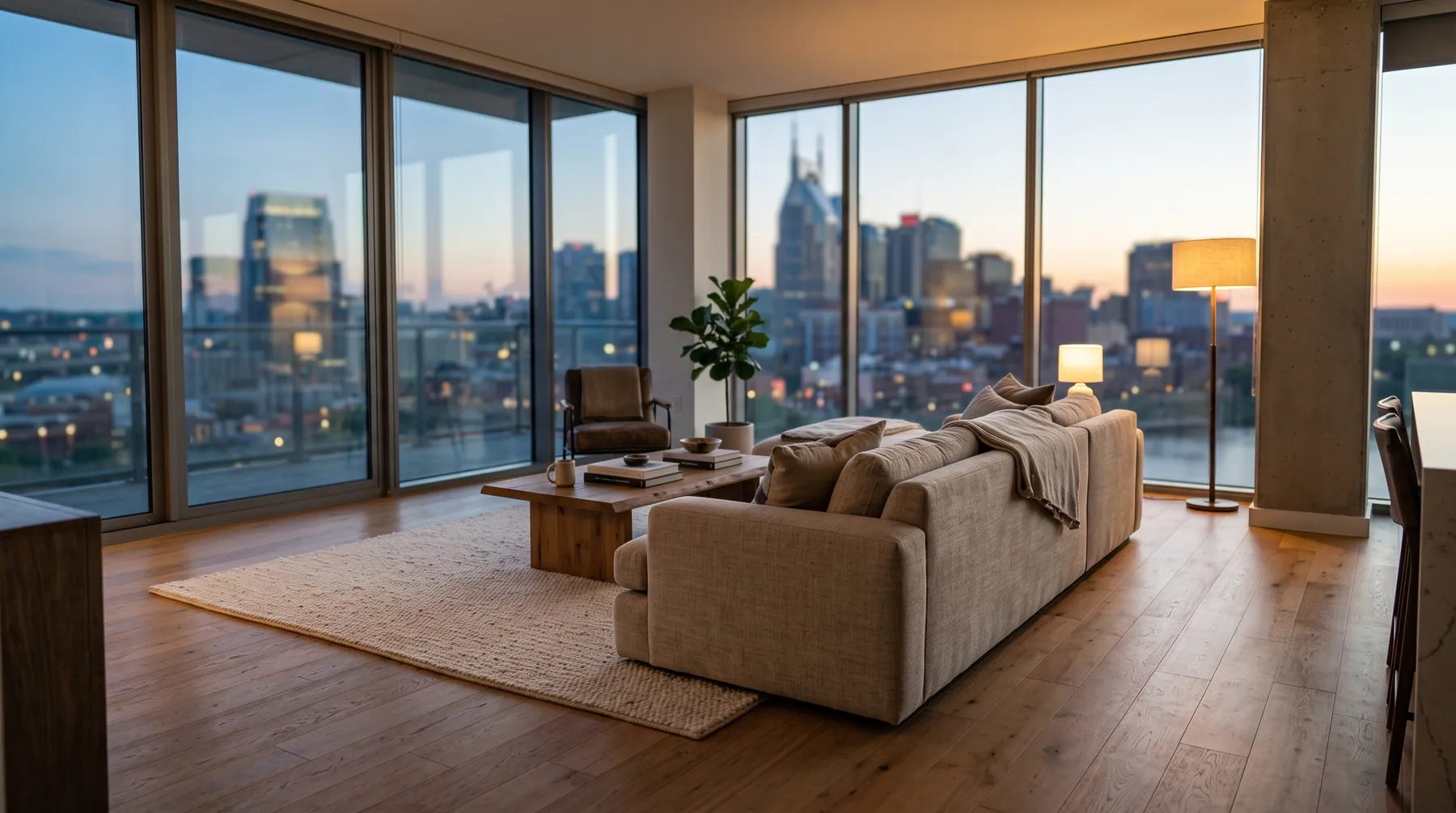
Top image: Illustration of a representative building, not a specific property.
To keep this page, print it or choose Save as PDF in your browser's print window. The printout keeps the sources and the date.
More property types
All 19
Mid-Size Apartment Buildings
A building of 50 to 200 units is big enough to need a real operating plan and small enough that one owner or one small fund can still make the call.
Mixed-Use Buildings
A mixed-use building has a business on the ground floor and homes above it.

Office Buildings
An office building is a rent roll that turns over suite by suite, with lobbies, elevators and restrooms you keep running for everyone.