










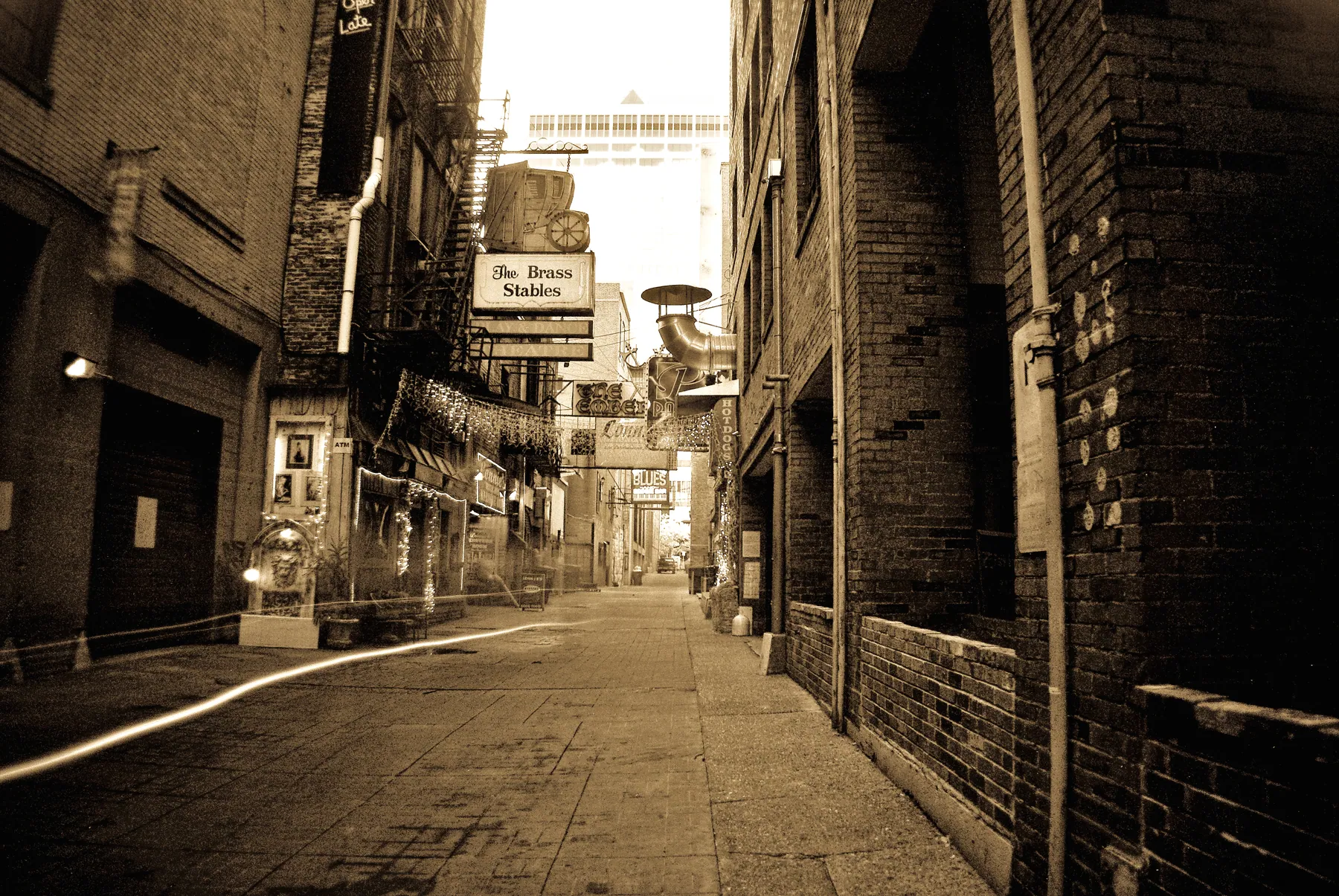
Printers Alley
Printers Alley is a short alley in downtown Nashville between Union and Church Streets, and the blocks around it hold hotels, nightclubs, old printing-trade buildings and upper-floor lofts. It sits in Metro's downtown zoning, where most subdistricts can still receive fresh permits for apartments whose owners live elsewhere. Rad Stay's Union Street Lofts, the four upstairs units at number 329, are on this block, so what follows comes from the owner's side of the table.
- ZIP code
- 37201
- Boundaries (historic district)
- Roughly 3rd and 4th Avenues North, Bank Alley and both sides of Church Street
- Zoning to know
- DTC (Downtown Code); DTC East is the one downtown subdistrict that does not allow new non-owner-occupied permits
- National Register listing
- Printers Alley Historic District, August 26, 1982
- Issued STR permits, ZIP 37201
- 346 (8 owner-occupied, 338 non-owner-occupied)
- Rad Stay's building
- Union Street Lofts, 329 Union St, Units 201-204
On this page
- Where it is
- How the area developed
- From Prohibition to the nightclub years
- Buildings and housing today
- Union Street Lofts as a local reference
- Downtown Code zoning around the alley
- Overlays and the historic district
- Permit rules that bite on this block
- Application steps and penalties for a stacked building
- Permits issued in ZIP 37201
- Who visits and why
- Longer stays near the alley
- Development from 2023 to 2026
- Getting around
- Which building types fit
- Checks before buying near the alley
- Rad Stay on a building near the alley
- Questions
- Sources
Where it is
Printers Alley runs between Union Street and Church Street, and between 3rd and 4th Avenues North, in downtown Nashville. Wikipedia gives its coordinates as about 36.164 north, 86.778 west. The National Register entry for the Printers Alley Historic District describes a larger area, roughly the area between Third and Fourth Avenues and Bank Alley, taking in both sides of Church Street, covering about 5 acres.
The ZIP code is 37201. That ZIP is on the lofts' address, and the permit counts below use it. Check the ZIP of any specific parcel before you rely on those counts.
For an owner, the thing to know is that the zoning here is downtown commercial, not residential. A building near the alley is most likely a commercial or mixed-use structure, and the decision is how to use the upper floors.
How the area developed
Wikipedia traces the land to the 1780s, when George Michael Deadrick, a Virginia businessman, gave it to the city of Nashville. By about 1830 it had become the center of printing in Nashville, and the alley took its name from the print shops and publishers that filled the surrounding buildings. By 1915 the street held two big papers, The Tennessean and the Nashville Banner, plus ten print shops and thirteen publishing houses.
In the late 19th century the same blocks were known as the Men's Quarter, with hotels, gambling halls, restaurants, saloons and brothels. That mix of newspaper offices and after-hours businesses explains the buildings you find today: narrow brick and stone structures of several stories, built for work during the day and for hotel rooms and drinking at night.
The hotel history is specific. Dream Nashville was built around two older buildings, the Climax Saloon, which opened in 1887, and the Utopia Hotel, which opened in 1891, according to the Nashville Sites history project. That project says the buildings reopened at the end of 2018 as Dream Nashville. Other accounts give different dates for the Utopia and the reopening, so confirm any date before you quote it.
From Prohibition to the nightclub years
Prohibition took effect in 1909, according to Wikipedia. Tennessee repealed it in 1937, and member's bars arose where customers could bring their own liquor.
In the 1940s, according to Wikipedia, restaurants in the alley combined fine dining, burlesque and live music. The Rainbow Room ran on that model for about 30 years. Other clubs named on the page include The Captain's Table, The Brass Rail Stables, The Embers, The Black Poodle Lounge and the Voo Doo Lounge. Performers who played the alley include Chet Atkins, Floyd Cramer, Boots Randolph, Hank Garland, Jeannie Seely, Mel Tillis, Dottie West and Hank Williams.
Alcohol was fully legalized in Nashville in 1968, which hurt the alley's businesses, and Ambrose Printing Company, the last printing company in the alley, left in 1977. The Printers Alley Historic District has held its National Register listing since August 26, 1982, under reference number 82003964, with Italianate, Queen Anne and Romanesque architecture noted. Today Wikipedia describes the alley as home to numerous restaurants and nightclubs.
Buildings and housing today
The building stock around the alley is older commercial space. The named, sourced examples are these.
Dream Nashville, at Printers Alley and Fourth Avenue North, is the largest. The developers, 4PANT, LLC and Dream Hotel Group, held the groundbreaking on August 23, 2016. The plan was a new 10-story structure connected to the existing six-story Utopia Hotel building, with 169 rooms and eight dining and nightlife venues in the announcement. A March 2019 Tennessean article quoted by Nashville Sites counts 168 rooms, so room counts differ by source. Earl Swensson Architects were the architects and Meyer Davis Studio did the interiors.
Upstairs in the block, 329 Union Street holds four units numbered 201 to 204. Metro's parcel data lists the parcel's base zoning as DTC.
A 15-story mixed-use project fronting both Bankers Alley and Printers Alley, at 215 Third Avenue North, was in planning in October 2023, according to the Nashville Post. No groundbreaking date had been announced. The development section below has the details.
If you own an older commercial building here, the first question is whether the upper floors already hold approved dwelling units. Metro permits dwelling units, so that answer comes before any short-term rental question.
Union Street Lofts as a local reference
Union Street Lofts is the only Rad Stay building referred to on this site, and it is on this block. Metro's open data shows each loft holding a separate not-owner-occupied permit from April 2023. On Airbnb the four lofts together have 214 reviews with a 4.98 average, and Kasra, who hosts them, holds Superhost status.
A loft can take 12 guests at most: count two per sleeping room, add four, so 8 is the most for a two-bedroom loft.
Rad Stay does not publish revenue or occupancy figures for the lofts. What an owner can check is the public record: the permits, their type and their dates are in Metro's data.
Downtown Code zoning around the alley
The blocks around Printers Alley fall in the Downtown Code, shown as DTC on Metro's zoning map. Four of its subdistricts, North, South, West and Central, can, with conditions, receive new absent-owner permits under Section 6.28.030, which the 17.08.030 table matches; DTC East gets a blank cell, meaning no new permits.
Nothing we opened says which DTC subdistrict covers each parcel on the block, so do not guess. Look the parcel up on Metro's zoning map or ask Codes which subdistrict applies, since that single answer settles whether a new permit can be had. At the edges of the area, other districts can appear; residential, farm and industrial zoning are closed to these permits, an NS suffix closes a district to both permit types, and an SP or PUD allows a permit only if its plan does. The zoning guide, linked below, names every district.
For a building near the center of the area the reading is better than in most of the county, since the downtown subdistricts that cover most of it are on the permitted list. It is still a parcel-level question for Metro Codes.
Overlays and the historic district
The alley sits in a National Register historic district. The listing is a federal honor. It does not by itself set zoning, and none of the sources opened here says what it asks of owners. Ask Metro Planning whether any overlay or design review applies to alterations, signs or windows on your parcel.
On short-term rentals specifically, Chapter 17.36 is silent in its historic overlay sections, 17.36.100 through .120, and in its urban design overlay sections, 17.36.270 through .320. Its one short-term rental provision belongs to the detached accessory dwelling overlay. That covers chapter 17.36 and not every overlay Metro has adopted, so a parcel-specific check still applies.
Permit rules that bite on this block
The citywide rules sit in our multifamily guide (link below); these are the ones that stand out for a stacked building near the alley. Each apartment needs its own permit covering four sleeping rooms or fewer, and no limit applies to the number of apartments per building that can hold one. Because the permit is for a residential dwelling unit, upper floors used as offices today must become approved apartments before anyone can apply.
Every applicant also attests that no lease, condo, co-op or association agreement forbids renting, and Metro's FAQ notes associations can impose tighter limits. Over a ground-floor bar or restaurant, read the lease and any recorded covenants first. Any property of three-plus dwellings gets the Fire Marshal; a single home or duplex would file a licensed inspector's certification.
The 100-foot rule is the one that catches downtown buildings: Metro issues no new absent-owner permit if a school, church, park or licensed day care sits less than 100 feet from the lot line, short of a Council waiver passed by 21 votes, and one such resolution can cover several units of one building. Our Legistar review found most waivers from 2023 to 2026 approved, but not all, so measure against the nearby churches and parks before pricing a purchase.
Once permitted, a unit runs under Metro's operating rules: no stay past 30 nights; a lead guest 21 or older; one party per booking; a contact for the property within a 25-mile radius, answering around the clock; a posted guest limit; liability insurance of $1 million per occurrence; the permit number printed in every listing; and renewal every 12 months, with reminder emails sent 60 days and 45 days before. The fee in the February 2026 FAQ is $313. Permits never transfer, not even to your own trust or LLC, so a buyer counts on applying fresh.
Application steps and penalties for a stacked building
Before filing, Section 6.28.030 requires written notice to all adjoining owners, and adjoining reaches the floors above and below as well as the lots on each side. In a building with a business downstairs and apartments above, that can mean the neighbors on the other side of your floor and ceiling, so go over the wording with your attorney before filing. The Fire Marshal visit is a separate step, so leave time for it.
Penalties are steep: $50 a day and a year before reapplying for renting with no permit, six months for renting on an expired one, a year after a revocation, and a guest register to keep for six months; the permit holder also may not serve food or leave RVs, buses or trailers in view. Under 6.28.035 a holder can ask the STR Appeals Board to review a revocation.
Two ordinances shaped these rules. BL2023-1884 added the 100-foot rule in August 2023, and BL2024-478, which the Mayor signed on November 12, 2024, ended permits on any change of owner and revised waivers. Metro's FAQ still names BL2020-187 as the law in force, so go by the code text rather than the FAQ summary. The zoning administrator sets the renewal fee, so confirm it with Codes; the $313 figure is the permit fee, and card payments add 2.3 percent.
Permits issued in ZIP 37201
Source: Residential Short Term Rental Permits, Metro Nashville open data, status Issued, downloaded October 6, 2026. ZIP 37201 had 346 issued, 338 not-owner-occupied and 8 owner-occupied. The county total in the same file was 7,022 issued permits.
What matters is the split. Of the 346 permits, 338, or about 98 percent, are non-owner-occupied, which fits a commercial and mixed-use area where few owners live on site. Only 8 are owner-occupied. For comparison, 37203 has 1,706 issued, about 95 percent of them, 1,617, not-owner-occupied. ZIP 37219 has 78, with 75 non-owner-occupied.
The four Union Street Lofts permits are 4 of the 338 non-owner-occupied permits in 37201, or about 1.2 percent. The number is a count of permit records with status Issued on the retrieval date, not of listings live on Airbnb or Vrbo, and a property that renews under a new number can appear more than once over time, so use it to see how common permits are. Guest numbers are not in it.
For a buyer, 346 permits in one ZIP tells you that Metro has issued permits here in volume. A guest has many other permitted rentals to choose from, so reviews and management quality matter.
Who visits and why
Tourism is the main reason. The Nashville Convention and Visitors Corp. reported that visitors to Davidson County generated a record $11.6 billion in spending in 2025, up 3.5 percent from 2024, in a release published in 2026. That is county-wide, not Printers Alley alone.
The alley itself has music clubs, bars and restaurants, and the Dream hotel adds eight dining and nightlife venues, according to the groundbreaking announcement. No source opened for this page breaks down downtown guests by purpose, and Rad Stay does not publish a guest mix for Union Street Lofts. If you are underwriting a building, ask a manager for booking data from comparable units, and ask how much of it is repeat business.
Noise comes with a nightlife block, so ask about it before you buy. On the permit side, Metro decides whether to allow 30 days of grace after a permit expires and refuses it where complaints are documented, and revocation, on 15 days' written notice, can follow a third general-provisions violation.
Longer stays near the alley
Not every unit here has to be a nightly rental. A stay longer than 30 consecutive nights falls outside the short-term permit, and some owners offer furnished stays of a month or more to people in town for a job or a project. Before you advertise a lease structure, ask Metro Codes how it will be classified, because the permit rules turn on transient occupancy.
This page gives no long-term rent figure because no dated source opened for it breaks out Printers Alley. Pull current asking rents for comparable units before you underwrite a long-term plan.
The reason the mid-term and long-term options matter is that they are fallbacks. If a parcel's district allows no new permits, or a church or park sits within 100 feet and no waiver is granted, the building can still run as furnished monthly units or ordinary leases. Rad Stay takes on nightly, monthly or yearly rentals and reviews each building before recommending a mix.
Development from 2023 to 2026
Confirmed development comes down to the mixed-use building proposed between Bankers Alley and Printers Alley. The Nashville Post reported in October 2023 that new images had been released for the project, a 15-story building at 215 Third Avenue North combining several uses. It would require demolition of an existing garage that the article says has no historical design value, and the Metro Planning Commission unanimously approved a rezoning to a specific plan in May 2022. No groundbreaking date had been announced. This page does not say whether construction has started, so check the site before you assume a new neighbor or a vacated garage.
Two other facts are older but shape the market. Dream Nashville, a hotel on the alley, was announced with a groundbreaking in August 2016 and reopened at the end of 2018 by one account. Union Street Lofts' permits were issued in April 2023.
The sources we opened showed no new apartment tower from 2025 or 2026 on the Printers Alley blocks. Check Metro Planning records before you assume one exists.
Getting around
Measure the walking distance from your parcel to Broadway and to the nearest transit stop on a map before you quote it to guests.
For transit, WeGo Public Transit Route 18 connects Nashville International Airport (BNA) to downtown, ending at the Elizabeth Duff Transit Center at WeGo Central. WeGo's page lists a $2 adult fare each way, about 20 minutes on express trips and 35 to 45 minutes on local trips.
Parking is the practical limit on a loft with no garage. Before you buy, find out whether a unit comes with a space, whether the building has a deal with a nearby garage, and what guests will be told about it. The Bankers Alley proposal would replace an existing garage, so a garage that exists today may not be there in a few years.
Which building types fit
The sources point to three types.
Historic downtown buildings and historic lofts: older structures, such as the 1887 Climax Saloon and 1891 Utopia Hotel buildings, with upper floors that may or may not be approved dwellings. Mixed-use buildings: commercial space below and units above, the arrangement Union Street Lofts uses. Hotel buildings: a hotel conversion to extended-stay units is another route, though it depends on zoning and on Metro permitting dwelling units, not hotel rooms.
Checks before buying near the alley
If a seller shows you a permit as a selling point, ask for the permit number and check it in Metro's open data. The permit does not move to you when the deed does.
- The exact zoning of the parcel, including the Downtown Code subdistrict, and whether DTC East or an NS suffix applies
- Distance to the nearest day care, park, school or church, lot line to lot line, and whether you would need a Council waiver
- Whether the upper floors have approval as dwellings, and for what occupancy and fire separation
- The Fire Marshal inspection required at three dwellings or more, and the cost of any life-safety work
- Lease terms with the ground-floor tenant, deliveries, trash pickup and the hours each side operates
- Any condominium declaration, covenants or association bylaws that restrict rentals
- Noise from nearby clubs and how the building's windows and walls handle it
- Any historic or overlay review of exterior changes, signs and windows
- Flood risk through the FEMA flood map, which this page does not cover
- Existing permits: they lapse at sale, so assume a new application and a new 365-day clock
Rad Stay on a building near the alley
Rad Stay's work covers short, mid and long stays: rates, guest messaging, cleaner schedules, booking automation, damage cover, plus help with permits and taxes. Near Printers Alley the work that matters most is keeping permits current and listings consistent with them, since every listing carries the permit number and every permit has a one-year term.
Guest messages matter for the same reason noise does: guests who know before they arrive that the building sits above a business and near late-night venues complain less, and staffing the responsible-party line Metro requires at all hours is part of the job. Rad Stay also reviews downtown buildings that an owner may want to sell or lease, or to partner on; send an address or parcel number, the floor plans, the unit count and the permits already issued, and we will say what we see.
Questions
Can a unit near Printers Alley get a new short-term rental permit?
Possibly. Four DTC subdistricts, North, South, West and Central, accept new permits for absent owners under Section 6.28.030, with conditions, but DTC East does not, and the parcel also has to sit 100 feet or more from any day care, school, church or park, unless Council grants a waiver. Have the parcel checked by Metro Codes.
How many permits are issued in ZIP 37201?
346, with 338 not-owner-occupied and 8 owner-occupied, in the data pulled from Metro on October 6, 2026. The county total in that file was 7,022.
Does the National Register listing prevent renting the units?
The historic overlay sections of Chapter 17.36 contain no rule about short-term rentals. The listing can still affect renovation and financing choices, so ask Metro Planning what applies to your parcel.
What if my parcel does not allow short-term rental?
The building can run as furnished mid-term units, with stays over 30 consecutive days, or as standard long-term leases. Ask Metro Codes how it will classify the lease structure you have in mind. Rad Stay manages all three and reviews each building before recommending a mix.
What is the best way from the airport to Printers Alley?
WeGo Route 18 runs from BNA to the Elizabeth Duff Transit Center at WeGo Central downtown for a $2 adult fare, about 20 minutes on express trips and 35 to 45 minutes on local trips. From there, check the walking distance to your address.
Sources
- Printer's Alley, Wikipedia (history, boundaries, National Register listing)
- Groundbreaking of Dream Hotel in Downtown Nashville's Printers Alley, Hospitality Net
- Dream Hotel, Utopia Hotel and Climax Saloon, Nashville Sites
- Real estate notes: new images released for Bankers Alley project, Nashville Post (Oct. 2023)
- Metro Code Chapter 6.28, Municode (current through June 23, 2026)
- Metro Code 17.08.030, land use table, Municode
- Metro Code chapter 17.36, overlay districts, Municode
- Metro Codes, Apply for a short term rental property permit (Wayback copy, Aug. 2026)
- Metro Codes, Not-owner-occupied checklist (Wayback copy, Feb. 2026)
- Metro Codes, Short term rentals FAQ (Wayback copy, Feb. 2026)
- Metro Nashville Residential Short Term Rental Permits (open data), status Issued, retrieved Oct. 6, 2026
- Metro Nashville open data, Parcels with Zoning
- Tourism in Davidson County generated record $11.6 billion in visitor spending in 2025, Nashville Convention and Visitors Corp.
- WeGo Public Transit, Nashville International Airport service
Checked October 18, 2026.
Photo: Isaac777, CC BY-SA 3.0, via Wikimedia Commons. Cropped.
To keep this page, print it or choose Save as PDF in your browser's print window. The printout keeps the sources and the date.
More markets
All 28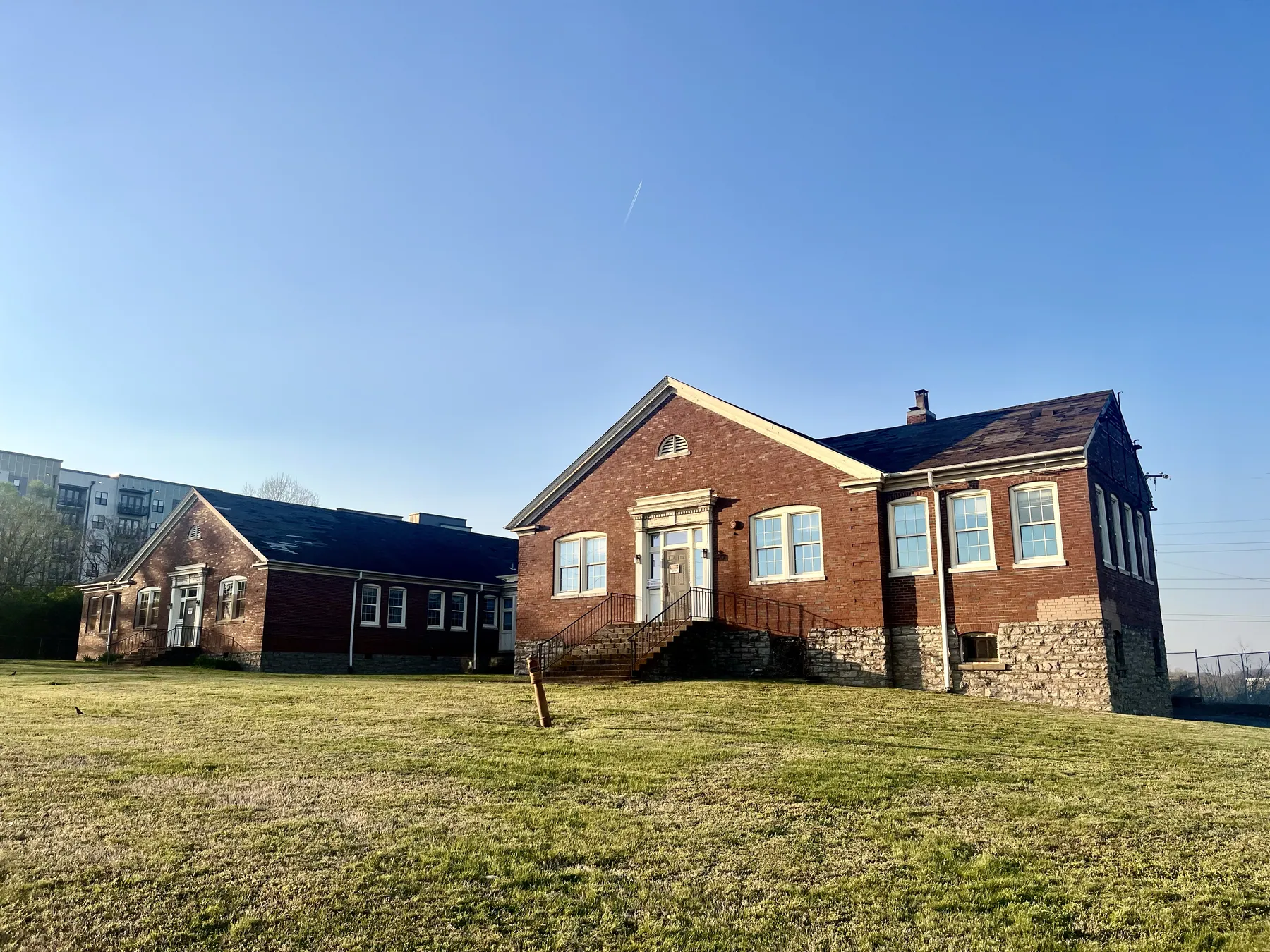
Rutledge Hill
Rutledge Hill sits just southeast of downtown Nashville, and Rolling Mill Hill, the former Nashville General Hospital site, is next to it.
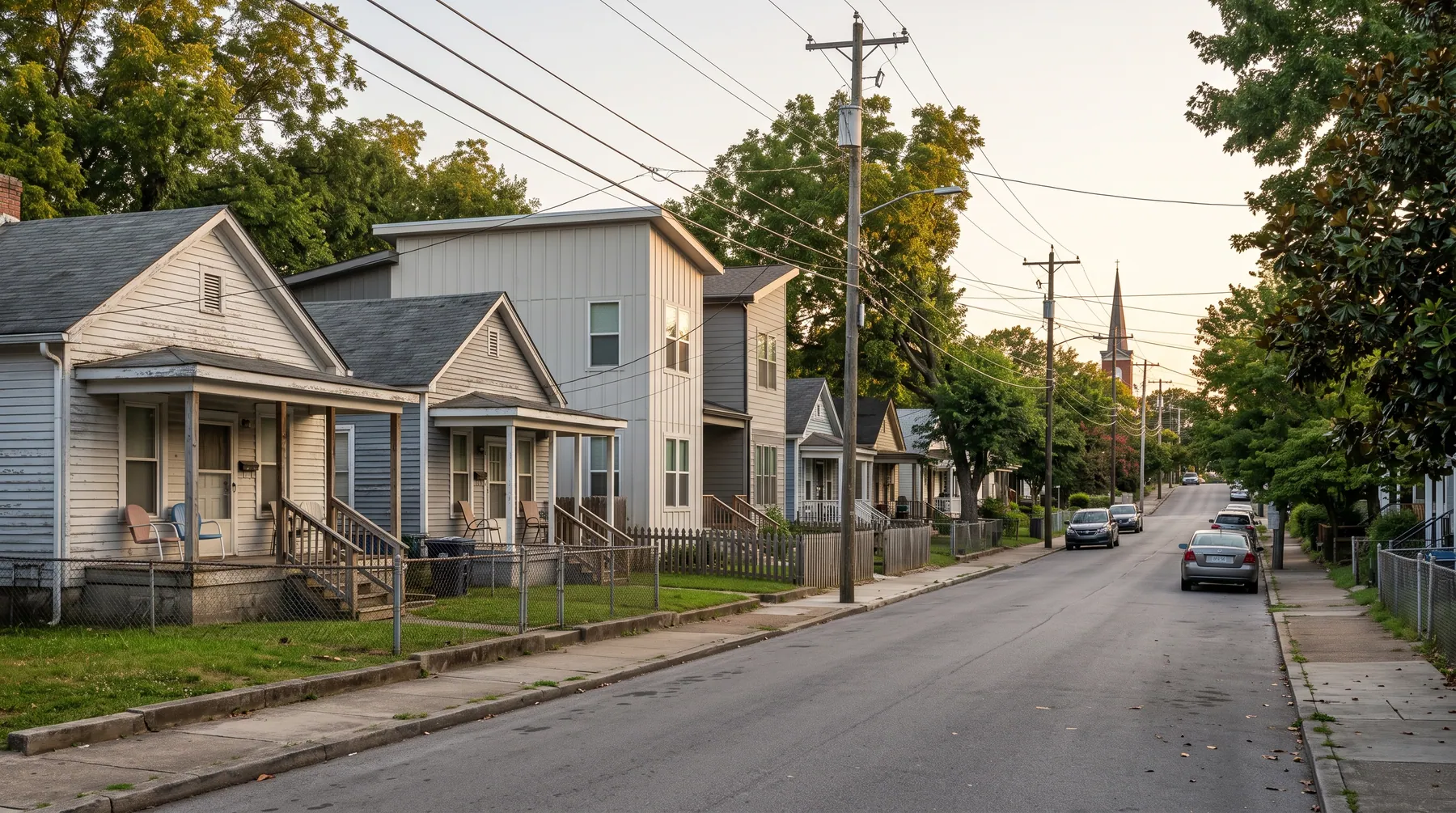
Salemtown
Salemtown is a small neighborhood just north of Germantown and downtown, built around the cotton and bag mills and now a mix of restored houses, townhomes and apartment buildings.
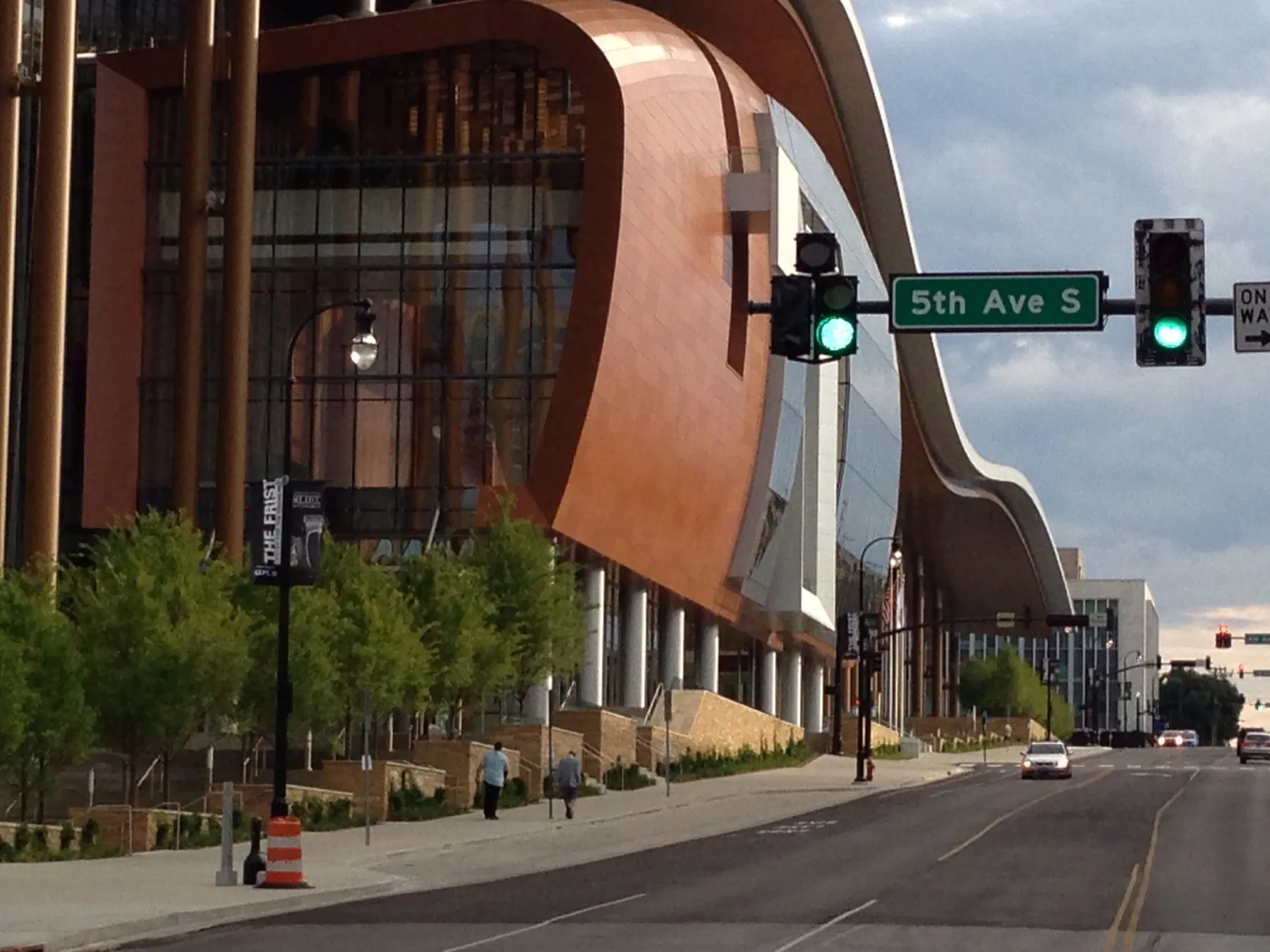
SoBro
SoBro is the part of downtown Nashville south of Broadway: the Music City Center, the Schermerhorn concert hall and a run of new residential and hotel towers.