










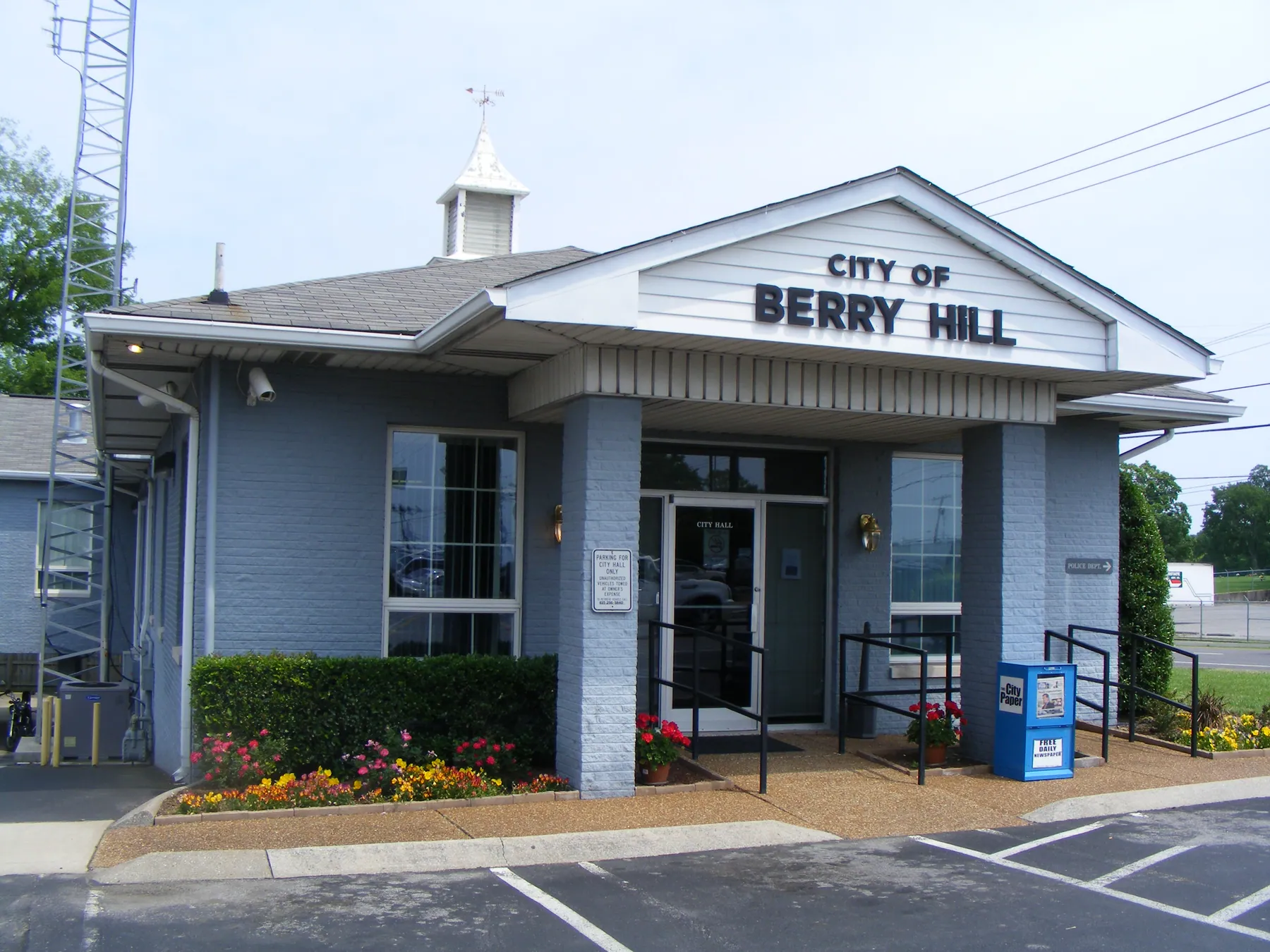
Berry Hill
Berry Hill sits inside Nashville's street grid, but it is its own incorporated city with its own city hall, its own zoning code and its own short-term rental ordinance. If you own or are looking at a multi-unit building here, Metro Nashville's permit map, district list and 100-foot rule are not the rules that decide what you can do. The first call is to Berry Hill City Hall.
- ZIP code
- 37204
- Land area
- 0.91 square miles
- Population
- 2,112 (2020 census)
- Housing units
- 1,657 (2020 census)
- Incorporated
- February 28, 1950
- STR permits issued by
- City of Berry Hill, not Metro
- Metro-issued STR permits in ZIP 37204
- 180 (83 owner-occupied, 97 non-owner-occupied)
On this page
- Where Berry Hill is
- How it became a separate city
- Population and housing
- Music Hill and the commercial base
- 100 Oaks and the medical employment base
- Newer multifamily: Broadstone Berry Hill
- Berry Hill's own short-term rental ordinance
- Zoning: why Metro's district list does not apply
- Berry Hill's Community Development Code
- The seven districts
- Density, height and lot rules by district
- Parking minimums for apartment buildings
- Definitions that decide what the building is
- Nonconforming uses
- Azalea Place and the studio blocks
- GEODIS Park and the Fairgrounds
- Issued permits in ZIP 37204
- Getting around
- Which buildings fit
- Checks before a Berry Hill purchase
- Rad Stay on a Berry Hill building
- Questions
- Sources
Where Berry Hill is
Berry Hill is a city in Davidson County, Tennessee. The 2020 census counted 2,112 residents on 0.91 square miles, all of it land. Its ZIP code is 37204, a ZIP that Berry Hill shares with parts of Nashville that are under Metro's jurisdiction. City Hall is at 698 Thompson Lane, and the phone number listed on the city's site is 615-292-5531.
Wikipedia places the city next to three landmarks that help you find it on a map: 100 Oaks Mall, the Tennessee National Guard Armory and Woodlawn Memorial Park. Wikipedia lists its coordinates as about 36.117 north, 86.766 west. The city's Zoning Ordinance page offers a downloadable district map and poster, so if a building is near an edge, check the parcel against that map before you assume which government applies.
That ZIP-code overlap matters for anyone searching data. A listing that says Nashville, TN 37204 can be inside Berry Hill or inside Metro Nashville, and the two have different permit offices.
How it became a separate city
On February 28, 1950, residents voted 138 to 135 to incorporate. Wikipedia says Berry Hill was the first Davidson County community to incorporate after Belle Meade did in 1938. Ralph Rosa, the first mayor, served 22 years. Wikipedia also records that the namesake William Wells Berry lived from 1813 to 1876.
In 1963, Berry Hill became part of Metropolitan Nashville, according to Wikipedia, yet it stayed a city with its own government. Wikipedia describes a commission-manager system with three commissioners and a city manager, plus its own police and public works departments. For an owner, the practical result is that land-use decisions on a parcel here are made at Berry Hill City Hall, which publishes its own zoning ordinance and district map.
Population and housing
Wikipedia's census table shows how much the city changed: 1,551 residents in 1960, 1,517 in 1970, 1,113 in 1980, 802 in 1990, 674 in 2000, 537 in 2010 and 2,112 in 2020.
The 2020 census counted 1,446 households, 61.5 percent of them single-person households, and 1,657 housing units, of which 12.7 percent were vacant. The median age was 28.0. More than six in ten households living alone is the number to weigh when you decide on unit sizes.
Music Hill and the commercial base
In 1970, Buzz Cason bought two houses in Berry Hill and converted them into his Creative Workshop recording studio. The area went on to become a recording-industry center, nicknamed Music Hill.
That history explains the current mix of studios, offices, restaurants and homes on the same blocks. A building owner here is more likely to be next to a recording studio or a medical office than next to a conventional apartment complex.
Wikipedia is the source for the music history above. Individual studios change hands and close, so check any specific business before you cite it to a guest or a lender.
100 Oaks and the medical employment base
100 Oaks Mall, at 719 Thompson Lane, opened on October 27, 1967, as Nashville's second enclosed shopping area, after Harding Mall. Its original tenants were Penneys, Woolco and Harveys. Woolco closed in 1983 and JCPenney in January 1986. Belz Enterprises bought the mall that year, closed the interior mall space in September 1991, and redeveloped it as an outlet center between 1995 and 1996.
After a renovation in 2008, the ground floor stayed in retail. Vanderbilt University Medical Center runs clinics and administrative offices on the upper floor and in the office building. Wikipedia calls the result a mixed-use medical and retail complex, completed in 2009. The Regal Cinemas Hollywood 27 sits next to the mall. Wikipedia places the mall about three miles south of downtown along I-65 and State Route 155.
For rental demand, the useful fact is the Vanderbilt presence. Clinics and administrative offices in one place can generate patients and visiting staff who need a few nights to a few months of housing. No source here counts those visitors, so test the idea with a manager before underwriting it.
Newer multifamily: Broadstone Berry Hill
The largest new apartment building tied to the Berry Hill name is Broadstone Berry Hill at 2500 Bransford Avenue, built by Alliance Residential Co. of Arizona. Multifamily Executive reported the land purchase on July 22, 2022: 3.25 acres at an entrance to Berry Hill, planned as 302 apartments, about half a mile from GEODIS Park. When REBusiness reported the opening on February 16, 2024, it counted 303 apartments averaging 790 square feet, from studios to two-bedrooms.
The building has a clubroom, a sky lounge, a fitness center, two courtyards and a coffee shop that REBusiness described as soon to open. It also houses Second Story, a private office collective with 19 private offices for rent. Rents listed on the property website at that time ran from $1,618 to $3,465 a month. That is a February 2024 figure and has certainly moved since.
For an apartment-building owner, it matters as a comparison. A 303-unit complex with studio-to-two-bedroom units is the long-term competition for any mid-term or furnished product nearby.
Berry Hill's own short-term rental ordinance
Berry Hill has a Short-term Rental Property Ordinance, No. 2017-435, in its Community Development Code. The city's summary document is titled as final as adopted January 8, 2018, and the city's Zoning Ordinance page offers it for download. The summary sets separate rules for the two kinds of rental, owner-occupied and not, covering occupancy limits, the permit number in ads, insurance, a responsible party, written notice to neighbors by registered or certified mail, and revocation with an appeal to the Board of Zoning Appeals.
The summary PDF could not be read cleanly for this page, so the exact limits are not listed here: the districts where each permit type is allowed, the occupancy formula, the insurance amount, the responsible-party distance and the number of violations that triggers revocation. Read the summary and the current ordinance text, then confirm every item with City Hall before you buy. The fee schedule is not covered here either.
A listing or a seller that tells you a Berry Hill building has a permit should be able to show you that permit from the city.
Zoning: why Metro's district list does not apply
Metro Nashville grants new absent-owner permits only in a listed group of business, office, mixed-use and downtown districts, never on residential land. Those names, such as MUL, MUI, CS and DTC, are Metro Code Title 17 districts. Berry Hill does not use Metro's Title 17. The city says its Community Development Code incorporates both land use regulations and design guidelines, and it publishes its own district map.
The practical rule: find the parcel's Berry Hill district on the city map, then read that district's use table and the STR ordinance together. A nearby Nashville street that allows absent-owner rentals under a Metro commercial district says nothing about the Berry Hill side of the city line.
Tennessee also has a Short-Term Rental Unit Act in the state code. Metro's own materials cite Tennessee Code Annotated 13-7-603 for the point that a holder keeps the rules in force when the permit was granted. The statute itself was not read for this page, so ask a Tennessee attorney how it applies to a Berry Hill building.
Berry Hill's Community Development Code
The city's zoning document is the Berry Hill Community Development Code. According to its own introduction, Ordinance No. 2009-374 adopted it and replaced the city's earlier zoning regulations, and Ordinance No. 2013-397 amended it. It is a form-based code: it sets standards for the shape of buildings and streets first and treats the use of the building second. The code describes itself as meant to guide development, not to change the character of the community. The city posts the code as a download on its Zoning Ordinance page. The Short-term Rental Property Ordinance, No. 2017-435, was adopted years after the code's introduction, so check with City Hall that the file you are reading is the current version.
The seven districts
The code splits the city into seven districts. District 1 is Franklin, along Franklin Pike and 8th Avenue. District 2 is Berry. District 3 is Craighead. District 4 is Melrose. District 5 is Rosedale. District 6 is Bransford. District 7 is Woodlawn Memorial. The city's official regulating plan decides where each boundary falls. Where a boundary follows a street, alley, railroad or creek, the code reads it as running down the center line, and where it follows a platted or deeded lot line, it runs along that line. When a boundary is unclear, the City Manager decides, and the decision can be appealed to the City Commission.
The code describes each district's intent. Franklin is meant to be a retail and entertainment district, with residential encouraged and buildings designed to look at least two stories tall. Berry mixes commercial, industrial and residential uses from single-family to multifamily, with several county offices and an electrical transfer facility, a rail line on the western border and a rail spur on the northern edge. Craighead lies south of Craighead Street, west of Bransford Avenue and east of Interstate 65, with the railroad tracks as its southern limit, and the code describes it as two large commercial and industrial buildings plus several smaller ones along Craighead Street.
For a building owner, the code means Franklin and Berry to carry a mix of uses, while Rosedale is described as mainly residential, with standards to keep it that way. A parcel's district and the street it fronts decide which uses are allowed. The code's permitted-use matrix lists each use as permitted, permitted conditionally or by special exception, by district and street. The matrix is an image in the posted file, so this page does not reproduce it. Ask City Hall for the row that covers your parcel.
Density, height and lot rules by district
The code's development standards matrix gives each district a density figure in units per acre and a height limit in floors and feet. In Franklin, the Franklin Pike frontage (A) has a density minimum of 20 units per acre and a limit of 5 floors and 75 feet, with a first floor at least 14 feet tall. The Franklin B frontage has a minimum of 10 units per acre and a limit of 2 floors and 35 feet, or 3 floors and 45 feet for multifamily and mixed-use buildings, with a building footprint capped at 8,000 square feet except for multifamily.
Berry has a 15-unit-per-acre minimum, a 4-floor, 60-foot limit, lot widths of 25 feet minimum and 30 feet maximum, and a 50 percent maximum street wall. Craighead has a 20-unit-per-acre minimum and 4 floors or 60 feet. Melrose has a 20-unit-per-acre minimum, 4 floors or 60 feet, and 3 floors or 45 feet for multifamily and mixed-use buildings. Bransford has a 20-unit maximum per acre on its own street frontage and on the streets east and west of it, 2.5 floors or 40 feet on Bransford itself, and 3 floors or 45 feet on the streets east and west of it. Along Thompson Lane the matrix sets a 20-unit minimum and 5 floors or 75 feet.
Check the density figure for your district against your lot size before you plan unit counts, because a minimum is a floor. Anyone who wants a use or standard it does not allow can file an alternative plan, a variance request or a special exception. The Board of Zoning Appeals decides variances and special exceptions, and the Zoning and Planning Commission and the Board of Commissioners decide alternative plans that do not qualify for those. The applicant meets the City Manager first in a pre-application meeting, and the city accepts two re-submittals within the same fee.
Parking minimums for apartment buildings
Parking is the standard that hits a small multifamily building hardest. The code's parking table requires 2 spaces per dwelling, plus 1 more for an accessory unit. A footnote changes the rule for multifamily structures over 12 units: they need 1 space per bedroom per unit up to two bedrooms, and a half space for each bedroom after that. Read together, a 12-unit building of one-bedroom apartments needs 24 spaces under the per-dwelling rule, while a 13-unit building of one-bedroom apartments needs 13 under the footnote. The footnote reads as written; ask the city how it counts a building at exactly 12 units.
Other uses in the table matter to a mixed-use owner. Office needs 3 spaces per 1,000 square feet. Retail and music studios need 4 per 1,000. Sit-down restaurants need 10 per 1,000, take-out restaurants 5 per 1,000 with a minimum of 5 spaces, and night clubs, taverns and bars 1 per 75 square feet. Warehouses need 1 space per 2,500 square feet and industrial uses 1 per 1,000. For a mixed-use project, the code allows a sharing factor. Its example is 25,000 square feet of office and 25 residential units: 125 spaces divided by a sharing factor of 1.4 gives 89 spaces, a cut of about 30 percent. An applicant can also submit a parking demand study by a recognized method.
The code limits how you can meet the number. Spaces must be on the lot, in a structure or paved area, and public rights-of-way do not count. A property with adjacent on-street spaces gets credit for 50 percent of them. Most districts allow up to 50 percent of the required spaces off site; the matrix says Melrose allows a maximum of 50 percent and states no off-site percentage for Rosedale. Off-site spaces serving a residential use must be within 150 feet of the use, and the Board of Zoning Appeals approves them at a public hearing after the applicant notifies, by certified mail, every owner between the two properties. The off-site lot must be under the same ownership or leased for at least the term of any lease on the principal use, or three years if the principal use is not leased. Handicapped spaces cannot be off site.
Definitions that decide what the building is
The code's definitions matter more than they sound. It defines an apartment dwelling as a building used by three or more families, each with separate living quarters, and says that includes triplexes and quadruplexes. A duplex is a building for two families. A condominium is an apartment building or townhouse of three or more units intended for separate ownership, and multifamily means a townhouse, condominium or apartment dwelling. A dwelling unit is a single unit with complete, independent living facilities, including permanent provisions for living, sleeping, eating, cooking and sanitation.
The code defines a family as one individual, or two or more people related by blood, marriage or law, or, unless state or federal law says otherwise, a group of not more than three unrelated people living together in a dwelling unit. Ask City Hall how that definition interacts with the STR ordinance and with mid-term stays for traveling workers, because it is written for residents and the code predates the STR ordinance.
The one lodging definition this review found is for a bed and breakfast inn: four through ten furnished guest rooms for pay, with meals possibly provided to overnight guests and a maximum stay of fourteen consecutive days for any guest. A search of the code's text found no definition of hotel or short-term rental, so if you plan a building of furnished rooms rather than separate apartments, ask the city which category it treats the building as. A home occupation counts as an accessory use only when no clients or patrons come to the property, and the code limits it to 20 percent of the floor area and 500 square feet.
Nonconforming uses
A building or use that was legal before the code took effect may not meet it. The code lets a legal nonconforming use continue, but under Tennessee Code Annotated section 13-7-208, which the code cites, a nonconforming industrial, commercial or business use that has been inactive for 30 continuous months or more must afterward follow the code, and intent to resume does not save it. Changing a nonconforming use to a conforming one forfeits the protections. Alterations beyond the incidental need a Board of Zoning Appeals permit and cannot change the type of use.
Azalea Place and the studio blocks
The recording studios cluster on blocks such as Azalea Place. Creative Workshop's history page says songwriter and producer Buzz Cason founded the studio in 1970, that it was the first recording studio in Berry Hill, and that Berry Hill is now home to nearly 40 recording studios. Its first record was Jimmy Buffett's High Cumberland Jubilee, and Doobie Brothers and Leon Russell sessions followed in the 1970s. The Cason estate sold the studio to Keith Stegall in 2025.
Wikipedia's article on Blackbird Studio traces another building on the same street. Buzz Cason built Creative Workshop II next door in 1982, and the article says Brent Maher later renamed the studio Creative Recording. On January 15, 2002, John and Martina McBride bought it, at 2806 Azalea Place, and it became Blackbird Studio. McBride invested about $3 million in expanding it, bought the land behind the building and built Studios C and D in 2004, and launched The Blackbird Academy in 2013, with its first class starting September 30, 2013. Wikipedia says that with nine studios, Blackbird became the largest recording facility in Nashville in 2015.
The city code treats these buildings as a conditional use. Music studios, also called sound recording studios, must keep exterior sound at the property line to no more than 50 dBA, measured as a level not exceeded for more than 30 minutes out of 24 hours. For an owner of an apartment building next door, the practical test is a visit after dark and on a Saturday or Sunday, before setting house rules or describing the block in a listing.
GEODIS Park and the Fairgrounds
GEODIS Park, at 501 Benton Avenue, is the stadium on the Nashville Fairgrounds that the Broadstone material measures against. According to Wikipedia, it is a 30,109-seat soccer-specific stadium owned by Metro Nashville and home to Nashville SC, which plays in Major League Soccer. Demolition on the site began March 16, 2020, it opened May 1, 2022 with Nashville SC hosting the Philadelphia Union, and it took its current name on March 10, 2022 after a sponsorship deal with Geodis.
The stadium also hosts events beyond club matches. Wikipedia lists a Shania Twain concert in 2023 as the first, and lists three group-stage matches of the 2025 FIFA Club World Cup and nine soccer matches planned for the 2028 Summer Olympics. It also lists U.S. national team matches and a Liverpool and Sunderland friendly on July 25, 2026. The page adds that match-day parking uses 11 official lots that require a prepaid pass, a ride-hailing lot, and two WeGo Public Transit bus stops nearby, with no special late-night service for matches.
For short-stay demand, match and concert nights are the dates that matter. Wikipedia gives the stadium's capacity and its schedule of marquee events, but no source used here counts how many guests those events send to Berry Hill, so ask a local manager for event-night booking data before you underwrite on them.
Issued permits in ZIP 37204
Metro's open data counts 180 issued permits in ZIP 37204 on October 6, 2026, with 97 for absent owners and 83 owner-occupied. Those are Metro-issued permits. They sit in the parts of the ZIP that Metro governs, not in Berry Hill's own jurisdiction, so they do not tell you how many Berry Hill permits exist or whether a Berry Hill building can get one.
Use the 180 as a signal about the neighboring Metro area and nothing more. Berry Hill's own permit list should come from City Hall. If a seller quotes you a Metro permit number for a Berry Hill address, ask why.
Getting around
100 Oaks sits about three miles south of downtown along I-65 and State Route 155, and Broadstone is about half a mile from GEODIS Park. Bus routes and parking rules were not confirmed here, so check both before promising guests a car-free stay.
Which buildings fit
The buildings with sources behind them are a 303-unit apartment community, a medical and retail complex and small studio and office buildings. A small-building owner is choosing among a few options, depending on the parcel's district and the ordinance: a fourplex or small apartment building leased monthly or yearly, a small building rented nightly with a Berry Hill permit per unit where the ordinance allows, or a mixed-use building with offices or studios at street level.
Parking deserves an early look. Berry Hill's ordinance summary includes occupancy limits, and a building with little off-street parking is the one most likely to run into them. Read the occupancy section of the current ordinance before you set a guest count.
Checks before a Berry Hill purchase
Confirm these in order: which government governs the parcel; its Berry Hill district; whether the current STR ordinance allows your permit type there; the occupancy limit; whether the building has HOA or condo rules that override a city permit; the insurance requirement; and whether any existing permit can be kept after a sale.
Pull FEMA's flood map as well, and think about noise. Flood zones were not researched for this page, and a street with a recording studio next door can have different noise expectations than a residential one.
Rad Stay on a Berry Hill building
Rad Stay manages nightly, monthly and yearly rentals, including rates, guest messages, cleaning, bookings, damage coverage and permit and tax filings. In Berry Hill that work starts with the permit office, not with the listing. It also reviews properties to buy, lease or partner on. Its only verified property is the Union Street Lofts building downtown, so Berry Hill would be a new market for the company, and an owner should hear that before signing anything.
Questions
Do I need a Metro Nashville STR permit for a Berry Hill building?
Berry Hill has its own short-term rental ordinance, No. 2017-435. Metro's permit rules apply in Metro's jurisdiction. Confirm which government covers your parcel with Berry Hill City Hall at 615-292-5531.
Does Metro's 100-foot rule from schools and parks apply in Berry Hill?
That rule sits in Section 6.28.030 of the Metro Code, so it governs Metro permits. Berry Hill's own ordinance sets its own conditions, which you should read on the city's site.
Who answers to the city for a Berry Hill rental?
The city's 2018 summary requires a responsible party and insurance, and it sets out revocation with an appeal to the Board of Zoning Appeals. Get the current limits from City Hall.
Can I transfer a Berry Hill STR permit when I sell?
The transfer rule was not confirmed for this page. Ask City Hall before pricing a Berry Hill building as though its permit conveys. Metro permits are different: they are not transferable.
Is the 180 permit count for ZIP 37204 Berry Hill's count?
No. It is Metro's tally of issued permits in the Metro parts of 37204, as of October 6, 2026.
How many parking spaces does a small apartment building need in Berry Hill?
The Community Development Code's table requires 2 spaces per dwelling. For multifamily structures over 12 units, a footnote switches to 1 space per bedroom per unit up to two bedrooms and a half space per bedroom after that. Up to 50 percent can be off site in most districts, with Board of Zoning Appeals approval.
How tall can I build in Berry Hill?
It depends on the district. The code's matrix lists 5 floors and 75 feet on Franklin Pike and Thompson Lane, 4 floors and 60 feet in Berry, Craighead and Melrose, 2.5 floors and 40 feet in Rosedale, and 2.5 floors and 40 feet on Bransford Avenue itself.
What happens if a nonconforming building sits empty?
The code cites Tennessee Code Annotated 13-7-208: a nonconforming industrial, commercial or business use inactive for 30 continuous months must afterward follow the code, and intent to resume does not preserve it.
Is there a noise limit for recording studios in Berry Hill?
Yes. The code makes music studios a conditional use and caps exterior sound at 50 dBA at the property line, not exceeded for more than 30 minutes out of 24 hours.
Does the code define a hotel or a short-term rental?
The text of the posted code defines a bed and breakfast inn as four through ten furnished guest rooms for pay with a 14-day maximum stay. It has no definition of hotel or short-term rental, so ask City Hall how it classifies your building.
Sources
- Berry Hill, Tennessee, Wikipedia
- City of Berry Hill, official site
- Zoning Ordinance page, City of Berry Hill
- Summary of Ordinance 2017-435, short-term rental property, City of Berry Hill (final as adopted 1-8-18)
- Berry Hill Community Development Code (Ordinance 2009-374, amended by 2013-397), City of Berry Hill
- GEODIS Park, Wikipedia
- Tennessee State Fairgrounds, Wikipedia
- Blackbird Studio, Wikipedia
- Our History, Creative Workshop
- 100 Oaks Mall, Wikipedia
- Alliance Residential Opens 303-Unit Broadstone Berry Hill Apartments in Nashville, REBusiness (Feb. 16, 2024)
- Alliance Residential Co. Acquires 3.25 Acres for Broadstone Berry Hill, Multifamily Executive (July 22, 2022)
- Metro Code 6.28.030, Short term rental property permit, Municode (current through June 23, 2026)
- Metro Nashville Residential Short Term Rental Permits (open data), status Issued, retrieved 2026-10-06
Checked October 18, 2026.
Photo: EVula, CC BY 3.0, via Wikimedia Commons. Cropped.
To keep this page, print it or choose Save as PDF in your browser's print window. The printout keeps the sources and the date.
More markets
All 28
Chestnut Hill
Chestnut Hill is the older residential and light-industrial neighborhood just south of downtown Nashville, around City Cemetery and Fort Negley.
Cleveland Park
Cleveland Park is an East Nashville neighborhood around the Metro park of the same name, mostly in ZIP 37207, with McFerrin Park along McFerrin Avenue in ZIP 37206.
Downtown Nashville
Downtown Nashville is the central business district, Lower Broadway, Second Avenue, Printers Alley and the Capitol area.