










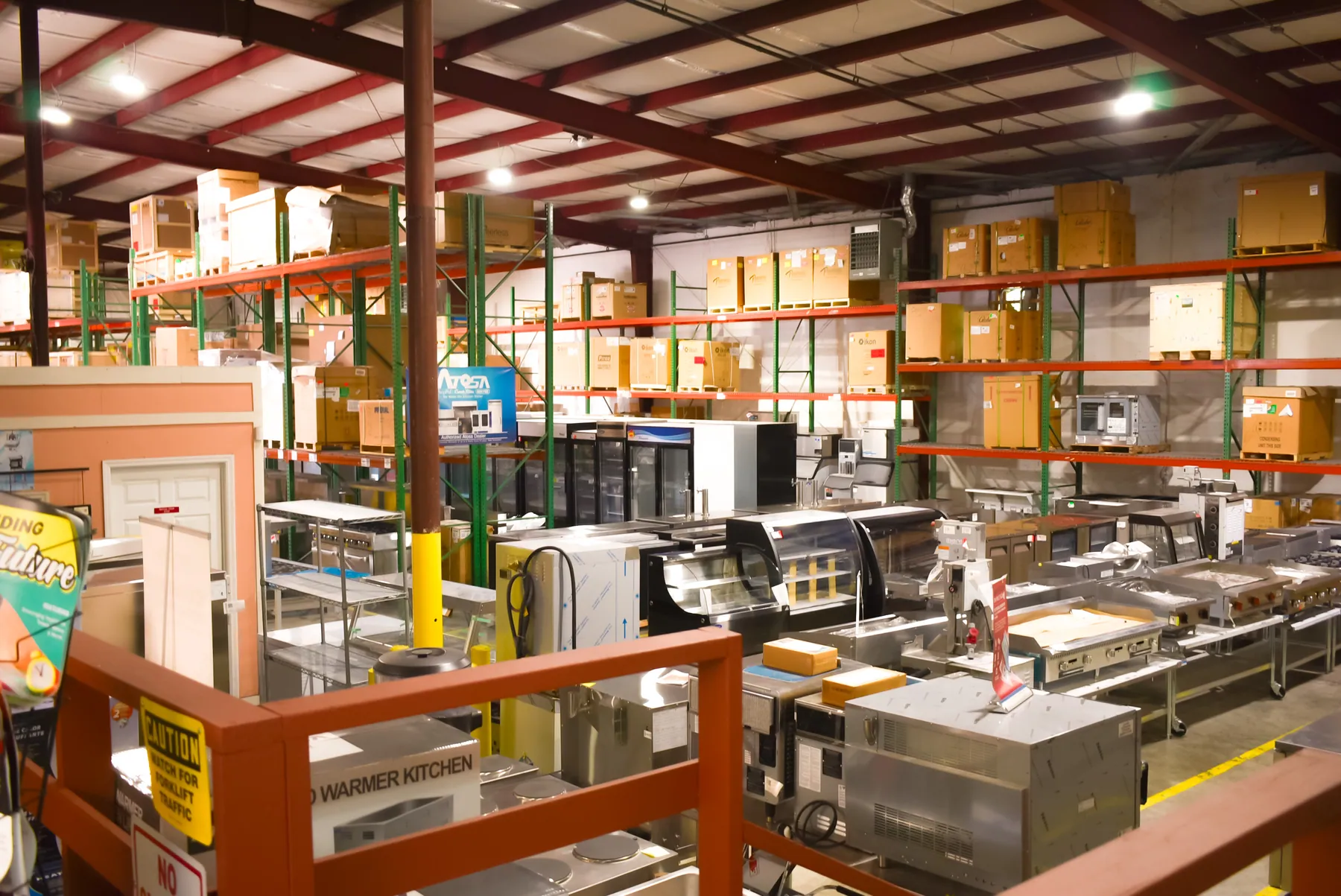
Warehouse and Flex Buildings
A warehouse stores and moves goods. A flex building mixes open floor, overhead doors and some finished space, often for several small businesses. Around Nashville the two behave like separate markets: in CBRE's Q3 2026 numbers, buildings under 50,000 square feet sat 1.2% vacant, against 8.5% for those of 250,000 to 499,999 square feet. If you own one, its size and location set your rent, your tenant and your workload.
- Industrial zoning districts
- IWD, IR, IG
- Not-owner-occupied short-term rental permits
- Not allowed in IWD, IR or IG
- R&D/flex, Nashville area
- 1.9% vacant, $16.29 per sq. ft. net (CBRE, Q3 2026)
- Distribution and logistics, Nashville area
- 8.2% vacant, $9.96 per sq. ft. net (CBRE, Q3 2026)
- Industrial CBD submarket
- 3.9% vacant, $11.12 per sq. ft. net (Cushman & Wakefield, Q3 2026)
On this page
- What counts as warehouse and flex space
- Vacancy and rent by building size
- Flex compared with distribution
- Nashville submarkets
- Why the market reports disagree
- Net leases and what stays with the owner
- Loading, racking and fire code
- Stormwater, chemicals and accessibility
- Zoning and short-term rentals
- Sale prices
- License rules for paid leasing and rent collection
- What Rad Stay handles
- Questions
- Sources
What counts as warehouse and flex space
A warehouse is mostly open floor, racking, loading doors and a small office. Flex space has adaptable open layouts, concrete floors, large overhead doors and direct access for vehicles. A contractor, a parts distributor or a showroom with stock behind it can all use the same flex bay, so a flex building may hold several small tenants where a warehouse holds one.
Brokers grade these buildings on a few physical facts. CBRE's research group counts competitive distribution, manufacturing and R&D/flex buildings larger than 10,000 square feet, and it calls an industrial building Class A when it was built after 2000 with 32 feet or more of clear height and ESFR sprinklers. Those three items show how your building compares with new construction. Measure the clear height and confirm the sprinkler design before you set an asking rent.
Vacancy and rent by building size
CBRE's third-quarter 2026 report for the Nashville area splits the market by building size, and this table tells a small-building owner more than any metro average. Asking rent per square foot falls at every step up in size. Vacancy climbs through 499,999 square feet, then drops for the largest boxes.
New supply is going somewhere else. Of the 5.13 million square feet under construction in that report, 15,000 was in buildings under 50,000 square feet. Matthews, in its own second-quarter 2026 report, described small-bay space as structurally undersupplied and said the pipeline is not aimed at it. One recent sign from Cushman & Wakefield's Q3 2026 report: four smaller tenants preleased all 79,380 square feet of CO-OP Business Park Building 1.
| Building size, sq. ft. | Total space | Vacant | Net rent asked | Being built |
|---|---|---|---|---|
| Below 50,000 | 27.28M | 1.2% | $15.21 | 15,000 |
| 50,000 to 99,999 | 24.75M | 3.8% | $13.23 | 247,000 |
| 100,000 to 249,999 | 58.44M | 7.1% | $11.37 | 1.60M |
| 250,000 to 499,999 | 41.34M | 8.5% | $8.98 | 356,000 |
| 500,000 to 749,999 | 32.57M | 5.3% | $7.99 | 2.91M |
| 750,000 and up | 54.86M | 4.1% | $7.36 | 0 |
Flex compared with distribution
Flex is the small end of the market: 11.38 million square feet against 146.80 million for distribution, with the higher rent and nothing under construction in that quarter.
The vacancy and availability columns measure different things. CBRE counts space as vacant if a tenant could occupy it within 30 days, and as available if it will be ready within six months, occupied or not. A gap like 1.9% against 5.5% means more flex space is about to come up than is empty today, so check lease expirations near your building before you assume a tight market will hold.
| Product type | Square feet | Vacant share | Available share | Net rent per foot |
|---|---|---|---|---|
| Distribution/Logistics | 146.80M | 8.2% | 11.7% | $9.96 |
| R&D/Flex | 11.38M | 1.9% | 5.5% | $16.29 |
Nashville submarkets
Cushman & Wakefield cuts the market into six submarkets for Q3 2026, with rents stated net for a year.
The Industrial CBD is the largest and highest priced submarket in that report. Its recent leases include 485 Craighead Street, and CBRE's similar CBD submarket shows second-quarter leases to DormCo on Briley Park Boulevard North and Noteworthy Warehousing on Massman Drive. Those are the buildings to compare with if you own near the center of Nashville.
Expect more large buildings in the pipeline. The East holds 3.7 million of the 7.5 million square feet under construction, and Cushman & Wakefield expects that supply to keep upward pressure on vacancy there. The Industrial CBD pipeline more than doubled in one quarter to 1.5 million square feet after five buildings of more than 100,000 square feet each broke ground.
| Submarket | Size in square feet | Vacancy rate | Rent asked | In construction |
|---|---|---|---|---|
| Industrial CBD | 73,401,902 | 3.9% | $11.12 | 1,499,041 |
| Southeast | 65,553,092 | 4.6% | $9.76 | 1,041,796 |
| East | 53,840,751 | 8.1% | $8.02 | 3,692,721 |
| North | 49,935,336 | 4.2% | $8.75 | 1,217,362 |
| 65-South | 12,014,867 | 7.5% | $9.79 | 0 |
| West | 7,843,645 | 0.5% | $6.00 | 0 |
Why the market reports disagree
Four firms published third-quarter 2026 numbers for this market, and they do not match. Vacancy was 5.1% at Cushman & Wakefield, 5.4% at CBRE, 5.7% at Lee & Associates and 7.3% at Matthews. Asking rent was $9.19, $10.21, $9.77 and $12.45 in the same order.
The firms survey different buildings. CBRE counts about 239.3 million square feet, Cushman & Wakefield about 262.6 million and Lee & Associates about 279.1 million, while Matthews reports 16 submarkets that reach counties such as Cannon and Macon. Pick one report, follow it quarter over quarter, and compare your rent with your own size band and submarket. If a broker quotes a single number, ask whose survey it came from.
Net leases and what stays with the owner
CBRE, Cushman & Wakefield and Lee & Associates label their rents net. In CBRE's glossary, gross means the rent typically covers real property taxes, building insurance and major maintenance, and net means at least one of those is billed apart. The label settles very little. Your lease has to say who pays for the roof, the paving, the dock equipment, the sprinkler system and the replacement of rooftop units.
In a single-tenant warehouse the tenant may hold most service contracts itself. In a multi-tenant flex building the owner tends to run those contracts, bill each tenant a share and reconcile estimates against actual costs once a year, so the share formula and any caps belong in the lease.
Tennessee's landlord-tenant chapter is written around homes: it defines a rental agreement by the use and occupancy of a dwelling unit. A warehouse lease therefore has to carry its own terms for deposits, default, notice and re-entry. Have a Tennessee attorney write them.
Tenant equipment needs a line too. Tennessee assesses commercial and industrial personal property at 30% of value, so put the filing and payment for racking, forklifts and other tenant property on the tenant.
Loading, racking and fire code
Loading decides who can use the building. Before you market a vacancy, count dock-high and drive-in doors, test the levelers and overhead doors, and walk the truck route from the street to the door with a full-length trailer in mind. Put those items on a written inspection calendar with the roof, paving and drains.
Racking is where a lease runs into the fire code. Since BL2025-1004, Metro's fire code has been the 2024 International Fire Code with local amendments. It treats storage as high-piled when the top of the stored goods is above 12 feet, and the fire code official can apply the term at 6 feet to certain high-hazard commodities such as rubber tires and Group A plastics. Using more than 500 square feet that way takes an operational permit, and plans go in for review and approval. Metro's 2024 building code sorts storage into Group S-1 or S-2 by what is stored. A new tenant with taller racks or a different commodity can change what your sprinklers have to do. Get the rack plan and product list before signing, then run them past Metro Codes and the Fire Marshal's office.
Stormwater, chemicals and accessibility
Federal stormwater rules list warehousing, under Standard Industrial Classification codes 4221 through 4225, among the activities that need permit coverage unless they qualify for the no-exposure exclusion. That exclusion requires all industrial materials and activities to sit inside a storm-resistant shelter, with a signed certification every five years, and storing most materials outdoors can end it. EPA's list of places where it still issues this permit does not include Tennessee, so ask the Tennessee Department of Environment and Conservation what applies to your site.
If a tenant keeps hazardous chemicals at or above federal thresholds, 10,000 pounds for most and 500 pounds or less for extremely hazardous substances, the facility reports its inventory by March 1 each year to the state commission, the local planning committee and the fire department. Require a copy in the lease.
Federal accessibility rules reach these buildings as well. A nonresidential building is a commercial facility, and areas you alter must be accessible to the maximum extent feasible. A flex tenant with a showroom open to customers is a sales establishment and so a place of public accommodation, which puts duties on landlord and tenant alike. They can divide those duties by contract, so write the division down.
Zoning and short-term rentals
Metro's industrial districts are IWD (Industrial Warehousing/Distribution), IR (Industrial Restrictive) and IG. Metro's use table gives not-owner-occupied stays no place in any of the three, and an owner-occupied permit shows up there only beside multi-family housing linked to artisan manufacturing. Council also moved multi-family use in IWD and IR from permitted with conditions to requiring a special exception, in BL2022-1508. A warehouse is not a quick route to nightly rentals.
Rezoning is the other route, and the result often does not help. We read Metro Council's Legistar bill titles for January 1, 2024 through October 2026 and counted 30 proposals to rezone away from those three districts: 27 passed, two sat at first reading and one was withdrawn. That count skips area-wide bills that list many districts. Twelve of the 30 sought Specific Plan zoning, where nightly permits depend on what the plan says, and nine sought a district with the NS suffix, which shuts out both permit types. Read the requested district before you put nightly income in a pro forma.
Sale prices
Matthews' Q3 2026 averages for industrial sales were $162 per square foot and a 6.51% cap rate. Its second-quarter report showed sales in the Central/West infill core at $170 per square foot against $68 in the North. Its local example was 640 Massman Drive in Nashville, 169,855 square feet sold for $24.93 million, or $146.77 per square foot at a 5.00% cap rate. Ask for comparable sales in your own submarket and size band before you decide to sell or hold.
License rules for paid leasing and rent collection
Tennessee's definition of a broker in Tenn. Code 62-13-102 covers a person who negotiates a lease or collects rent for a fee. Section 62-13-104 exempts owners for their own property, and its resident-manager exemption is written for apartment buildings, duplexes and residential complexes. If you plan to pay someone to lease space or collect rent in a warehouse, put those two sections in front of your attorney or the state real estate commission and ask how they apply to your arrangement.
What Rad Stay handles
Rad Stay's main work is short-term rentals. It also looks after commercial, industrial and warehouse property, and it will review a building as a purchase, a lease or a partnership. Union Street Lofts, the one property this site documents, is residential, so ask for a written scope covering billing, expense reconciliation, vendor contracts, inspections and lease renewals, and judge any manager on that document.
Questions
Can I turn my warehouse into short-term rentals?
Not under industrial zoning. Metro's list of districts for not-owner-occupied permits leaves out IWD, IR and IG, and a permit only ever covers a home with four or fewer sleeping rooms. You would need a rezoning and a residential conversion first. Confirm the path with Metro Codes and Metro Planning.
What rent can a small warehouse ask in Nashville?
CBRE's third-quarter 2026 averages were $15.21 per square foot net for buildings under 50,000 square feet and $13.23 for 50,000 to 99,999. Those are market-wide asking rates. Location, clear height, door count and condition move your number, so get comparable leases from your own submarket.
Who pays for the roof on a net lease?
Whoever the lease says. CBRE's definition of net rent covers leases that exclude one or more of taxes, insurance and major maintenance, so two leases with the same label can leave the roof with different parties. Spell out repair and replacement separately.
What should I ask a tenant before it installs racking?
Ask for the rack plan, the top-of-storage height and the product list. Goods stacked above 12 feet, or above 6 feet for certain high-hazard commodities where the fire code official requires it, fall under the high-piled chapter of Metro's fire code, with a permit above 500 square feet and reviewed plans. Have a fire protection engineer read the plan before you sign.
Does a warehouse need a stormwater permit?
It might. Federal rules list warehousing among regulated activities, with an exclusion when everything stays under a storm-resistant shelter. Ask the Tennessee Department of Environment and Conservation whether your site needs coverage or a no-exposure certification.
Sources
- CBRE Research, Nashville Industrial Figures, Q2 2026 (second-quarter leases)
- Cushman & Wakefield, Nashville Industrial MarketBeat, Q3 2026
- Lee & Associates, Nashville Industrial Market Overview, Q3 2026
- Matthews, Nashville Industrial Market Report, Q3 2026
- Matthews, Nashville Industrial Market Report, Q2 2026
- Metro Code chapter 6.28, short-term rental permits, Municode (current through June 23, 2026)
- Metro Code section 17.08.030, land use table, Municode (current through June 23, 2026)
- Metro Codes, short-term rental permit types (Wayback copy, Feb. 17, 2026)
- Metro Council legislation, Legistar public records (BL2022-1508 and zoning bills introduced Jan. 1, 2024 through Oct. 2026, read Nov. 5, 2026)
- 40 CFR 122.26, stormwater discharges and no-exposure exclusion, Cornell LII
- EPA, Stormwater Discharges from Industrial Activities
- EPA, 2021 Multi-Sector General Permit, areas where EPA is the permitting authority
- EPA, EPCRA Sections 311-312, chemical inventory reporting
- 28 CFR 36.104, ADA definitions, Cornell LII
- 28 CFR 36.201, landlord and tenant responsibilities, Cornell LII
- 28 CFR 36.402, alterations, Cornell LII
- Tenn. Code 62-13-102, broker definition (FindLaw)
- Tenn. Code 62-13-104, license exemptions (FindLaw)
- Tenn. Code 66-28-104, residential landlord and tenant definitions (FindLaw)
- Tenn. Code 67-5-901, personal property assessment (FindLaw)
- Wikipedia, Flex space
- CBRE Research, Nashville Industrial Figures, Q3 2026 (product type, size and submarket tables, definitions)
- Metro Council BL2025-1004, 2024 fire code, passed Oct. 9, 2025 (Legistar)
- Nashville and Davidson County Fire Code 2024, chapter 2, definitions (UpCodes)
- Nashville and Davidson County Fire Code 2024, chapter 32, High-Piled Combustible Storage (UpCodes)
- Nashville and Davidson County Fire Code 2024, chapter 1, permits (UpCodes)
- Nashville and Davidson County Building Code 2024, chapter 3, Occupancy Classification (UpCodes)
- Metro Council BL2025-898, 2024 building codes, passed July 15, 2025 (Legistar)
Checked November 5, 2026.
Photo: Jeremy Anderson, CC BY-SA 4.0, via Wikimedia Commons. Cropped.
To keep this page, print it or choose Save as PDF in your browser's print window. The printout keeps the sources and the date.
More property types
All 19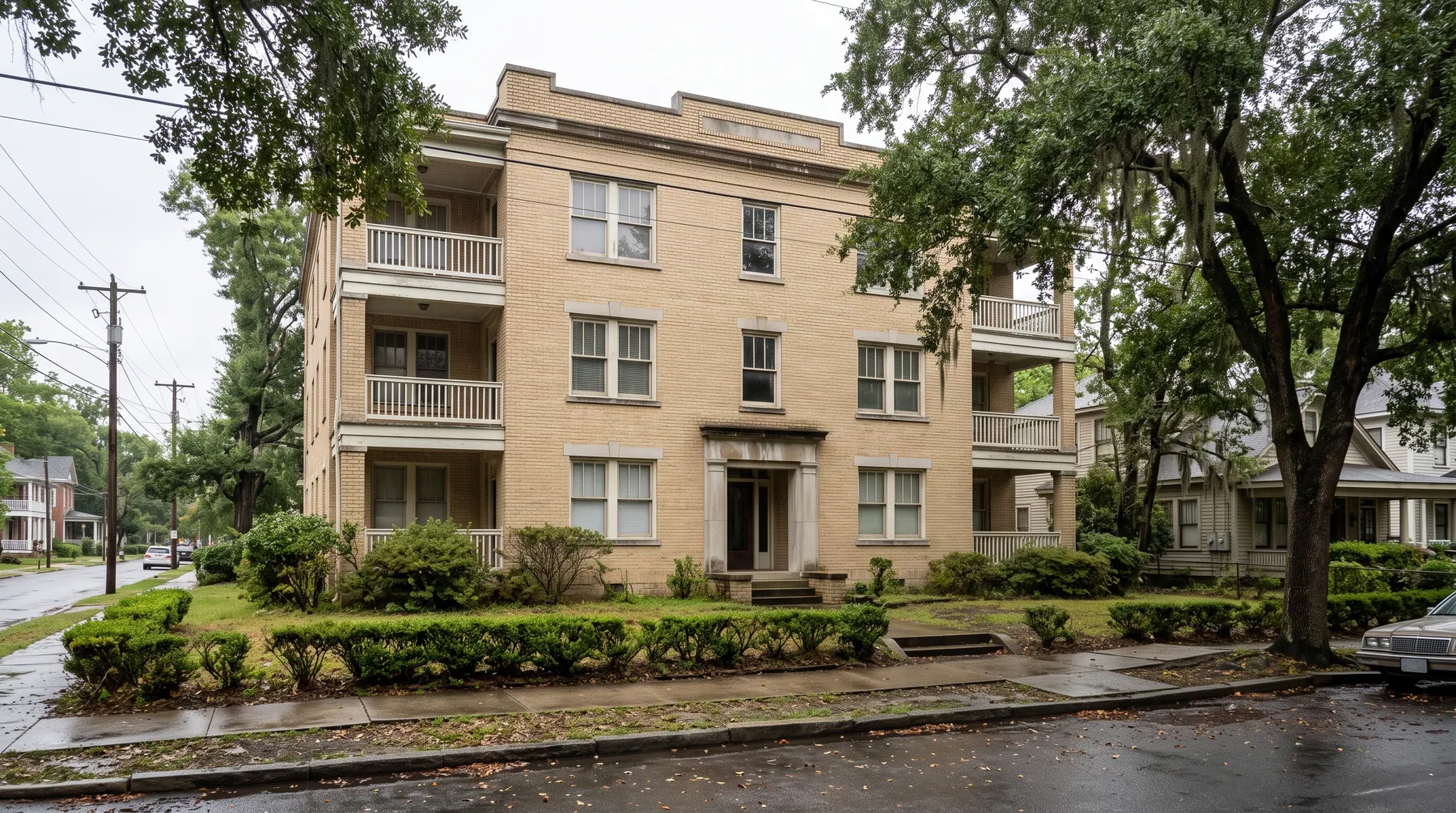
Eightplex
An eightplex is big enough that its layout and zoning drive the rules.
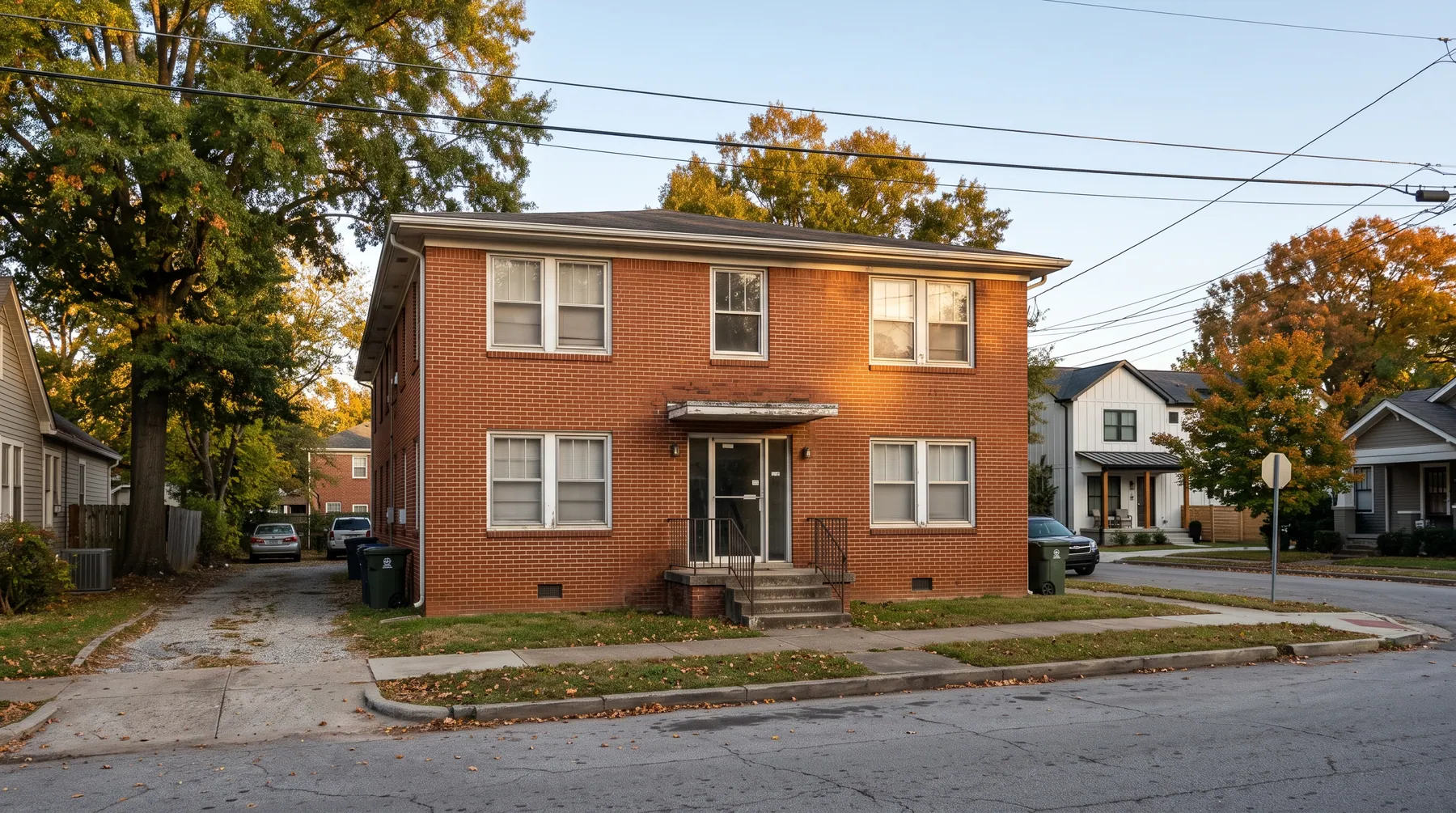
Sixplex
Six units is the size where a Nashville building starts to be run like a small business.
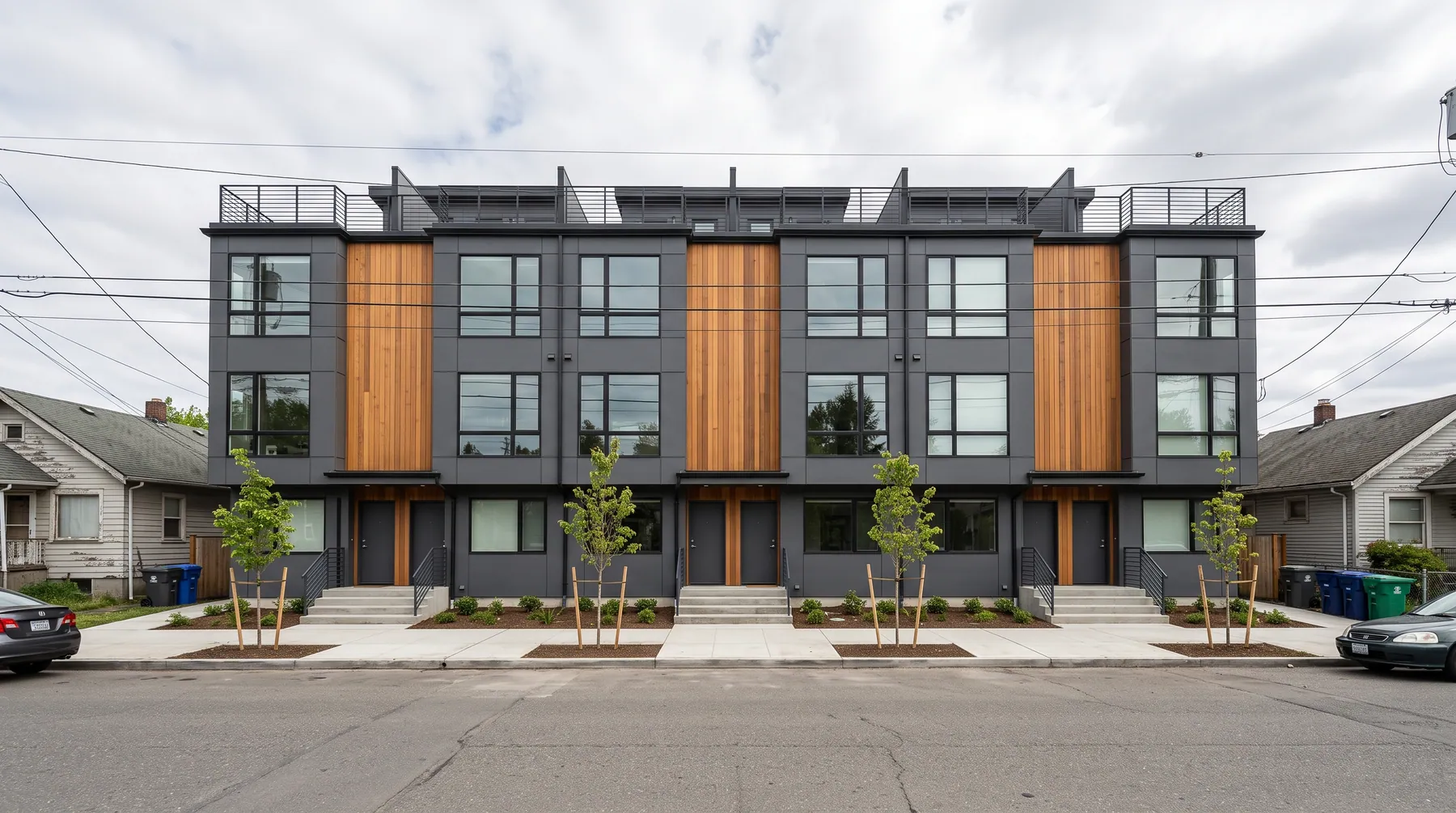
Tenplex
At ten units, an owner in the right district faces a real choice: ten separate short-term rental permits, a lodging use that Metro's zoning code calls hotel/motel, or a building of residents.