










Industrial Buildings
An industrial building is where the work happens: light manufacturing, assembly, fabrication, repair. In the Nashville area, CBRE's third-quarter 2026 survey put general manufacturing buildings at 0.7% vacant, the lowest of any product type it tracks. For the owner, the harder questions are what the tenant does inside, who holds the environmental and code duties, and what the site is worth when the lease ends.
- General manufacturing buildings
- 0.7% vacant, $10.07 per sq. ft. net (CBRE, Q3 2026)
- Nashville-area manufacturing jobs
- 88,700 in August 2026, up 0.6% over the year
- Real property assessment
- 40% of appraised value for industrial and commercial
- Zoning bills since January 2024
- 30 to leave IWD, IR or IG; 12 to enter
- Phase I timing
- Within one year before you acquire, some parts within 180 days
On this page
- Tenant types
- Market figures
- Triple-net terms
- Property tax on an industrial building
- Environmental review before you buy
- Oil, tanks, chemicals and workers
- Building code when the use changes
- Zoning and land value
- Move-out and restoration
- Tennessee licensing for paid leasing work
- What Rad Stay handles
- Questions
- Sources
Tenant types
Third-quarter 2026 lease lists show the range. Cushman & Wakefield recorded Construction Resources taking 192,240 square feet at 485 Craighead Street and Advanced Composites renewing 100,000 square feet, both in the Industrial CBD, and Saunders Electric taking 109,807 square feet on Joe B Jackson Parkway in the Southeast. Lee & Associates classed Legrand's 400,064-square-foot lease in Lebanon as light manufacturing and distribution. CBRE's second-quarter list adds Sealed Air renewing 139,000 square feet on Heil Quaker Boulevard and Wausau taking 125,000 on Butler Drive, both in Interchange City. Cushman & Wakefield also counted 88,700 manufacturing jobs in the Nashville area in August 2026, up 0.6% over the year, and noted Tennessee's third-place finish in Area Development's 2026 Top States for Doing Business.
The tenant's process matters more than its name. Metro's 2024 building code sorts a factory as Group F-2 when it makes goods from noncombustible materials with no significant fire hazard in processing, and as F-1 for other industrial uses, and fire protection follows from that. Ask every prospect what comes in, what goes out, what it burns, stores or discharges, and how much power and compressed air it uses. Those answers set your insurance questions, your environmental file and the wear on the building.
Market figures
CBRE's third-quarter 2026 report gives general manufacturing buildings 78.94 million square feet, 2.9% availability and a $10.07 average asking rent, with nothing under construction after the 2.2 million-square-foot Hankook Tire plant expansion delivered in East Clarksville. Its submarket table, shown here, covers all product types, and its second-quarter report read the spread in rents as a premium for infill and smaller-format locations.
Across all product types CBRE had vacancy at 5.4%, availability at 8.5% and asking rent at $10.21 net, up from $7.98 three years earlier. Space under construction dropped to 5.13 million square feet from roughly 8.5 million a quarter before. Other brokers' totals differ because they survey different buildings, so track one source over time.
| CBRE submarket | Total square feet | Vacant now | Available soon | Average net ask |
|---|---|---|---|---|
| CBD | 63.37M | 3.2% | 7.1% | $12.15 |
| Interchange City | 60.27M | 4.0% | 6.8% | $10.15 |
| I-40 East/I-840 | 49.37M | 11.2% | 12.5% | $8.49 |
| Northeast / I-65N Corridor | 34.69M | 5.3% | 11.4% | $10.91 |
| I-65 South Corridor | 17.78M | 3.4% | 3.8% | $10.36 |
| East Clarksville | 7.99M | 2.9% | 4.6% | $9.84 |
| Columbia Corridor | 5.78M | 4.5% | 10.1% | $8.99 |
Triple-net terms
Under a triple-net lease the tenant pays base rent plus its share of property taxes, building insurance and maintenance. The phrase leaves a lot open, and disputes start in the gaps. Settle these points in writing before signing.
- Repair versus replacement of the roof, structure, paving and rooftop units
- Whether capital work is amortized to the tenant, and over how many years
- Whether a management fee passes through, and on what basis
- Any cap on controllable costs, and the tenant's right to audit
- Who contests a tax appraisal and who keeps a refund
- What insurance the tenant carries and whether the owner is an additional insured
Property tax on an industrial building
Tennessee assesses industrial and commercial real property at 40% of appraised value, compared with 25% for residential property. A building appraised at $2 million has an assessed value of $800,000, and the bill is that figure times Metro's rate for your service district. Confirm the rate with the Metro Trustee.
Davidson County's 2025 reappraisal raised the median value 45% from 2021, with Council-district medians from 38% to 54%, according to NewsChannel 5. Those figures blend homes with commercial parcels, so your building may differ. Machinery a tenant owns is a separate schedule, assessed at 30% of value, and the lease should say the tenant reports and pays it.
Environmental review before you buy
Federal Superfund liability can follow the land. Completing All Appropriate Inquiries can help a buyer qualify for protection as an innocent landowner, a contiguous property owner or a bona fide prospective purchaser, and EPA treats the ASTM E1527-21 Phase I process as consistent with its rule. Timing is strict. The inquiry has to be done within one year before you acquire the site, and interviews, records review, the site visit, lien searches and the environmental professional's declaration must be done or updated within 180 days. Protection also depends on continuing obligations after closing.
Tennessee has its own route for known problems. Tenn. Code 68-212-224 creates a voluntary cleanup oversight and assistance program for brownfield projects, open to a willing and able person who did not generate, transport or release the contamination. The participation fee is $5,000, which the commissioner may waive. An agreement can limit liability for the contamination it addresses and can reach future owners, tenants and lenders. It leaves out later contamination, anything the agreement did not identify and third-party injury or damage claims. FindLaw dates its copy January 2, 2024, so have your environmental attorney check for later changes.
Oil, tanks, chemicals and workers
These programs deserve a check on any older plant, and each one belongs in the lease as a named duty with a yearly copy to the owner.
- Oil spill plans. The SPCC rule reaches the owner or operator of a facility that could reasonably discharge oil to navigable waters. A site is exempt at 1,320 gallons or less of aboveground capacity, counting only containers of 55 gallons or more, with 42,000 gallons or less completely buried.
- Underground tanks. EPA regulates a petroleum or hazardous-material system with at least 10 percent of its combined volume underground. Heating oil used on the premises and tanks on a basement floor are among the federal exemptions, though state and local rules may still apply.
- Chemical reporting. Above federal thresholds the facility files an annual inventory. Ask to see last year's filing before you renew a chemical-using tenant.
- Stormwater. The federal list names light manufacturing such as food processing, printing and electrical equipment. A no-exposure exclusion applies to a whole facility, never to one outfall.
- Workplace safety. Tennessee's OSHA-approved plan, run by the Department of Labor and Workforce Development, covers private-sector workplaces with a few listed exceptions, so a tenant answers for its own employees and you answer for yours.
Building code when the use changes
A new tenant can change the building's classification. Metro adopted the 2024 code editions in July 2025, and Council's analysis of BL2025-898 lists the existing building code among them. The 2021 Tennessee text of that code applies its change-of-occupancy provisions to a change within a group or from one group to another. If the new use needs sprinklers or a fire alarm under Chapter 9 of the building code, the same text requires them for the area of the change. A plain re-lease can become a capital project, so have Metro Codes check the 2024 wording against your use before you promise it to a tenant.
Remodeling a plant also triggers the federal accessibility standard for the altered areas, while routine upkeep such as reroofing generally does not.
Zoning and land value
Metro Council's records show industrial zoning moving in both directions. From January 2024 through October 2026, bill titles in Legistar show 30 bills to move land out of IWD, IR or IG, and 27 passed. Twenty of those started from one industrial district alone and covered 91.5 acres. The largest was 40.96 acres of IG east of Korean Veterans Boulevard, moved to DTC in 2026. Others moved 9 acres of IG on Cowan Court to MUI-A, and 2.7 acres of IR on Charlotte Avenue into a Specific Plan with 249 apartments.
All 12 bills going the other way passed, covering 155.94 acres from R8, R20, AR2a and OR20 zoning. They include 64.24 acres on Couchville Pike and Reynolds Road from R20 to IWD, and 36.46 acres on Owen Drive and Old Hickory Boulevard from AR2a to IWD. Area-wide bills with long district lists are not in these counts.
Investment prices are moving as well. Matthews' average cap rate fell for a seventh straight quarter to 6.51% in Q3 2026. Lee & Associates listed third-quarter Class A sales at $220.43 per square foot in Smyrna, $154.32 in Spring Hill and $131.89 in Lebanon.
If redevelopment is a real possibility, a long lease can block it. Price a termination or relocation right into any long lease on a close-in site. Nightly rentals are not part of that math under industrial zoning, because the code gives not-owner-occupied permits no place in those three districts.
Move-out and restoration
Write the exit into the lease on day one. Require removal of machinery, tanks, rack anchors and process piping, sealing of floor penetrations, a final environmental report if the tenant handled regulated materials, and a walk-through with photographs against the condition recorded at move-in. A baseline environmental report at the start gives you something to compare it with.
Tennessee licensing for paid leasing work
Under Tenn. Code 62-13-102, leasing work and rent collection done for pay fall inside the definition of a broker. An owner acting on property it owns or leases is exempt under section 62-13-104. An attorney or the state commission can tell you how those sections fit the contract you have in mind for an industrial building.
What Rad Stay handles
Short-term rentals come first at Rad Stay. The company also takes on commercial, industrial and warehouse management, and it will study a site it might buy, lease or go into with a partner. Its documented property here, Union Street Lofts, is residential. For an industrial building, ask any manager for a compliance calendar naming each filing and who holds it, along with a written scope for billing, reconciliation and inspections.
Questions
What does triple net mean on an industrial lease?
The tenant pays base rent plus its share of property taxes, building insurance and maintenance. By CBRE's glossary, a lease counts as net if even one of those costs sits outside the rent, so read who replaces the roof and rooftop units.
Should I order a Phase I if I already own the building?
The federal timing rules are tied to acquisition, so a report after closing does not earn those protections. A baseline before a new tenant moves in is a business choice that gives you evidence if contamination turns up later. Ask an environmental attorney whether the tenant's process justifies it.
Who is responsible for an oil spill plan, the owner or the tenant?
The SPCC rule applies to the owner or operator of the facility, so it can reach either one. Assign the duty in the lease and ask for the plan and the tank list once a year.
How much tax does an industrial building pay?
Tennessee assesses it at 40% of appraised value, then Metro's rate for your service district applies. A $2 million appraisal becomes an $800,000 assessed value. On a net lease the tenant usually reimburses its share, and the Metro Trustee can confirm the current rate.
Can an industrial building be converted to apartments or nightly rentals?
Only after zoning allows it. BL2022-1508 requires a special exception for apartments in IWD and IR, and a not-owner-occupied permit needs another district altogether, so the parcel would have to be rezoned. Talk to Metro Planning and Metro Codes before you spend on design.
Sources
- CBRE Research, Nashville Industrial Figures, Q2 2026 (second-quarter leases and commentary)
- Cushman & Wakefield, Nashville Industrial MarketBeat, Q3 2026
- Lee & Associates, Nashville Industrial Market Overview, Q3 2026
- Matthews, Nashville Industrial Market Report, Q3 2026
- Tenn. Code 67-5-801, real property assessment (FindLaw)
- Tenn. Code 67-5-901, personal property assessment (FindLaw)
- NewsChannel 5, Nashville property values rise 45% in latest assessment (2025)
- EPA, Brownfields All Appropriate Inquiries
- 40 CFR 312.20, All Appropriate Inquiries timing, Cornell LII
- Tenn. Code 68-212-224, voluntary cleanup oversight and assistance program (FindLaw, current as of Jan. 2, 2024)
- 40 CFR 112.1, SPCC applicability, Cornell LII
- EPA, Learn About Underground Storage Tanks
- EPA, EPCRA Sections 311-312, chemical inventory reporting
- EPA, Stormwater Discharges from Industrial Activities
- 40 CFR 122.26, no-exposure exclusion, Cornell LII
- OSHA, Tennessee State Plan
- 28 CFR 36.402, alterations, Cornell LII
- Metro Council legislation, Legistar public records (BL2022-1508 and zoning bills introduced Jan. 1, 2024 through Oct. 2026, read Nov. 5, 2026)
- Metro Code section 17.08.030, land use table, Municode (current through June 23, 2026)
- Tenn. Code 62-13-102, broker definition (FindLaw)
- CBRE Research, Nashville Industrial Figures, Q3 2026 (product type, size and submarket tables, definitions)
- Nashville and Davidson County Building Code 2024, chapter 3, Occupancy Classification (UpCodes)
- Metro Council BL2025-898, 2024 building codes, passed July 15, 2025 (Legistar)
- Metro Codes, Metro adopts 2024 International Building Codes (July 23, 2025)
- Tennessee Existing Building Code 2021, chapter 10, Change of Occupancy (UpCodes)
- Tenn. Code 62-13-104, license exemptions (FindLaw)
Checked November 5, 2026.
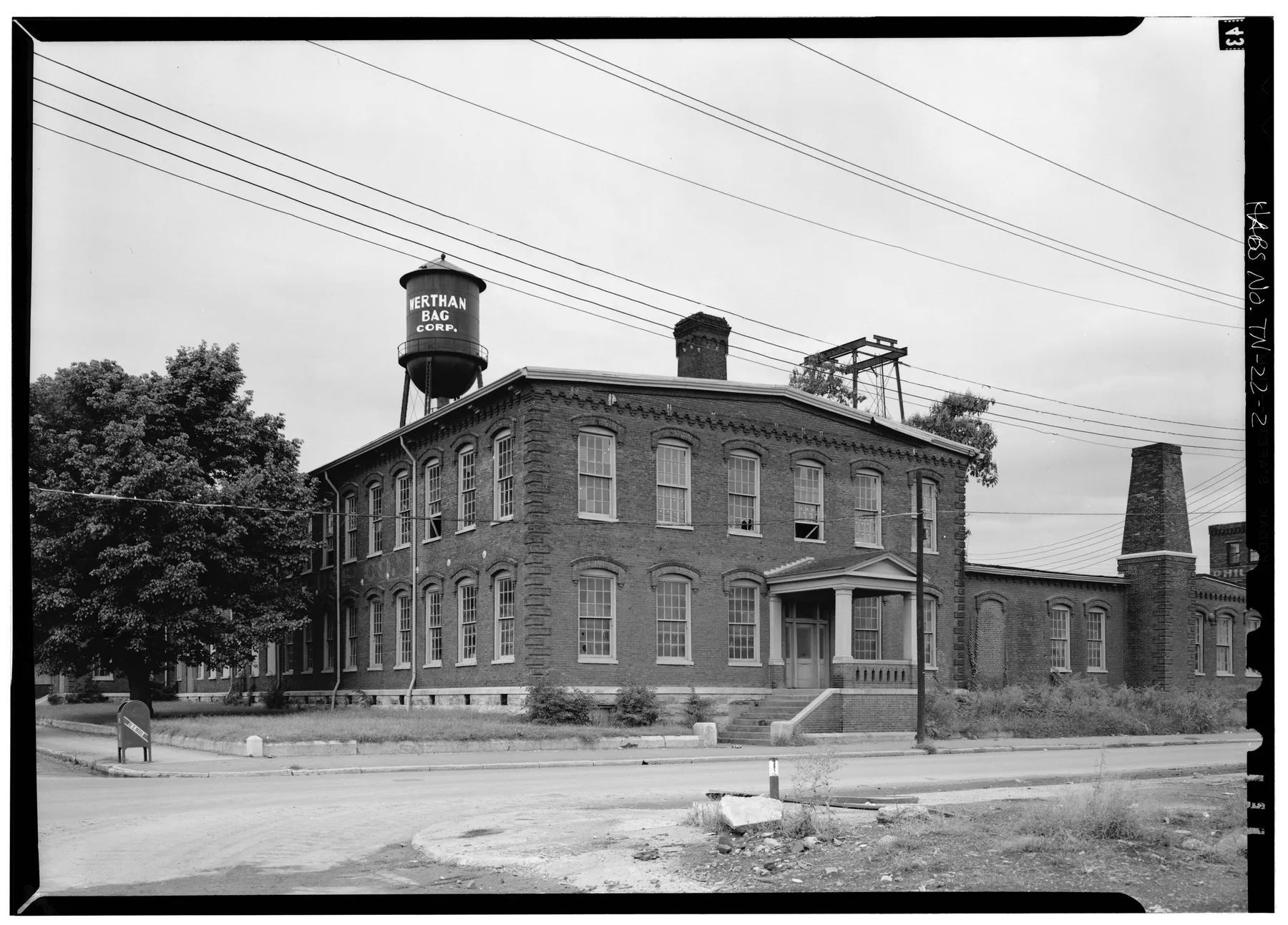
Photo: Library of Congress, Public domain, via Wikimedia Commons. Cropped.
To keep this page, print it or choose Save as PDF in your browser's print window. The printout keeps the sources and the date.
More property types
All 19
Lease-Up Buildings
A lease-up building is a new apartment building that is filling its units for the first time.

Luxury Apartment and Condo Units
A unit in a Nashville tower is owned or leased one apartment at a time, inside a building whose rules you did not write.
Mid-Size Apartment Buildings
A building of 50 to 200 units is big enough to need a real operating plan and small enough that one owner or one small fund can still make the call.