










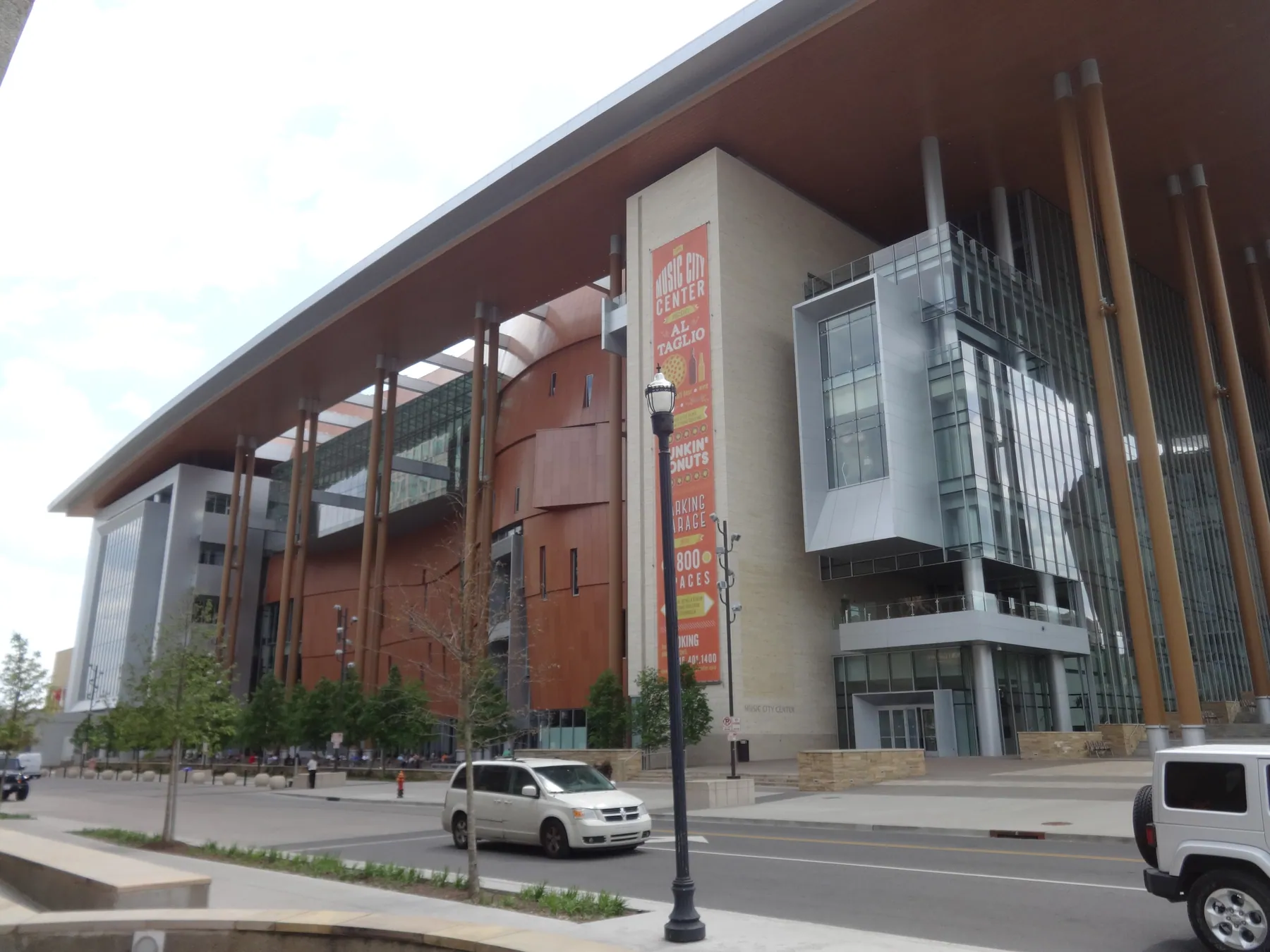
Music City Center and Convention Business
The Music City Center is Nashville's downtown convention center, and its events required 423,500 hotel room nights in fiscal 2025, more than in fiscal 2019 even though the building hosted fewer event days. A June 2025 study found it turns away business for lack of space and dates, and in 2026 the Convention Center Authority bought land and won Metro Council approval for financing that clears the way for an expansion. For an owner, the center's calendar is one of the earliest signals of weekday and shoulder-season demand downtown.
- Opened
- May 2013
- Building size
- 2.1 million sq ft
- Function space, 2025
- 517,000 sq ft (353,000 exhibit, 75,500 ballroom, 88,700 meeting)
- Event days, FY2025
- 571
- Attendance, FY2025
- 359,400
- Required hotel room nights, FY2025
- 423,500
- Recommended expansion
- 300,000 sq ft of new function space
On this page
The building
The Music City Center opened in May 2013. Its Wikipedia entry gives a total floor area of 2.1 million square feet and a construction cost near $623 million, with Metro's housing and development agency, MDHA, as developer. Since opening it has hosted 2,654 events, including 544 local nonprofit events, for 5.1 million attendees and $4.4 billion in direct economic impact for the region, NewsChannel 5 reported when the 2025 expansion study came out.
The Convention Center Authority hired HVS Convention, Sports & Entertainment to study an expansion, and its June 5, 2025 presentation measured 517,000 square feet of function space: 353,000 of exhibit halls, 75,500 of ballroom and 88,700 of meeting rooms. Against 15 peer centers, from Orlando and Atlanta to Austin and Columbus, the exhibit space ranked second to last, under half the group average of 710,000 square feet. Ballroom space sat just below the peer average of 80,400 and meeting space well below the average of 155,600.
Who gets the dates
The center's sales plan for fiscal 2024 and 2025, quoted by HVS, sets the order in which events get space. Two or more years out, meeting and exhibit space is held for national meetings, conventions and trade shows that need at least 1,500 hotel rooms on their peak night, which the industry calls citywides. Inside two years, the center begins selling to smaller events that still commit to hotel room blocks. About a year out, it opens remaining dates to events that bring few or no hotel rooms, such as consumer shows and local meals.
That order matters to anyone pricing rooms downtown. A citywide on the calendar means at least 1,500 rooms of committed demand on its peak night, known years ahead of the date.
Fewer events, more room nights
The center's own figures, as reported by HVS, show the effect of that policy. Event days and attendance fell from fiscal 2019, while the hotel room nights required by its events rose.
| Fiscal year | Event days | Attendance | Required room nights |
|---|---|---|---|
| 2019 | 775 | 487,900 | 392,200 |
| 2023 | 602 | 343,600 | 413,500 |
| 2024 | 654 | 346,300 | 410,300 |
| 2025 | 571 | 359,400 | 423,500 |
How full the building runs
HVS put total function space occupancy at 60% in fiscal 2019, 44% in 2020, 17% in 2021, 56% in 2022, 71% in 2023 and 62% in 2024, an average of 63% over the last three of those years. Conventions and trade shows drive the heavy use of exhibit halls: an average convention used about 241,300 square feet of space, against 90,000 for the average event of every type.
Most events fit inside the current halls, which is why the building's limits show up at the top end. HVS found that 80% of events use 180,000 square feet of exhibit space or less, while the other 20% need more than 240,000.
Business the center could not book
Across fiscal 2023 and 2024, the center lost an average of 383 conventions, 32 trade and consumer shows and 184 other events a year, HVS reported. The lost conventions alone averaged 2,469 event days a year, more than four times the 571 event days the building actually hosted in fiscal 2025.
Where the reason was known, 37% of lost events wanted dates that were not available, 10% needed more function space than the building has, 22% chose another city and 30% left for other reasons. Taken together, space and dates explain more than 45% of the losses, the share NewsChannel 5 highlighted when it reported the study.
What planners said about Nashville
HVS surveyed about 2,200 national event planners and got a 16% response. Planners rated downtown walkability at 96%, restaurants at 93%, nightlife at 92%, ground transportation at 90% and airport access at 88% on a net promoter scale. Two scores stood far lower: cost of hotel rooms at 35% and cleanliness and streetscape at 14%. The center's customer advisory board also listed hotel prices and room block problems among its threats.
HVS counted about 14,800 hotel rooms within a mile of the center, using STR data, and noted that Nashville has no hotels of more than 1,000 rooms. For an owner of furnished units near downtown, the planners' complaint about room cost is the clearest opening: attendees who share a multi-bedroom unit, or who extend a trip past the block dates, need somewhere to stay.
The expansion HVS recommended
HVS recommended adding 300,000 square feet of function space: a 200,000-square-foot flex hall that can split into four parts, a 50,000-square-foot ballroom and about 50,000 square feet of meeting rooms. That would take total function space to 817,000 square feet, a 58% increase, inside about 587,000 square feet of new building. NewsChannel 5 reported that the addition would need about seven acres.
With the expansion, HVS projected the center would reach 737 event days, 657,300 attendees and 662,900 required room nights a year by 2034, against 505,400 attendees and 504,100 room nights in its 2030 starting year. Those are the consultant's projections in a market study, not a forecast the center has adopted, and they depend on the building being built.
Land and financing in 2026
The first piece of land came in June 2026. WSMV reported on June 9 that the authority had spent a little more than $52 million on roughly 1.3 acres at 811 McGavock Street, where the garage for the old Kefauver federal building stood, under a block from the existing hall. CEO Charles Starks said the expansion will likely have to use multiple sites, and that site selection was the next step.
On Aug. 18, 2026 the Metro Council passed RS2026-2135 by 31 to 6. The agreement lets the authority refinance its 2010 construction bonds without Metro's credit behind them, issue separate expansion bonds that mature by Dec. 31, 2028, and move up to $300 million to the East Bank Development Authority for roads, bridges and utilities. Fox 17 reported that the change removes Metro's backstop on bonds tied to the center and the Omni hotel. The resolution does not approve construction of any expansion.
How the center is paid for
Visitors pay for it through Metro's tourist accommodation taxes, which apply to short-term rentals as well as hotels. The Council staff analysis attached to the tourism tax ordinance BL2026-1493, which passed on September 1, 2026, lays out where the money goes under current law. One-third of the hotel occupancy privilege tax sits in a reserve fund for building and running a convention center, and revenue of up to two dollars a night from the flat per-room charge goes into the Convention Center Fund. The ordinance keeps those shares and ranks their uses in order of priority, and it takes effect only after the authority's existing debt has been paid off, defeased or refinanced. Metro Finance collects the short-term rental version of these taxes under its own occupancy tax page. The hotel tax page on this site covers rates and filing.
What conventions mean for an owner
Conventions fill weekday nights that concerts and festivals leave open, and they book years ahead. Check the center's event calendar when you set prices months out, and look for multi-day citywides; those are the dates when downtown hotel blocks fill and rates rise across the core. A unit within walking distance of the center competes for attendees who want to skip a commute, and HVS's survey shows planners already rank downtown walkability highly.
Group business also changes the stay. A multi-day convention can justify testing a longer minimum on its dates than you would set for a leisure weekend. Weigh those nights against your permit's limits and your building's rules before you accept a block of colleagues in one unit.
Questions
How big is the Music City Center?
Roughly 2.1 million square feet in all. HVS measured the rentable event space in 2025 at 517,000 square feet, most of it exhibit hall.
How many hotel room nights does the Music City Center generate?
Its events required 423,500 hotel room nights in fiscal 2025, up from 392,200 in fiscal 2019, by the center's figures as reported by HVS.
Is the Music City Center expanding?
It is preparing to. The consultant called for 300,000 more square feet of event space, the authority bought its first nearby parcel in June 2026, and in August 2026 the Council approved a deal that lets it sell expansion bonds. No construction had been approved by that vote.
Why does the convention center turn events away?
Of lost events with a known reason in fiscal 2023 and 2024, 37% wanted dates that were taken and 10% needed more space than the building has, HVS found.
Do short-term rental guests help pay for the Music City Center?
Yes. Permitted rentals collect the same tourist taxes hotels do. Under Metro Code, a third of the percentage tax goes to a convention center reserve fund and up to two dollars of the flat nightly charge go to the Convention Center Fund, shares the 2026 tourism tax ordinance keeps.
Sources
- HVS, Music City Center Expansion Market Study, June 5, 2025
- NewsChannel 5, Music City Center eyes major expansion, June 2025
- WSMV, Music City Center buys site for $52 million, June 9, 2026
- Pamphleteer Council Watch, RS2026-2135 Music City Center financing agreement, passed Aug. 18, 2026
- Fox 17, Metro Council approves plan to refinance Music City Center debt, August 2026
- Metro Council, BL2026-1493, tourist accommodation taxes, passed Sept. 1, 2026 (Legistar)
- Metro Finance, Pay Short Term Rental Property Occupancy Tax (Wayback copy Oct. 22, 2026)
- Wikipedia, Music City Center
Checked November 12, 2026.
Photo: Michael Rivera, CC BY-SA 4.0, via Wikimedia Commons. Cropped.
To keep this page, print it or choose Save as PDF in your browser's print window. The printout keeps the sources and the date.
More market data
All 15Nashville International Airport Passenger Traffic
Nashville International Airport (BNA) counted 25,715,851 passengers in calendar 2025, and the Metropolitan Nashville Airport Authority reported a record 26.7 million for its fiscal year that ran from July 1, 2025 through June 30, 2026.
Nashville's Biggest Annual Events for Owners
A short list of yearly events pushes Nashville hotels close to full: CMA Fest in June, the Fourth of July, New Year's Eve, the big stadium concerts and a run of college games.
Nashville Hospitals and Medical Travel
Health care produced $72.1 billion in economic output and supported 372,160 jobs across the Nashville metro in 2024, according to the Nashville Health Care Council.